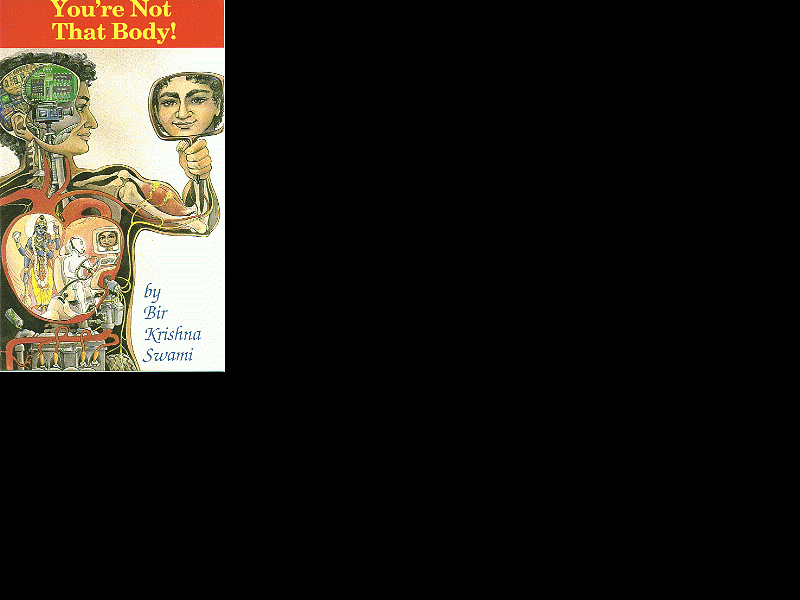
You Know You're Not That Body...
Then who exactly are you? (or closer to home Who Am I?)

"We refer collectively to the essentially ('swarupa')
of several things. But there cannot be a single essential attire common
to many 'swarupas' as 'swarupa' by definition is strictly particular, belonging
to only one thing. If another generality of 'swarupatva' is admitted to
run through many 'swarupas', that one and the other (remaining) 'swarupas'
will have to be brought under the purview of another 'swarupatva' in its
turn and so on ad infinitum. The difficulty can be avoided only by recognising
with Madhwa that the different 'swarupas' are referred to by the same term
'swarupa' to show that each has a 'swarupa' of its own like any other and
that no real thing is without a 'swarupa' of its own." (B.N.K. Sharma.1986.
Philosophy of Sri Madhwacarya. page 110.)
The 'swarupa' of 'Jivas' is that they are part
of the Lord, manifest for His pleasure, and are totally dependent upon
Him. Others are that they are eternal, blissful nature, full of knowledge
and having an original spiritual form spiritually similar to the Lords'.
However despite the resemblance to God's ('bimba'), no two individuals
('pratibimbatvas') being unique and distinctive, but tiny, will bear the
same resemblance to the Lord in every respect, such as spiritual attributes,
consciousness and bliss. (B.N.K. Sharma.1986. Philosophy of Sri Madhwacarya.
page 110.)
"Since the association of the 'Jivas' with any kind of embodiment (in 'lingasharira' or gross material bodies) has necessarily to be an impermanent and non-eternal association, if release from bondage is to have any meaning, such an association of the 'Jiva' with the appendage like 'Lingasharira' or the gross body in the form of an 'apurvavisheshopajana' (birth of a new trait) cannot, in the nature of things, be deemed to be co-eternal ('yavaddravyabhavi') with the 'Jivaswarupa' itself. For this reason, the passage in Jaya Tirtha's Nyaya Sudha, 'Apurva Visheshopajane hi' (Page 431.) has to read along with its clarification given by himself with reference to 'yavad-dravyabhavi' attributes and should not be interpreted without reference to the clarification given by him again in his Gita Tatparya Tika (page 187 b.) (B.N.K. Sharma.1986. Philosophy of Sri Madhwacarya. page 229.)
Madhwa and his followers conception of the 'Jivatman',
the tiny 'Jiva' soul is not only that it is different from Iswara or God,
but also different from the inanimate universe, as well as being individually
different from other Jivas. Consciousness and bliss are of the essential
nature of the 'Jiva' (Tattwaprakashika, page 119.). "The bliss, however
remains unmanifested due to 'avidya' which in its turn is caused by the
'maya' potency of Iswara. It is only at the time of liberation that the
Lord's benediction reveals to the 'Jiva' his true blissful nature and self-illuminating
character" (K. Narain. 1986. A Critique of Madhva Refutation of the Samkara
School of Vedanta. page 291.).
Unlike Sankaracarya, Madhwa says that the attributes
of consciousness and bliss belong intrinsically to the Jiva "..and have
absolutely no relation with Brahman." (K. Narain. 1986. A Critique of Madhva
Refutation of the Samkara School of Vedanta. page 291.). Sankara's conception
of consciousness and bliss are that they are qualities of 'Brahman' and
not the 'Jiva'.
Madhwa also states that the 'Jiva' has eternal
individuality, possesses a form and a body, and that this is 'swaprakasha',
self-illuminating. This although a totally different doctrine from Sankara's
is sometimes termed as 'dehatmavada' in Madhwa literature.
Madhwa's understanding of the 'Jiva' being 'amshatva',
part of Brahman is different from that of Sankara. According to Madhwa
the 'amshatva' of 'Jivas' is quite real and eternal.
The followers of Sankara interpret the 'amshatva'
as being 'kalpanika', imaginary and this being the only possibility that
to them is logical (Madhusudan Saraswati, Advaita-Siddhi, page 846; K.
Narain. 1986. A Critique of Madhva Refutation of the Samkara School of
Vedanta. page 315.). Actually Sankara didn't make any doctrine of the 'Jiva',
his followers did (K. Narain. 1986. A Critique of Madhva Refutation of
the Samkara School of Vedanta. page 274.). According to Sankara Vedanta
the effect, Brahman, the world, and the Jiva is absolutely or exclusively
non-different from its effective cause, names, forms etc., which appear
to have existence apart from Brahman are all unreal and as illusions have
no existence of their own. (K. Narain. 1986. A Critique of Madhva Refutation
of the Samkara School of Vedanta. page 198.).
The Definition Theory:
According to Vachaspati explaining passages on
Sankara's 'Bhamati', says that, "....the pure and absolute Brahman gets
defined as individual soul through its association with such categories
as the intellect, the 'manas' mind, and subtle and gross bodies, imagined
by inexplicable 'avidya', just as the pure, infinite and all-pervasive
ether gets determined as pot-ether and bowl-ether by the pot and bowl respectively.
The Jivatman which, from the 'paramarthika' point of view, is absolutely
identicle with Brahman appears through its 'upadhis' as an agent and enjoyer."
(K. Narain. 1986. A Critique of Madhva Refutation of the Samkara School
of Vedanta. page 275.).
The Reflection Theory:
The latter follower of Sankaracarya, Vidyaranya
tries to say that the 'Jiva' is a reflection of Brahman. The reflection
being a modification of the original manifest through 'upadhi', but this
again makes the Jiva reflection or 'pratibimba' of Sankara false and not
real (K. Narain. 1986. A Critique of Madhva Refutation of the Samkara School
of Vedanta. page 278.). Not withstanding its virtue as an explanation of
some of the outstanding attributes of the individual soul, 'the definition
theory' fails to explain the vital nature of of the 'Jiva' where the upadhis
come from, as well as the concept of 'guiding antaryami' or 'paramatma'
super-soul as explained in the shastra. For example 'avacchedava' cannot
be accepted on the basis of its major presentation of pot-ether as it would
be impossible to account for the presence of a single principle pervading
all pots. Because not inert pot has a unitary pervading principle, there
can be no principle that may govern and rule over all Jivas by virtue of
its status as an 'antryamin super-soul'. Without identifying the principle
of multifarious separated functionary energies of the Lord, Parambrahman.
Sankara tries to say, "....the Jiva is neither the Paramatma nor a different
substance. The Jiva is like a reflection of Paramatma as the Sun is reflected
in water" (Brahmasutrasankarabhasya page 302.) However this 'pratibimbavad'
which uses water in the pot as its medium 'upadhi', for manifesting the
'Jiva' shows that after destruction of the pot and water reflection, 'Jiva'
ceases to exist. They say then that only what exits is the eternal original
Sun, Brahman. The 'Jiva' gives up its reflected identity. But this is not
the teachings of Lord Krsna in Bhagavad Gita.
The 'mayavadin' Vivarna school or 'vivaran-prasthan',
say that 'avidya' causes differentiation of the Jiva from Brahman. They
say that the reflection of the prototype Iswara, Brahman of Pure Intelligence,
creates a Jiva-consciousness, and that conditioned or 'upadhi' is called
'avidya'. Another follower of Sankara, Sarvajnatamuni says that Iswara
is Himself the reflection, 'Jiva'. He says that Iswara or God "....is the
reflection of Consciousness ('caitanya') in 'avidya' or 'maya' which is
the only principle of phenomiality responsible for the manifestation of
the Ultimate Reality into the varied forms of matter, 'jadaprakrti'. The
'Jivas' and the Lord who being omniscient is the creator of the whole cosmos"
(Samkshepashariraka 165-169. K. Narain. 1986. A Critique of Madhva Refutation
of the Samkara School of Vedanta. page 279.). But then says that the 'Jivas'
appearance is a reflection od consciousness in 'anthahkarana', which is
an effect of 'avidya' with the predominance of the veiling power, 'avarana
shakti' (Samkshepashariraka 164. K. Narain. 1986. A Critique of Madhva
Refutation of the Samkara School of Vedanta. page 279.). In effect this
means in his theory that 'avidya' or 'maya' is more powerful than Iswara,
the Supreme Controller Godhead.
The 'prakatatha' view is very similar to Sarvajnatamuni's,
but with the slight modification that Iswara is the reflection of intelligence
in the beginningless indeterminate primal cause of all beings viz., 'maya'
and the reflection of Intelligence in innumerable limited parts of 'maya',
i.e., 'avidya' with their obscuring and projecting powers that produce
the 'Jivas' (K. Narain. 1986. A Critique of Madhva Refutation of the Samkara
School of Vedanta. page 280.).
The Condition Theory:
As individuals we still hold faithful to Madhwa's 'swarupabheda'
or 'swarupa-vishesha' distinctions of individuals.
"To the ordinary passer by, the sheep may all be just
so many numerable units; but to the shepherd who lives with them all through
their lives and in daily contact, they are real individuals each with very
different features and characteristics. Even so, to Madhwa, the Divine
Shepherd who knows all about the constitution of the souls, knows how to
distinguish one soul from another, on the basis of essential peculiarities
embedded in their nature." (B.N.K. Sharma. 1986. Philosophy of Sri Madhwacarya.
page 28.).
It is then suggested in 'Madhwa' that the deep
rooted inequalities in the lives of the Jivas who extend into various species
of human, animal, plant, aquatic, etc., is not satisfactorily explained
merely on some hypothesis of 'intrinsic differences of their natures',
resulting in their respective good and bad. This is where Madhwa introduces
us to 'Adrshtha'. The subtle subconscious influences of attitudinal thought,
past deeds and unseen merit accruing, or 'unseen moral force'.
'Hatha' (fitness) aligns itself with 'adrshtha'
and 'swarupa visheshas' carving the character of the Jiva into his nature,
and what we see and even taking for granted see, and don't see!
In the condition theory, "....the individual soul is nothing
but Brahman conceived otherwise through 'avidya' which is absolutely unrelated
to its 'swarupa' (K. Narain. 1986. A Critique of Madhva Refutation of the
Samkara School of Vedanta. page 281.) intrinsic nature. According to this
view, "Brahman after having attained 'Jiva-hood', posits the whole Universe
along with the Lord and its attributes viz., omniscience, omnipotence etc.
Iswara, thus is an assumption of the 'Jiva', which is only one, as in the
analogy of the perception of the Deity in a dream. But if this were the
case presupposing there were 'One Soul' when any one 'Jiva' attains liberation
then all others would too!" (K. Narain. 1986. A Critique of Madhva Refutation
of the Samkara School of Vedanta. page 282.). This is strongly refuted
in Baladeva Vidyabhusana's Govinda Bhasya commentary to Vedanta Sutra (II:1:23.;
II:1:26.)
Prakashananada's (the 'mayavadi' who Lord Caitanya
smashed Caitanya Caritamrta Adi Lila 7th chapter) view was that the "Jiva"
is only one and that the rest are like its projection likened to the animal,
creatures etc., one sees in a dream (K. Narain. 1986. A Critique of Madhva
Refutation of the Samkara School of Vedanta. page 283.). Appaya Dikshita
in his 'Siddhantaleshasamgraha' opines that, "Hiranyagarbha which is the
sole reflection of Brahman is the principal 'Jiva', whereas, the others
that are the reflections of Hiranyagarbha are apparent Jivas. The second
view, however, asserts that a single 'Jiva' animates and creates all bodies
without distinction. Because the Hiranyagarbha in each aeon ('kalpa') are
different it would be a problem to decide which of them is the Principal
Jiva. (K. Narain. 1986. A Critique of Madhva Refutation of the Samkara
School of Vedanta. page 283.).
But this is soundly refuted by presenting the Lord's
system of causation as spoken by Srila Vyasadeva in the Srimad Bhagavatam:
varsa-puga-sahasrante
tad andam udake sayam
kala-karma-svabhava-stho
jivo 'jivam ajivayat
"Thus all the universes remained thousands of aeons within
the water [the Causal Ocean], and the Lord of living beings, entering in
each of them, caused them to be fully animated." (Srimad Bhagavatam 2:5:34.)
Purport: "The Lord is described here as the 'Jiva'
because He is the leader of all other Jivas (living entities). In the Vedas
He is described as the 'nitya', the leader of all other 'nityas'. The Lord's
relation with the living entities is like that of the father with the sons.
The sons and the father are qualitatively equal, but the father is never
the son, nor is the son ever the father who begets. So, as described above,
the Lord as Garbhodakasayi Visnu or Hiranyagarbha Supersoul enters into
each and every universe and causes it to be animated by begetting the living
entities within the womb of the material nature, as confirmed in the Bhagavad
Gita (14:3.). After each annihilation of the material creation, all the
living entities are merged within the body of the Lord (Maha-vishnu), and
after creation they are again impregnated within the material energy. In
material existence, therefore, the material energy is seemingly the mother
of the living entities, and the Lord is the father. When, however, the
animation takes place, the living entities revive their own natural activities
under the spell of time and energy, and thus the varieties of living beings
are manifested. The Lord, therefore, is ultimately the cause of all animation
in the material world." (Srimad Bhagavatam Canto 2:5:34. A.C.Bhaktivedanta
Swami Prabhupada's purport.). This 'merging' referred to here does not
mean giving up one's individual identity, rather it means being with, as
one would be with someone at a railway station awaiting departure (This
is dealt with very nicely in the book "Our Original Position" pages 72-73.;
118.), as well as 'Brahman' or any other 'origin' or 'surrogate pure status'
("Our Original Position" pages 96-97.)
Here we can argue as to whether Sankarshan is the Ultimate Reservoir of the individual living entities, Jivas, and in what capacity. This Maha-Sankashan is otherwise known as Maha-Visnu. It has become popular to accept Him as a primary cause for the world we know, as well as for the multitude of incarnations of the Lord that come to it. In some aspects of 'creation' He undoubtedly is its source. Even in the staunchest of Madhwas' (B.N.K. Sharma and others) admit this, but also admit this as a secondary cause and not primary. (B.N.K. Sharma. 1986. Philosophy of Sri Madhwacarya. page 283.) When one enters the material realm by the grace of Maha-Visnu one's accredited 'karma' is allotted. But if 'karma' is only of the material realm this infers something which the Vaishnava schools do not agree with, that 'karma' is the cause of our being. However B.N.K. Sharma points out that 'karma' is a secondary or resultant reaction or effect of something else, desire. This is where we come back to the philosophy of 'free-will', fall due to 'envy' and our former association with Krsna.
In Srimad Bhagavad Gita As It Is, (A.C.Bhaktivedanta Swami
Prabhupada's 13:20. purport.) it is said, "Both the material nature and
the living entity are eternal. That is to say that they existed before
creation. The material manifestation is from the energy of the Supreme
Lord, and so also are the living entities, but the living entities are
of the superior energy. Both the living entities and material nature existed
before this cosmos was manifested. Material nature was absorbed in the
Supreme Personality of Godhead, Maha-Visnu, and when it was required, it
was manifested by the energy of the 'mahat-tattwa'. Similarly the living
entities are also within Him, and because they are conditioned, they are
averse to serving the Supreme Lord. Thus they are not allowed to enter
into the spiritual sky. But with the coming forth of material nature these
living entities are again given a chance to act in the material world and
prepare themselves to enter into the spiritual world. That is the mystery
of this material creation. Actually the living is originally the spiritual
part and parcel of the Supreme Lord, but due to his rebellious nature,
he is conditioned within material nature. It really does not matter how
these living entities or superior entities of the Supreme Lord have come
in contact with material nature. The Supreme Personality of Godhead knows,
however, how and why this actually took place." Here Srila Prabhupada makes
the point that living entities are within Maha-visnu because they are averse
to serving the Lord, thus they are not allowed to enter into the spiritual
sky. But with the coming forth of material nature they are again given
a chance to act and prepare themselves to enter the spiritual world. It
seems that some are getting very caught up in this world of names; Sankarshan;
Maha-visnu; 'Jiva-shakti' etc., etc.
Let us look at the analogy of a friendly football
game. All the players are there on the field. They all have their individual
functions, and propensities, as members of the teams. Among all the individuals
there are some who are obviously of a superior calibre. One in particular
among all the others ('kartas') stands out as the Best ('Adi-karta'). He
is the Supreme player by far. Most of the players on the field recognise
this as a fact and are pleased just to be there 'playing ball' with Him.
However, a few who obviously have developed a negative attitude due to
their not coming to terms with their limitations, and enjoyed status as
unique, become disgruntle and have to be spoken to by the 'Karta's' expansion.
This expansion, extension, is the origin of all coaches, and is known for
His strength of character, Baladev. The game continues only to the loss
of a few who now have to sit it out on the marginal side-line for their
'envy'. Their misidentifying the game to be for their pleasure, has caused
their 'ego' to become misplaced or 'false'. Sitting there nursing their
wounded 'false-ego' there is a chance still for counsel and reform. Baladev,
never misses a game, and so His assistant (expansion) Sankarshan takes
over requesting the marginal rebels to get it together, and get back into
the game. "Hey, I want to be the Karta too, you know!" Yes. Sankarshan
knows well. But instead of being 'Karta', they are carted off the field
to face disciplinary action due to their persistent non-co-operative attitude.
A further chance is given, but alas they are determined to be the enjoyer
and doers. Because of their reluctance to chance they are placed in the
holding 'cell' where they are kept in 'suspended' (in animation), a waiting
placement centre where they are given a further chance in a dream-like
state to fulfil their independent desires to be the 'Karta', but without
gaining actual physical 'karmas'. Another chance is given, some wake up,
and return home, but for some the rebellion is by now deep rooted. Those
who refuse this chance are covered by gross and subtle material coverings,
and injected into the 'enjoyers - fools paradise'. Not just cast of to
rot, the all merciful Lord remains with them (the wayward players always
waiting for them to turn to Him), 'tagged for observation' by the internal
witness the Supersoul, 'Paramatma' or 'Antayamin' (Srimad Bhagavatam 4:28:53.;
4:28:54. A.C.Bhaktivedanta Swami Prabhupada's purport, & "Our Original
Position", pages 76-78.) As the 'visual reality' (the head set being robust
false-ego) of simulated birth, death, old, age and disease continues, fulfilment
of 'varsanas' and 'karmas' gets worked out. Over the following period of
insignificant material time so many opportunities are offered to the tiny
player ('kartatva') while he tries to enjoy the facilities of the 'state's
prison'. When the eventual cry of realisation/frustration is expressed,
free will again allows the tiny Jiva to contact a representative of Balarama's
('Guru'), the guide and a suitable guide manual ('shastra' - scripture)
that will enable the healthy recovery through counselling, good diet, and
positive re-development. Of which when complete, through this process of
'sadhana bhakti' will return one to the 'game eternal'. Meanwhile back
on the field, the pass has been sent, now all you have to do is get back
in the game, which in reality takes only but a split-second.
This analogy which takes the teaching of those
who say the Jivas came from active 'rasa' with Krsna, and those who say
the Jivas came from Maha-Visnu and allows both to exist simultaneously.
This is also in agreeance with the teachings of Srila Bhaktisiddhanta Saraswati
Thakura (Sri Caitanya's Teachings, page 116.)
'Aneka-Jivada'
- One Soul?
('I Am You; You Are Me, We Are All Together !?')
In 'anekajivada' it has been a persistent feeling with
them that the theory of 'One Soul' is hardly consistent with such common
place notions as the difference between the bondage and the released souls,
the absence of the feeling of pleasure and pain of one soul in the other
and the difference between teacher and taught and also with the doctrine
of 'karma' that allows reward of a man's deed only to him and to none else
(K. Narain. 1986. A Critique of Madhva Refutation of the Samkara School
of Vedanta. page 283.). If this 'anekajivada' be the case then my eating
would naturally satisfy your hunger; my spending your hard earned wages
(continuously) would bring you and I mutual pleasure; my liberation would
naturally give you and all other 'Jivas' the same; one individual single
thread from a wool blanket supplied in the cold of winter, would give the
same warming effects all over, as a full-size woven blanket.
In view of all these short-comings Vachaspati and
his followers almost in the strain of Mandana Mishra argued for pluralism
of souls in the context of Vedantic Monism by interpreting their differences
as being caused by their 'upadhis'. (K. Narain. 1986. A Critique of Madhva
Refutation of the Samkara School of Vedanta. page 284.). To them then the
external circumstances only need to be changed, then the above will be
so. This is where you can see that the followers of Sankara preach a form
of covered Buddhism. The Buddhists insist that it is the adjustment of
the mind and intellect that proves or disproves a thing either into existence
or non-existence. What the mind has yet to conceive is therefor possible
but, unmanifest due to our ignorance of it.
However, "This conception of ignorance, 'avidya'
as the conditioning factor allows Vachaspati an easy task in finding a
philosophy that loosely explains the apparent distinctions between the
'Jivatmans'. 'Nescience' or 'avidya' binds every Jiva because in respect
of each 'Jiva' it has a different capacity to bind and when a particular
Jiva is released that particular capacity is lost though 'nescience' itself
persists for the other 'Jivas'." (K. Narain. 1986. A Critique of Madhva
Refutation of the Samkara School of Vedanta. page 284-285.). From this
account of Vachaspati's enunciation it is not difficult to realise that
his doctrine of 'avidya' as being manifold and having its location in the
'Jiva' opened for him a pathway towards the philosophy of 'plurality of
souls'. This has not been possible to understand for those whose objectivity
of 'nescience was focused as a possession or attribute of Brahman. However,
this partially is the reason according to Sarvajnatamuni which spurred
Sankaracarya to find another view, "That the 'Jiva' is the seat of ignorance."
The 'mayavadi' follower of Sankara, Vidyaranya
in his book Panchadasi says that the 'Jiva' is a reflection of 'Chit' knowledge,
and according to relative gradation of 'avidya', ignorance and the influence
of 'prakrtik' modes of impurifications fo 'rajas' and 'tamas' maintain
plurality of souls. Remove these coverings and you are left with pure Brahman,
God. (K. Narain. 1986. A Critique of Madhva Refutation of the Samkara School
of Vedanta. page 285.). Another rascal, Chitsukha in his Tattwapradipika
(page 384) suggests that after the 'One Brahman' has been conditioned by
the beginningless and infinite 'avidya' the 'One Brahman' in illusion conceives
itself as being innumerable apparent selves ('Jivabhasa') which is the
only valid condition of plurality, according to him. This, he says, is
done in the way that individuals and their nescience are presented by the
dreamer in his dream. His logic is that if the 'One Soul' can imagine two
'avidyas' of waking and dream, then why can't the same 'One Soul' imagine
the innumerable 'avidas' of the 'various or many Jivas', 'bahujivavada'
? This is conclusive proof that by logic alone one rarely comes by the
truth.
"Absolute flawlessness of 'indriya' ('swarupa-jnan' is sometimes called 'swarupa-indriya') is only possible in respect of the knowledge of God, Lakshmi Devi and the released. 'Swarupa-jnana' of 'Uttamajivas' is always true while the 'vrtti-jnana' of all three classes of un-released souls is subject to error, as the senses in their case are material. These limitations in the nature of 'swarupa-jnana' and 'Vritti-jnana' of the different orders of beings may perhaps explain from the Madhwa point of view the impossibility for ordinary human perceptions to know the 'ding an sich' as it is. It is another way of explaining that our senses are not constituted in such a way as to enable us to know all about given objects of perception but only as much of reality as is adequate to our normal life. .......Only God's knowledge being 'pratyakshatmaka', complete and harmonious. (B.N.K.Sharma.1986. Philosophy of Sri Madhwacarya. page 132.)
"The relationship of 'Bimbapratibimba' between 'Brahman'
and 'Jivas', being the result of 'avidya' in 'Advaita ('mayavada' philosophy),
is taken to be destroyed in release along with the extinction of the individuality
as such. But the same relation being in 'Swabhavika' and not due to 'Upadhis'
in Madhwa's view, is not, therefore liable to destruction in 'Moksha'.
Hence its persistence in release also along with the persistence of individuality,
shorn of all obscuring elements. Madhwa, therefore holds that even in the
state of 'Moksha the realisation of personal bliss, to the full, is dependent
on the will of the Supreme (Anu Vyakhyana 1:1:1.). The limitations of the
('Jiva') soul are, therefore, partly intrinsic and partly extrinsic (Bhagavat
Tatparyanirnaya 1:2:22.)
The extrinsic ones are terminable. The intrinsic
remain with the self. The limitations of the self are, in general expressed
in and through the eight fold determinations of cosmic life, which includes
'Moksha' also, to which they are subject. Though essentially uncreated,
they are, nevertheless, associated from eternity with a series of material
coils known as 'Aavaranas.' They are: (i) 'Linga-sarira' or the subtle
body or psycho-physical mechanism of sixteen elements. This carries the
causal potentialities that lead to a number of future lives, in the fulness
of time; (ii) 'Prarabdhakarma' or 'karma' which has begun to bear fruit;
(iii) 'Kaama' or desire which is the seed of activity; and (iv) positive
ignorance ('bhavarupajnana') or 'avidya' which is both real and destructible.
This is not simply a negative element ('jnanabhava'). It must be recognised
as a positive force in view to its being a product of 'Tamoguna' (the mode
of ignorance) encircling the soul and getting destroyed by 'Aparokshajnana'.
The essence of this 'Ignorance' is the assumption of independence and initiative
and looking upon accessories given to the self as his own, in his own right
(Nyaya Sudha page 26.)
This locus of this 'Ignorance' is the self. Such
ignorance is not incompatible with the self-luminous character of the self,
in as much as the Supreme Being which is Independent and All-powerful ('adhartatadhatanaapatiyan')
obscures a part of the self's nature by means of 'Prakrti'. This positive
nescience has two aspects - 'Jivacchadika' and 'Paramacchadika'. The former
conceals the true nature of the self (qua 'Pratibimba' and metaphysically
dependent on 'Brahman') from itself ('Swagunacchadika') whereby man comes
to assume independence of initiative and believes himself and the world
around to be self-subsisting (Madhwa's Bhagavat Tatparyanirnaya 2:9:2.)
Indeed, it is the assumption of this independence
that is the root cause of bondage ('pramadatmakatvat bandhraya') (Brahma
Sutra Bhasya). The marvellous hold of this ignorance on people which makes
them oblivious of their own weakness, while being alive to the shortcomings
of others, is effectively portrayed in the Vishnurahasya:
paresham rogahatitrah ksharogam na vijanatai
etan mayabalagm vishnomrahashaktemrhatmanah
It would, thus be seen that the dependence is the distinctive mark of the finite at all times.
The Individual
Soul Refers To 'A Multitude Of Individual Souls And Not One Soul':
Purport: "The form of the Supreme Personality of Godhead
is described to be transcendental, very subtle, eternal, all-pervading,
inconceivable and therefore non manifested to the material senses of a
conditioned living creature. He desired to expand Himself into many living
entities, and with such a desire He first created a vast expanse of water
within the universal space and then impregnated that water with living
entities. By that process of impregnation a massive body appeared, blazing
like a thousand suns, and in that body was the first creative principle,
Brahma.
"Sometimes foolish people take for granted that
because scorpions are born from heaps of rice, the rice has produced the
scorpions. The real fact, however, is that the mother scorpion lays eggs
within the rice, and by the proper fermentation of the rice the eggs give
birth to several baby scorpions, which in due course come out. This does
not mean that the rice gives birth to the scorpions. Similarly, sometimes
bugs are seen to come from dirty beds. This does not mean, however, that
the beds give birth to the bugs. It is the living soul that comes forth,
taking advantage of the dirty condition of the bed. There are different
kinds of living creatures. Some of them come from embryos, some from eggs
and some from the fermentation of perspiration. Different living creatures
have different sources of appearance, but one should not conclude that
matter produces such living creatures."
"The form of the Supreme Personality of Godhead
is described to be transcendental, very subtle, eternal, all-pervading,
inconceivable and therefore non manifested to the material senses of a
conditioned living creature. He desired to expand Himself into many living
entities, and with such a desire He first created a vast expanse of water
within the universal space and then impregnated that water with living
entities."
"There are different 'tattvas' or truths, including
'Isa-tattva', 'Jiva-tattva' and 'shakti-tattva'. 'Isa-tattva' refers to
the Supreme Personality of Godhead Visnu, who is the supreme living force.
In the Katha Upanishad it is said, 'nityo nityanam cetanas cetananam':
the Supreme Personality of Godhead is the supreme eternal and the supreme
living force. The living entities are also eternal and are also living
forces, but they are very minute in quantity, whereas the Supreme Lord
is the supreme living force and the supreme eternal. The supreme eternal
never accepts a body of a temporary material nature, whereas the living
entities who are part and parcel of the supreme eternal are prone to do
so. Thus according to the Vedic mantras the Supreme Lord is the supreme
master of innumerable living entities. The 'mayavadi' philosophers, however,
try to equate the minute living entities with the supreme living entity.
Because they recognise no distinctions between them, their philosophy is
called 'advaita-vada', or monism. Factually, however, there is a distinction."
(Caitanya Caritamrta Adi Lila 6:14-15. A.C.Bhaktivedanta Swami Prabhupada's
purport.).
The
number of 'jivas' in any one body???
We know that the physical body consists of many organs
which are made up of tissues which are made up of cells. Some ask if we
should consider each cell as a living entity - if this premise is correct
(as it intuitively seems so!), then each cell must house a soul. In that
case with millions of cells in the body not to mention the other living
organisms such as bacteria and viruses etc., the bodies of which also must
each posses at least one soul, which soul are we talking of when one refers
to one's 'soul'?
Let us examine a discussion with Srila A.C.Bhaktivedanta
Swami Prabhupad and Professor Gottfried Wilhelm von Leibnitz, the great
mathematician who invented the calculus. He was also a philosopher. The
following discussion is which later came about between His Divine Grace
and his disciple Shyamasundar dasa:
Shyamasundara: "So even between the atoms of matter
there is a spiritual life, spiritual force?"
Prabhupada: "Yes. That force means spiritual force."
Shyamasundara: "He says that all bodies are ultimate
quantums of force, that the essential nature of all bodies is force."
Prabhupada: "Yes. Force is the spirit soul. Without
the spirit soul, the body has no force. It is a dead body."
Shyamasundara: "But just as there is a dead body
of a man lying there, still there is force going on in that body. There
are worms coming out..."
Prabhupada: "But that individual soul, force,
is not perfect. As Krsna is within the atom, the body is combination of
so many atoms, so therefore the force for creating another living entity
is there."
Shyamasundara: "So just the decomposing is a force,
turning to gasses. So there is force in every body."
Prabhupada: "Yes. That individual soul’s force
is stopped. That we call dead body. But Krsna’s force is still there, because
it is combination of atoms."
Shyamasundara: "He says that which is manifested
to our senses, which occupy space and exists in time, is only an effect
of the basic nature, which is transcendental to the physical nature. The
physical nature is just an effect of a higher nature."
Prabhupada: "Physical nature is a by-product.
Just like I explained that you create your body. The physical nature is
subservient to the soul. Therefore, according to my desire, I get a body.
I create a body."
Shyamasundara: "His idea is that these monads,
they create bodies."
Prabhupada: "Yes. That I say. So 'ya ya vapi smaran
bhava tyajaty ante kalevaram'. At the time of death, as you are thinking,
your next body is created. Therefore you create the body."
Shyamasundara: "But does the monad of a, say,
a hydrogen molecule, does that also create its own body? Does it only accidentally
become part of a water molecule, or does it..."
Prabhupada: "Nothing is accidental."
Shyamasundara: "It also desires to become a water
molecule? Does the atom of hydrogen desire to combine with oxygen and become
a water molecule?"
Prabhupada: "He... The ultimate desire is of Krsna."
Shyamasundara: "But does each atom, even of matter..."
Prabhupada: "If you take it that way, Krsna is
within every atom. So Krsna wants to be it; therefore He is willing to
let these two things become one, and there is some creation, and again
another creation, and another creation. The ultimate brain is Krsna."
Shyamasundara: "Does the hydrogen molecule have
an independent desire?"
Prabhupada: "No, but within the hydrogen atom,
there is Krsna; therefore it is combining. Not this hydrogen atom as matter
is combining, but because Krsna is within that hydrogen atom existing.
He knows that by combination this thing will come about, that will come
out, that will come out...
Shyamasundara: "But the individual soul has a
little independence to choose?"
Prabhupada: "No, no."
Shyamasundara: "Has no independence?"
Prabhupada: "No. The individual soul does not.
In Bhagavad Gita it says that 'anumanta', individual soul, wants to do
something and Krsna gives orders. Man proposes and God disposes.
Shyamasundara: "So we have no free will?"
Prabhupada: "No. Without sanction of Krsna we
cannot do anything. Therefore He is the ultimate cause."
Shyamasundara: "But I thought you had been saying
that we have a little independence."
Prabhupada: "That independence that Krsna wants
me to do something but I want to deny it. But unless Krsna sanctions, you
cannot do that also."
Shyamasundara: "What I’m trying to get at is that
if we desire something and we take a body because of that desire, can a
hydrogen molecule desire to become part of water and be given that body?
Does it have the independence to desire something and take a body accordingly?
The hydrogen molecule, does it have a life?"
Prabhupada: "So far as we get information, our
knowledge is from the Vedic information, 'antantara-stha paramasu': Krsna
is within, the Paramatma. It does not say the soul is within, the Paramatma."
Shyamasundara: "It doesn’t say that an individual
soul is present within the atom?"
Prabhupada: "No. Krsna is present."
Shyamasundara: "So then this philosophy of Leibnitz
is not correct."
Prabhupada: "No."
Shyamasundara: "Because he says in matter there
is also this kind of individuality."
Prabhupada: "That individual is Krsna. Krsna knows
that so many atoms will be combined, then another thing will be formed.
It is not the individual soul but Krsna directly."
Shyamasundara: "But when you come to the living
entities, then the individual soul is also there."
Prabhupada: "Yes. Within the body. Both of them—Krsna
is also there, and the individual soul is also there."
Shyamasundara: "He says that the definition of
substance is a being capable of action. Substance means to be capable of
action, and that existence means action."
Prabhupada: "Substance is original. Other things
are categories."
Shyamasundara: "So being capable of action, is
that a good definition of substance?"
Prabhupada: "Yes. Substance means the original
cause, so He is completely able to act."
Shyamasundara: "He says to be is to be active."
Prabhupada: "Yes, to be means to be active. Without
activity, what does it mean to be?"
Shyamasundara: "He says that these monads change
in their appearances because the inner desire impels it to pass from one
phenomenal representation to another."
Prabhupada: "The monad does not change, but his
mind has changed. But I do not know what this means, monads. He is complicating.
He cannot express what is this monad."
Shyamasundara: "Monad is very vague. It means
a small unit of oneness or unity, which is the substance behind everything
else, even the atom."
Prabhupada: "That is Krsna. Krsna is fully independent."
Shyamasundara: "He says, for instance, that a
monad changes its appearance according to its desires."
Prabhupada: "That indication is for the soul.
But Krsna is not that. Krsna is 'kuta'; means he does not change."
Shyamasundara: "He says just like this thing,
(holding up an object) it will change to another thing, to another thing,
to another thing, depending on its desire, which impels it to change. He
says that even behind some object there is some ability to change."
Prabhupada: "That I have already said. Just like
Krsna, first of all He created the whole total cosmic energy, and then,
by
His plan, by His devices, He divides into so many things, changes, parts
and parts and parts. It can be taken in that way. The material changes
are going on according to the will of God, or Krsna. Is that clear?" (Philosophy
Discussions with Professor Gottfried Wilhelm von Leibnitz)
The
Facilitational Habitat of the 'jiva':
Some say that there is only one 'jiva' in the body, whose
body it is for that particular life. A clearer understanding of that would
be that there is one 'jiva' who is allocated the body of a human, cat,
dog, hog or whatever by their 'karmas', by the Lord's administration. All
the other living entities that are then found living off of that primary
living entity are secondary due to the level of conditioning and subsequent
awareness that they have being covered by the powerful mode of 'tamas',
ignorance. Therefore, bacteria and viruses, if and when present in the
body, are definitely different 'jivas' but they are obviously not the ones
referred to when addressing a person.
There is an interesting story found in Sri Chaitanya
Charitamrta in regard to Sri Vasudev Datt, a humble soul who had a diseased
body that had worms coming out of it. Being transcendental to the situation
of his bodily circumstances he thought that the worms had just as much
right to be in his body as he, and so as some dropped wriggling from his
open wounds he would replace them from whence they came.
So we can say that even though scientifically speaking they call "living cell" and "dead cell", the cells in the body are not separate 'jivas'. One 'jiva' itself pervades the entire body by way of 'chetana' (conscious reality - and not merely physically as a being might be large or minute). We are all the same size. What makes the 'jivas' active is their endowment of consciousness. For example a 'jiva' in the body of a tree, or in a jewel or rock or mountain is covered to such a degree of the immobilising mode of inertia 'tamas' that in most cases the being cannot even be perceived. What makes the entire 'jada' (insentient) body 'live' is the 'jiva' within it and that 'jivas' endowment of consciousness. Sometimes we see that a human is having some identity crisis in which they become subject to symptoms of the mode of ignorance 'tamas' and becomes illusioned, bewildered, dirty, unkempt, etc. Then other beings, ghosts, try to and in some cases do occupy that body and compete for who will control the seat of directive intelligence, the mind. A strong and healthy person of higher consciousness ('satwic' or even 'rajasmic') need not worry for such things.
The proof of the difference of the primary soul's ('jivas') presence being of utmost importance to the healthy existence of the body is also proven from the fact that the entire body becomes 'dead' when that one 'jiva' (accompanied by Paramatman and the 'pranas') leave that body. If it were up to the other, lesser or secondary 'jivas' or the cells of the other different 'jivas' being present, then there is no reason why they could not survive on their own - but that is never seen, not even as a rare exception. (The topic of 'jiva' in a body is discussed in the 4th pada of the 2nd Adhyaya of Brahma-sutras.)
So who is independent, who is dependant, and the power of consciousness, what to speak of spiritual consciousness need be examined before we can identify ourselves.
Only A Tiny Jiva Comes To The Material World, In A Material Body.
salokya-sainioya-sarsti-sarupya-prakara
cari m ukti diya kare jivera nistara
"He delivers the fallen living entities by offering them the four kinds of liberation - 'salokya', 'samipya', 'sarsti' and 'sarupya'." (Caitanya Caritamrta Adi Lila 5:30.)
brahma-sayujya-muktera taha nahi gati
vaikuntha-bahire haya ta' sabara sthiti
"Those who attain 'brahma-sayujya' liberation cannot gain entrance into Vaikuntha; their residence is outside the Vaikuntha planets." (Caitanya Caritamrta Adi Lila 5:31.).
vaikuntha-bahire eka jyotir-maya mandala
krsnera angera prabha, parama ujjvala
"Outside the Vaikuntha planets is the atmosphere of the glowing effulgence, which consists of the supremely bright rays of the body of Lord Krsna." (Caitanya Caritamrta Adi Lila 5:32.)
'siddha-loka' nama tara prakrtira para
cit-svarupa, tanha nahi cic-chakti vikara
"That region is called Siddhaloka, and it is beyond material nature. Its essence is spiritual, but it does not have spiritual varieties."(Caitanya Caritamrta Adi Lila 5:33.)
surya-mandala yena bahire nirvisesa
bhitare suryera ratha-adi sa visesa
"It is like the homogeneous effulgence around the sun.
But inside the sun are the chariots, horses and other opulences of the
sun-god." (Caitanya Caritamrta Adi Lila 5:34.)
Purport: "Outside of Vaikuntha, the abode of Krsna,
which is called 'paravyoma', is the glaring effulgence of Krsna's bodily
rays. This is called the 'brahmajyoti'. The transcendental region of that
effulgence is called Siddhaloka or Brahmaloka. When impersonalists achieve
liberation, they merge in that Brahmaloka effulgence. This transcendental
region is undoubtedly spiritual, but it contains no manifestations of spiritual
activities or variegatedness. It is compared to the glow of the sun. Within
the sun's glow is the sphere of the sun, where one can experience all sorts
of varieties."(Caitanya Caritamrta Adi Lila 5:34. A.C.Bhaktivedanta Swami
Prabhupada's purport.)
sei para-vyome narayanera cari pase
dvaraka-catur-vyuhera dvitiya prakase
"In that spiritual sky, on the four sides of Narayana,
are the second expansions of the quadruple expansions of Dvaraka." (Caitanya
Caritamrta Adi Lila 5:40.)
Purport: "Within the spiritual sky is a second
manifestation of the quadruple forms of Dvaraka from the abode of Krsna.
Among these forms, which are all spiritual and immune to the material modes,
Sri Baladeva is represented as Maha-Sankarsana. The actions in the spiritual
sky are manifested by the internal potency in pure spiritual existence.
They expand in six transcendental opulences, which are all manifestations
of Maha-Sankarsana, who is the ultimate reservoir and objective of all
living entities. Although belonging to the marginal potency known as 'Jiva-shakti',
the spiritual sparks known as the living entities are subjected to the
conditions of material energy. It is because these sparks are related with
both the internal and external potencies of the Lord that they are known
as belonging to the marginal potency". (Caitanya Caritamrta Adi Lila 5:40.
A.C.Bhaktivedanta Swami Prabhupada's purport.).
tada etat satyam:
yatha sudiptat pavakad visphulingah
sahasrasah prabhavante sarupah
tathaksharad vividhah somya bhavah
prajayante tatra caivapi yanti
"This is the truth: As sparks of similar form spring forth by the thousands from a strongly blazing fire, so from the Absolute Truth are produced the various living beings, O gentle one, and there also do they go." (Mundaka Upanishad 2:1:1.)
Purport: "Sankaracarya says (verse 42.) that devotees
think the Supreme Personality of Godhead Vasudeva, Sri Krsna, to be one,
to be free from material qualities and to have a transcendental body full
of bliss and eternal existence. He is the ultimate goal of the devotees,
who believe that the Supreme Personality of Godhead expands Himself into
four other eternal transcendental forms; Vasudeva, Sankarsana, Pradyumna
and Aniruddha. From Vasudeva, who is the primary expansion, come Sankarsana,
Pradyumna and Aniruddha in that order. Another name of Vasudeva is Paramatma,
another name of Sankarsana is 'jiva' (the living entity), another name
of Pradyumna is mind, and another name of Aniruddha is 'ahankara' (false
ego). Among these expansions, Vasudeva is considered the origin of material
nature. Therefore Sankaracarya says that Sankarsana, Pradyumna and Aniruddha
must be creations of that original cause.
"Great souls assert that Narayana, who is known
as Paramatma, the Supersoul, is beyond material nature, and this is in
accordance with the statements of the Vedic literature. Mayavadis also
agree that Narayana can expand Himself in various forms. Sankara says that
he does not attempt to argue that portion of the devotees' understanding,
but he must protest the idea that Sankarsana is produced from Vasudeva,
Pradyumna is produced from Sankarsana, and Aniruddha is produced from Pradyumna,
for if Sankarsana is understood to represent the living entities created
from the body of Vasudeva, the living entities would have to be non-eternal.
The living entities are supposed to be freed from material contamination
by engaging in prolonged temple worship of the Supreme Personality of Godhead,
reading Vedic literature and performing 'yoga' and pious activities to
attain the Supreme Lord. But if the living entities had been created from
material nature at a certain point, they would be non-eternal and would
have no chance to be liberated and associate with the Supreme Personality
of Godhead. When a cause is nullified, its results are nullified. In the
Second Chapter of Vedanta-sutra, Acarya Vedavyasa has also refuted the
conception that the living beings were ever born ('natma sruter nityatvac
ca tabhyah'). Because there is no creation for the living entities, they
must be eternal.
"Sankaracarya also says (verse 44.) that he cannot
accept the devotees' idea that Sankarsana, Pradyumna and Aniruddha are
equally as powerful as the absolute Personality of Godhead, full in the
six opulences of knowledge, wealth, strength, fame, beauty and renunciation,
and free from the flaw of generation at a certain point. Even if They are
full expansions, the flaw of generation remains. Vasudeva, Sankarsana,
Pradyumna and Aniruddha, being distinct individual persons, cannot be One.
Therefore if They are accepted as absolute, full and equal, there would
have to be many Personalities of Godhead. But there is no need to accept
that there are many Personalities of Godhead, because acceptance of one
omnipotent God is sufficient for all purposes. The acceptance of more than
one God is contradictory to the conclusion that Lord Vasudeva, the absolute
Personality of Godhead, is one without a second. Even if we agree to accept
that the quadruple forms of Godhead are all identical, we cannot avoid
the incongruous flaw of non eternity. Unless we accept that there are some
differences among the personalities, there is no meaning to the idea that
Sankarsana is an expansion of Vasudeva, Pradyumna is an expansion of Sankarsana,
and Aniruddha is an expansion of Pradyumna. There must be a distinction
between cause and effect. For example, a pot is distinct from the earth
from which it's made, and therefore we can ascertain that the earth is
the cause and the pot is the effect. Without such distinctions, there is
no meaning to cause and effect. Furthermore, the followers of the 'pancharatric'
principles do not accept any differences in knowledge and qualities between
Vasudeva, Sankarsana, Pradyumna and Aniruddha. The devotees accept all
these expansions to be one, but why should they restrict oneness to these
quadruple expansions? Certainly we should not do so, for all living entities,
from Brahma to the insignificant ant, are expansions of Vasudeva, as accepted
in all the 'srutis' and 'smrtis'. (Dangerous logic, but refuted earlier
- JTCD.)
"Sankarsana, the second expansion, is Vasudeva's
personal expansion for pastimes, and since He is the reservoir of all living
entities, He is sometimes called 'Jiva'. The beauty of Sankarsana is more
than that of innumerable full moons radiating light beams. He is worshipable
as the principle of ego. He has invested Anantadeva with all the potencies
of sustenance. For the dissolution of the creation, He also exhibits Himself
as the Supersoul in Rudra, irreligiosity, 'ahi' (the snake), 'antaka' (death)
and the demons.
"In commenting on the forty-second verse of the
Vedanta-sutra, Sripad Sankaracarya has claimed that Sankarsana is Jiva,
the ordinary living entity, but there is no evidence in any Vedic scripture
that devotees of the Lord have ever said that Sankarsana is an ordinary
living entity. He is an infallible plenary expansion of the Supreme Personality
of Godhead in the Visnu category, and He is beyond the creation of material
nature. He is the original source of the living entities. The Upanishads
declare, 'nityo nityanam cetanas cetananam': 'He is the supreme living
entity among all the living entities.' Therefore He is 'vibhu-caitanya',
the greatest. He is directly the cause of the cosmic manifestation and
the infinitesimal living beings. He is the infinite living entity, and
ordinary living entities are infinitesimal. Therefore He is never to be
considered an ordinary living being, for that would be against the conclusion
of the authorized scriptures.
"Sripad Ramanujacarya has also refuted the arguments
of Sankara in his own commentary on the Vedanta-sutra, which is known as
the Sri-Bhasya: 'Sripad Sankaracarya has tried to equate the Pancharatras
with the philosophy of the atheist Kapila, and thus he has tried to prove
that the Pancharatras contradict the Vedic injunctions. The Pancharatras
state that the personality of 'Jiva' called Sankarsana has emerged from
Vasudeva, the supreme cause of all causes, that Pradyumna, the mind, has
come from Sankarsana, and that Aniruddha, the ego, has come from Pradyumna.
But one cannot say that the living entity ('Jiva') takes birth or is created,
for such a statement is against the injunction of the Vedas. As stated
in the Katha Upanishad (2:18.), living entities, as individual spiritual
souls, can have neither birth nor death. All Vedic literature declares
that the living entities are eternal. Therefore when it is said that Sankarsana
is 'Jivah', this indicates that He is the predominating Deity of the living
entities.
"That the Lord can manifest Himself before His
devotees by His inconceivable power is not against the teaching of the
Pancharatra. Since Sankarsana, Pradyumna and Aniruddha are actually the
predominating Deities of all living entities, the total mind, and the total
ego, the descriptions of Sankarsana, Pradyumna and Aniruddha as 'Jiva',
mind and ego are never contradictory to the statements of the scriptures.
These names identify these Deities, just as the terms 'sky' and 'light'
sometimes identify the Absolute Brahman.
"The scriptures completely deny the birth or production
of the living entity. In the Parama-samhita it is described that material
nature, which is used for others' purposes, is factually inert and always
subject to transformation. The field of material nature is the arena of
the activities of fruitive actors and since the material field is externally
related with the Supreme Personality of Godhead, it is also eternal. In
every samhita, the Jiva (living entity) has been accepted as eternal, and
in the Pancharatra the birth of the 'Jiva' is completely denied. Anything
that is produced must also be annihilated. Therefore if we accept the birth
of the living entity, we also have to accept his annihilation. But since
the Vedic literatures say that the living entity is eternal, one should
not think the living being to be produced at a certain time. In the beginning
of the Parama-samhita it is definitely stated that the face of material
nature is constantly changeable. Therefore beginning, annihilation and
all such terms are applicable only in the material nature. Considering
all these points, one should understand that Sankaracarya's statement that
Sankarsana is born as a 'Jiva' is completely against the Vedic statements.
"Vasudeva, Sankarsana, Pradyumna and Aniruddha
are all changeless, transcendental plenary expansions of the Supreme Lord
who have no relation to the material modes. The Sankarsana form in the
second quadruple is not only a representation of Balarama but also the
original cause of the Causal Ocean, where Karanodakasayi Visnu lies asleep,
breathing out the seeds of innumerable universes.
"In the spiritual sky there is a spiritual creative
energy technically called 'suddha-sattva', which is a pure spiritual energy
that sustains all the Vaikuntha planets with the full opulences of knowledge,
wealth, prowess, etc. All these actions of 'suddha-sattva' display the
potencies of Maha-Sankarsana, who is the ultimate reservoir of all individual
living entities who are suffering in the material world. When the cosmic
creation is annihilated, the living entities, who are indestructible by
nature, rest in the body of Maha-Sankarsana. Sankarsana is therefore sometimes
called the total 'Jiva'. As spiritual sparks, the living entities have
the tendency to be inactive in the association of material energy, just
as sparks of a fire have the tendency to be extinguished as soon as they
leave the fire. The spiritual nature of the living being can be rekindled,
however, in association with the Supreme Being. Because the living beingcan
appear either in matter or in spirit, the 'Jiva' is called the marginal
potency. Sankarsana is the origin of Karana Visnu, who is the original
form who creates the universes, and that Sankarsana is but a plenary expansion
of Sri Nityananda Rama. (Caitanya Caritamrta 5:41. A.C. Bhaktivedanta Swami
Prabhupada's purport.).
tanha ye ramera rupa--maha-sankarsana
cic-chakti-asraya tinho, karanera karana
"There the personal feature of Balarama called Maha-Sankarsana is the shelter of the spiritual energy. He is the primary cause, the cause of all causes." (Caitanya Caritamrta Adi Lila 5:42.)
cic-chakti-yilasa eka 'suddha-sattva' nama
'suddha-sattva-maya yata vaikunthadi-dhama
"One variety of the pastimes of the spiritual energy is described as pure goodness ['visuddha-sattva']. It comprises all the abodes of Vaikuntha." (Caitanya Caritamrta Adi Lila 5:43.)
sad- vidhaisvarya tanha sakala cinmaya
sankarsanera vibhti saba, janiha niscaya
"The six attributes are all spiritual. Know for certain that they are all manifestations of the opulence of Sankarsana." (Caitanya Caritamrta Adi Lila 5:44.)
'jiva'-naina tatasthakhya eka sakti haya
maha-sankarsana--saba jivera asraya
"There is one marginal potency, known as the Jiva. Maha-Sankarsana
is the shelter of all Jivas." (Caitanya Caritamrta Adi Lila 5:45.)
yanha haite visvotpatti, yanhate pralaya
sei purusera sankarsana samasraya
"Sankarsana is the original shelter of the 'purusa', from whom this world is created and in whom it is dissolved." (Caitanya Caritamrta Adi Lila 5:46.)
sarvasraya, sarvadbhuta, aisvarya apara
'ananta' kahite nare mahima yanhara
"He [Sankarsana] is the shelter of everything. He is wonderful
in every respect, and His opulences are infinite. Even Ananta Shesha cannot
describe His glory." (Caitanya Caritamrta Adi Lila 5:47.)
turiya, visuddha-sattva, 'sankarsana', nama
tinh o yanra amsa, sei nityananda-rama
"That Sankarsana, who is transcendental pure goodness,
is a partial expansion of Nityananda Balarama."(Caitanya Caritamrta Adi
Lila 5:48.)
Purport: "It is the function of Maha-Sankarsana
in the form of Karanodakasayi Visnu to glance over the material creation,
which is situated beyond the limits of the Causal Ocean. Material nature
is connected with the Personality of Godhead by His glance over her and
nothing more. It is said that she is impregnated by the energy of His glance.
The material energy, 'maya', never even touches the Causal Ocean, for the
Lord's glance focuses upon her from a great distance away.
The glancing power of the Lord agitates the entire
cosmic energy, and thus its actions begin at once. This indicates that
matter, however powerful she may be, has no power by herself. Her activity
begins by the grace of the Lord, and then the entire cosmic creation is
manifested in a systematic way. The example of a woman's conception can
help us understand this subject to a certain extent. The mother is passive,
but the father puts his energy within the mother, and thus she conceives.
She supplies the ingredients for the birth of the child in her womb. Similarly,
the Lord activates material nature, which then supplies the ingredients
for cosmic development.' (Caitanya Caritamrta Adi Lila 5:51. A.C.Bhaktivedanta
Swami Prabhupada's purport.).
ghatera nimitta-he tu yaiche kumbhakara
taiche jagatera karta--purusavatara
"Just as the original cause of an earthen pot is the potter, so the creator of the material world is the first purusa incarnation [ Karanarnavasayi Visnu ]".(Caitanya Caritamrta Adi Lila 5:63.)
Purport: "The Lord creates this material world and impregnates
the material energy with the living entities who will act in the material
world. All these actions have a divine plan behind them. The plan is to
give the conditioned souls who so desire, a chance to enjoy sense gratification.
But there is another plan behind the creation: to help the living entities
realize that they are created for the transcendental sense gratification
of the Lord and not for their individual sense gratification. This is the
constitutional position of the living entities. The Lord is one without
a second, and He expands Himself into many for His transcendental pleasure.
All the expansions, the 'Visnu-tattvas', the 'Jiva-tattvas' and the 'shakti-tattvas'
(the Personalities of Godhead, the living entities and the different potential
energies) are different offshoots from the same one Supreme Lord. The 'Jiva-tattvas'
are separated expansions of the 'Visnu-tattvas', and although there are
potential differences between them, they are all meant for the transcendental
sense gratification of the Supreme Lord. Some of the Jivas, however, wanted
to lord it over material nature in imitation of the lordship of the Personality
of Godhead. Regarding when and why such propensities overcame the pure
living entities, it can only be explained that the 'Jiva-tattvas' have
infinitesimal independence and that due to misuse of this independence
some of the living entities have become implicated in the conditions of
cosmic creation and are therefore called 'nitya-baddhas', or eternally
conditioned souls." (Srimad Bhagavatam Canto 3:5:51. A.C.Bhaktivedanta
Swami Prabhupada's purport.) .
This is interesting. Here it is said that, "The
plan is to give the conditioned souls who so desire, a chance to enjoy
sense gratification." This echoes the same concept spoken of earlier that,
long before the wayward Jivas arrive at the 'station' of Sankarsan or Maha-Visnu,
they had already messed up, becoming indolent, rebellious, envious etc.
Purport: "The expansions of Vedic wisdom also give
the 'nitya-baddhas', the conditioned living entities, a chance to improve,
and those who take advantage of such transcendental knowledge gradually
regain their lost consciousness of rendering transcendental loving service
to the Lord. The demigods are amongst the conditioned souls who have developed
this pure consciousness of service to the Lord but who at the same time
continue to desire to lord it over the material energy. Such mixed consciousness
puts a conditioned soul in the position of managing the affairs of this
creation. The demigods are entrusted leaders of the conditioned souls.
As some of the old prisoners in government jails are entrusted with some
responsible work of prison management, so the demigods are improved conditioned
souls acting as representatives of the Lord in the material creation. Such
demigods are devotees of the Lord in the material world, and when completely
free from all material desire to lord it over the material energy they
become pure devotees and have no desire but to serve the Lord. Therefore
any living entity who desires a position in the material world may desire
so in the service of the Lord and may seek power and intelligence from
the Lord, as exemplified by the demigods in this particular verse. One
cannot do anything unless he is enlightened and empowered by the Lord.
The Lord says in Bhagavad Gita (15:15.), 'mattah smrtir jnanam apohanam
ca'. All recollections, knowledge, etc., as well as all forgetfulness,
are engineered by the Lord, who is sitting within the heart of everyone.
The intelligent man seeks the help of the Lord, and the Lord helps the
sincere devotees engaged in His multifarious services." (Srimad Bhagavatam
Canto 3:5:51. A.C.Bhaktivedanta Swami Prabhupada's purport.) . This fits
in well with Madhwa's ontology, wherein the 'devs' are categorised under
'duhkha-sprshtha' (liable to be affected by 'maya'), and further as 'duhkha-samsthaa'
(unliberated) and 'mukti-yogyaa' (suitable for liberation.)
Purport: "Sri Bhaktisiddhanta Sarasvati Thakura
explains in his Anubhasya: 'There are specific symptoms by which the internal
devotees and the unalloyed or pure devotees are to be known. All unalloyed
devotees are 'shakti-tattvas', or potencies of the Lord. Some of them are
situated in conjugal love and others in filial affection, fraternity and
servitude'." (Caitanya Caritamrta Adi Lila 7:17. A.C.Bhaktivedanta Swami
Prabhupada's purport.).
The Size Of The Soul:
'Anuparimanavad' means that the soul is atomic in size.
This is the view of the Vaishnavacaryas like Sriyuts Ramanujacarya, Madhwacarya,
Nimbarkacarya, Vallabhacarya, Visnu Swami, Sri Caitanya Mahaprabhu etc.
These 'acaryas' say that the soul is atomic in size and permeates the body
in the similar way as a single mark of fragrant sandalwood on the forehead
permeates and keeps the whole body fresh, the atomic soul through connection
with the various stimuli of the body, the skin ('tvaca') knows and responds
to these stimuli on the whole surface of the body. The 'advaitists' object
to this saying that like a lamp in one room cannot possibly illuminate
all the rooms of a house, so an 'atomic soul' cannot pervade the entire
body, only an all pervading soul could do so! The Vaishnavas reply that
the illumination through consciousness by the atomic soul is different
giving the analogy of a pleasing and fragrant flower having a separate
existence when it has been placed in a house, and again is absent. Or like
having a house where something that smells very strong, is placed and then
removed and the fragrance remains but the object cannot be seen. So similarly
although the Jiva soul may not be located in all the parts or spots of
the body it pervades by it quality of consciousness. (K. Narain. 1986.
page 289.). The atomic nature of the soul is an absolute necessity for
the satisfactory explanation of the movement and transmigration of the
Jiva mentioned so often in scriptural texts. (Vedanta Sutra II:3:20.; Brhadaranyaka
Upanishad IV:4:11.; IV:4:6.; IV:4:2. etc.)
utkranti gati agatinam
"The soul is atomic, because the scripture declares that it passes out, it goes and returns; while such declarations would be unmeaning if the Jiva were omnipresent" (Vedanta Sutra of Badarayana Vyasa. II:3:18.).
"Just as the sun's rays are minute particles of the brilliant
constitution of the sun, so a living entity is a minute particle of the
Supreme Spirit. The individual soul and the Supreme Lord are not separated
as in material differentiation. The individual soul is a particle from
the very beginning. One should not think that because the individual soul
is a particle, it is fragmented from the whole spirit. 'Mayavada' philosophy
enunciates that the whole (Absolute) spirit exists, but a part of it, which
is called the Jiva, is entrapped by illusion. This philosophy, however,
is unacceptable because (the Supreme) spirit cannot be divided like a fragment
of matter. That part, the Jiva, is eternally a part. As long as the Supreme
Spirit exists, His part and parcel also exists. As long as the sun exists,
the molecules of the sun's rays also exist."
"The Jiva particle is estimated in
the Vedic literature to be one ten-thousandth the size of the upper portion
of a hair. It is therefore infinitesimal. The Supreme Spirit is infinite,
but the living entity, or the individual soul, is infinitesimal, although
it is not different in quality from the Supreme Spirit. Two words in this
verse are to be particularly noted. One is 'nirantaram', which means 'non
different', or 'of the same quality'. The individual soul is also expressed
here (Srimad Bhagavatam 3:25:17. text.) as 'animanam'. 'Animanam' means
'infinitesimal'. The Supreme Spirit is all-pervading, but the very small
spirit is the individual soul. 'Akhanditam' means not exactly 'fragmented'
but 'constitutionally always infinitesimal'. No one can separate the molecular
parts of the sunshine from the sun, but at the same time the molecular
part of the sunshine is not as expansive as the sun itself. Similarly,
the living entity, by his constitutional position, is qualitatively the
same as the Supreme Spirit, but he is infinitesimal." (A.C.Bhaktivedanta
Swami Prabhupada. Srimad Bhagavatam 3:25:17. purport.)
'Madhyamaparimanavada' is the view of the Jain
school, where the soul is believed to be in size proportion to the dimensions
of the physical body. 'Madhyamaparimanavada' or 'dehaparimanavada' is refuted
as futile in the scriptures (Vedanta Sutra II:2:34.; Mundaka Upanishad
3., 1., & 9.) ......'esho anuratma cetasa veditavyo'.......saying that
the soul as being atomic in size in which five vital breaths converge ('prana',
'apana', 'vyana', 'udanya' and 'samya') is to be known through knowledge
and realisation.
Srila Baladeva Vidyabhushana says "They hold that
the 'Jiva' has the size of the body that it animates. Therefore the 'soul'
of a child or youth being smaller in size would not be able to fill completely
the body of a grown up man. Nor would the soul of a man, being of the size
of the man, fill the entire body of an elephant, if owing to some fault
of his past 'karmas', he is condemned to occupy that body. The body being
too big for the soul, it would not perceive the pleasure and pain in its
entire organism. Similarly, when it is condemned to occupy a small body,
like that of a mosquito or a gnat, it would be too big for that body, and
would not be able to enter it fully." (Govinda Bhasya Vedanta Sutras II:2:34).
We have also realised at the time of my putting
on bodily-weight, does that mean I have become more of an 'atma' than previously,
or after prolonged fasting, illness, or weight-loss does that make me any
less the Jiva I was formerly?
The soul cannot be as they say for it has been
proven that these bodies are made of matter. The compound of which is made
of molecules. Inside of which are myriads of minuscule atoms, each like
a small universe unto itself. Inside the atoms are countless numbers of
electrons which move at an inconceivable rate of speed.
The illusion of the body being a solid mass is
only relative to the manipulation of the elements mentioned above brought
together, and yet separated from one another by a distance greater than
their mass.
Even blunt material science informs us of the compound
of a body. For instance, the body of an average man weighing approximately
one hundred and sixty pounds (85-90 kilograms) is composed of about seventeen
primary chemical elements.
95 pounds (57 kg) of Oxygen.
38 pounds (18 kg) of Carbon.
15 pounds (6.5 kg) of Hydrogen.
4.5 pounds (2.25 kg) of Calcium.
4 pounds (2 kg) of Nitrogen.
6 ounces (185 grms) of Chlorine.
4 ounces (125 grms) of Sulphur.
3.5 ounces (105 grms) of Potassium.
3 ounces (90 grms) of Sodium.
2.5 ounces (75 grms) of Fluorine.
2 ounces (60 grms) of Magnesium.
1.5 ounces (45 grms) of Silicon.
.25 ounces (7 grms) of Iron.
Plus small traces of Arsenic, Iodine, Aluminium etc.
These chemicals are worth but a few dollars/pounds/Rupees
commercially and may be purchased in any modern chemical plant. On their
own, and of their own volition this is all they are worth.
Which part of these minuscule gross elements are
we?
The answer is none of them. They are simply drawn together
likened to an electro magnetic force which can be recognised in this instance
as the three modes of material nature ('Sattwa', 'Rajas', and 'Tamas'),
that the consciousness of the 'atomic soul' attracts and wears like a coat
as if projected by the conglomerate material mass 'mahat', due to the individuals'
desire and subsequent activities.
A friend of mine has a couple of small children
who love to partake of icey poles . Her analogy of the body being like
the wrapper on the icey pole, and the soul needing to be protected within
has helped these children understand the difference between them and their
out covering the body. She tells them, “If the wrapper gets damaged
then you have to put the contents (the soul) into a new wrapper”.
'Vibhuparimanavada' means that the 'atma' is all-pervasive.
This is claimed by the followers of Nyaya-Vaisheshika, Mimamsaka, Samkhya-Yoga
and Advaita-Vedanta of the 'mayavadins'.
“In the Bhagavad-gitä both the living beings
and the Supreme Being are said to be all-pervading (‘yena sarvam idam tatam’),
yet there is a difference between these two kinds of all-pervasiveness.
A common living being or soul can be all-pervading within his own limited
body, but the supreme living being is all-pervading in all space and all
time. A common living being cannot extend its influence over another common
living being by its all-pervasiveness, but the Supreme Supersoul, the Personality
of Godhead, is unlimitedly able to exert His influence over all places
and all times and over all living beings." ”(A.C.Bhaktivedanta Swami Prabhupada.
Srimad bhagavatam 1:12:11. Purport.)
The tiny ‘jivas’ may wish to be able to do this,
and we hear so many proclaim that “they are one” with everything, etc.,
yet we disagree, therefore there is TWO – ‘dwaita’ – individuality and
separatedness of the ‘jiva’ souls as well as from the Supreme Soul – God.
'Vishistha-dvaita' View; "The Ramanuja conception
of Jiva in relation to God as sparks to the fire or as rays to the Sun
is taken verbatim by the Gaudiyas as we find in the following line. 'The
principle of God is like that of a blazing fire, while the soul of jiva
is like a spark, the living soul is but an attribute of God' (Caitanya
Caritamrta Adi lila 7:116.) According to Ramanuja, the distinguishing attribute
is a part of a thing because it resides in it ('Ekavastveka-desatvam hyam
satvam visistasyaika-vastuno visheshan amamsha eva'. Vedanta Tatvasara
Sutra, 14:24.). Though Ramanuja places the substance and its attributes,
God and the individuals, in relation of the whole and its parts, yet they
differ in essential character. The souls are sometimes regarded as the
effects of the Brahman which is quite different from Sankara's Vaastu Parinama
or modification of Brahman (Ramanujacarya. Sribhasya 1:4:27.). The effects,
the souls are not (produced by the) evolution of the Brahman Who is the
material and efficient cause as Sankara thinks. On the contrary, the cause
always remains as such producing the effects without undergoing any change
in the form of contraction and expansion ('Sankuchita' and 'Vikachita')
like a spider which remains as it is in spite of producing the threads
out of itself for spinning its web (Tattva Traya. 23-26.) The Gaudiyas
are of the same opinion (Caitanya Caritamrta Madhya lila 6:171.) Ramanuja's
absoluteness does not cancel the Jiva's 'Free-Will' which is the cause
of his bondage to matter and 'karma' (Vedanta Tatvasara Sutra. 14: P. 24.)
Ramanuja succeeds in dealing with human 'freedom' and God's sovereignty
- these are possible as one and the same, without any hindrance to each
other. According to Ramanuja, there are three classes of Jivas or Chits
namely (i) 'Nitya'; they who live in Vaikuntha with Narayana as His close
associates, free from Karma or the qualities of 'prakrti', (ii) 'Mukta';
who liberated themselves through 'Prapatti', (iii) 'Vaddha' ('Baddha');
they who are bound in 'Samsara' to the cycle of birth after-birth. But
in essence all souls are of a like kind. The Gaudiyas also divide
the Jivas into three groups such as 'Nityamukta' (ever free), 'Sadhana
Siddha' (freed soul through devotion), and 'Vaddha' ('Baddha' - or in bondage.)."
(Sambidananda dasa. 1991. The History & Literature of the Gaudiya Vaishnavas
and their relation to other medieval Vaishnava Schools. page 131-132.)
The Sri Vaishnavite (followers of Ramanujacarya)
hold that there are other influences too. "The non-conscious substance
is also threefold (i) 'Suddha Sattwa'; which works under the will of God
in Vaikuntha for His Lila or Sports, (ii) 'Sattwasunya' or 'Kala'; which
is responsible for the form of existence of relationship distinctions,
(iii) 'Misrasattwa'; which through the threefold mood, 'Sattwa', 'Rajas',
and 'Tamas' compels the Jivas to work and thereby bind themselves to the
cycle of birth and re-birth." (Sambidananda dasa. 1991. The History &
Literature of the Gaudiya Vaishnavas and their relation to other medieval
Vaishnava Schools. page 132.)
Relationships
Are Formed Between Persons:
"It is important to bear in mind that Sankaracarya's
presumption of a relation between the Jiva soul and the Deity (God) on
purely ethico-religious considerations is not between Jiva and Brahman
(the Supreme Absolute Truth or Universal or Cosmic force), but between
'Jiva' and Iswara as is clear from his commentary on the Sutra 'api ca
smaryate', where he writes that Iswara whose 'upadhi' is par-excellence
rules over the Jivas whose 'upadhis' are vile and low" (Brahmasutrashankarabhasya
page 298; K.Narain. 1986 page 314.)
Therefore is is truly only possible to understand
the nature of the 'Jivas', the Lord, and the functions, and attributes
of both by accepting the Vaishnava school of thought on the attributes,
nature and existence of God (Brahman, Ishwara, Narayana, Vishnu, Krsna),
as well as His various energies which include the 'Jiva' souls.
Let us analyse the attributes of each, the 'jiva'
and the Lord, according to shastra: "Sri Bhagavan to Prithu:- (Sri Bhagavan
here says about His own Divine characteristic which is spiritually ever
distinct from 'jiva' souls) 'The Supreme Soul is ; (1) one without a second,
but the jiva souls are innumerable; (2) Pure (untainted by Maya) but 'jivas'
are tainted by Maya; (3) self-effulgent (beyond the three Gunas of Prakrti)
whereas 'jivas' are subjected to the three Gunas; (4) Beyond the phenomenal
qualities, whereas 'jivas' are subjected to Prakrti; (5) Possessing Transcendental
qualities, but 'jivas' possess mundane qualities; (6) All pervading but
'jivas' are confined; (7) The Supreme Observer of everything and also Monitor
of all souls but the 'jivas' are defective; (8) There is no distinction
of the inner self and the Body being everything Transcendental (Deha-dehi-avedha)
but the soul of the 'jivas' are quite different from the body; (9) He is
the paramount Self and Self-same in His character and the Supreme Master
of everything whereas 'jivas' are subjugated to Him' (Srimad Bhagavatam
4:20:7.)"(B.P. Yati. 1978. Bhaktivinoda Thakura's Sri Srimad Bhagavata
Arka Marichimala. Chapter 7:13. page 172.)
An interesting point is made by the follower of Madhwacarya,
Prof. B.A.Krishnaswamy Rao (in his book 'Outlines of Madhwa Philosophy')
in regard to 'muktas', souls in release.
"There are various classes of released souls in
'moksha' and the souls have definite shapes and are atomic in size. Every
object in 'creation' in the world has its own beauty and such beauty alone
is what obtains in 'moksha'. The souls in the state of 'moksha' have heir
intrinsic beauty and charm as reflected in their counterparts in this world
of ours. The souls have their intrinsic bodies of intelligence and can
take up material bodies of 'Shuddha-sattwa' at pleasure and cast them away
at will. There are souls who are like kings; who are like 'Rshis' doing
penance, souls who are always performing sacrifices, souls who are 'Sannyasins,
souls in holy wedlock and souls in 'brahmacarya'. These are mere modes
of enjoyment for them. The souls have hunger, but whereas hunger is a source
of pain for us on the Earth, it is a still greater source of pleasure.......!
Some souls however, even after release stay in the world itself and some
others in the higher world including Brahma-loka. They are however, in
the state of 'Mukti' (liberation) and never return to the state of bondage.
This is also confirmed in Narayana Pandit's Madhwa Vijay (Canto 11.)
"There is no death, disease, disappointment or
any other kind of defect in the state of 'Moksha', all are attuned towards
God and there is no (material) competition (where someone loses), no jealousy,
no strife. The souls cherish the highest devotion to Sri Hari and such
devotion is in the nature of eternal happiness". (Svami Tapasyananda. 1990.
Sri Madhvacarya, His Life, Religion & Philosophy. page 90.)
The Origin Of The
Jiva:
It appears that there is much theorising on the original
causation of the tiny 'Jiva' souls. In the different schools of philosophical
thought different persons have tried to stretch their limited intellects
to capture some insights into our origins.
Sometimes it is heard that God is the creator. In the strict sense of the word it is not true. However in the sense that the 'Jiva' has no other existence outside of his relationship to the Lord, He is the creator, or Father. But in actuality the 'Jiva' is an effect of the Lord. We hear that God is everything, and in that way He has simultaneously brought everything into existence. The Lord has multifarious energies or potencies, when they are latent in Him, they are said to be non-existent; when they come out of Him the creation is said to originate. Thus in Vedanta Sutra (Govinda Bhasya II:3:16. Baladeva Vidyabhusana's commentary R.B.S.Chandra Vasu. 1912. page 351.), the enjoying 'Jivas' are described as 'effects' of Brahman or God, being sent forth by Him.
"From whom is the birth of the creatix of the universe,
who poured down the souls along with the cosmic water on this Earth, He
who through the herbs entered into men and animals, all moveables and immoveables.
(Mahanarayan Upanishad 1:4., part of the Taittiriya Aranyaka Upanishad.).
So also in Chandogya Upanishad we find, 'O dear,
all these beings have the 'Sat' (God) for their origin'." (Govinda Bhasya
of Baladeva Vidyabhusana, commentary on Vedanta Sutra of Badarayana Vyasa
II:3:15., Adhikarana XI page 349.).
In the commentary of Baladeva Vidyabhushana to
Vedanta Sutra (Govinda Bhasya II:1:35.), says, "The Sruti says, 'the Being
or the God ('Sat') alone existed in the beginning, one only without a second'
(Chandogya Upanishad VI:1.). This shows that when the creation started,
there were no 'karman' or 'Jivas', distinguishable from Brahman. He alone
existed, all in all. To this objection, raised in the first half of the
Sutra, the next half gives the answer, by saying, 'this is not so, because
of the beginninglessness.' The 'karmas' and 'Jivas' are beginningless,
just like Brahman, and this is the theory adopted by the author (Vyasadeva).
Thus there is no fault, because every subsequent 'karma' is motivated by
the tendencies generated by past karmas. In 'Pralaya', the 'karmas', good
or bad, done by the 'Jivas' are not absolutely destroyed. The next 'kalpa'
is conditioned by the 'karmas' of the past.
..........therefore, His creation of a world with
perfect regard to the 'karma' of the 'Jivas', and to time and substance,
does not detract from His omnipotence. But rather shows forth his great
wisdom and compassion. Though He can act against all the laws of matter,
spirit and 'karma', yet He alone is not doing so, and His making the 'Jivas'
act in accordance with the tendencies generated by their beginningless
'karma', is a matter for His glory, and not an instance of His partiality."
(Govinda Bhasya II:1:35.).
Certainly this refers to creation, but this is
a secondary creation which is being discussed here, that coming through
Maha-vishnu, and not in the 'paravyoma' (Goloka or Vaikuntha).
"Vrajanatha: 'purve shuniyachi, cij-jagat nitya evam jiva
o nitya; taha haile nitya-vastura udbhava, shrshti o prakatya kirupe sambhava
haya'?"
"Previously, I heard that the spiritual world and
the living entities are eternal. If that is true, then how can an eternal
object be created of manifested? If they are manifest at a particular time,
then it would imply that they were unmanifest before that; then how can
they be considered eternal?"
"Babaji: 'jada-jagate ye desha o kala anubhava kariteche,
taha cij-jagatera desha o kala haite vilakshana. jada-jagatera kala - bhuta
vartmana o bhavishyat - ei tin vibhage vibhakta; cij-jagatera kala akhanda-rupe
nitya-vartmana-kale pratita. amara ye kichu varnana kari, sakala i jada
kale o deshera adhikrta; sutaram amara yakhana 'jiva shrshta haiyachilena','jiva
pare maya-baddha hailena', 'cij-jagat prakata haila', 'jivera gathane cit
vai mayara karyya nai', eirupa katha bali, takhan amadera vakyera upara
jadiya laera vikrama haiya thake - amadera baddhavasthaya e prakara
varnana anivaryya; ei janya jiva vishaye, cid-vishaye samasta varnane i
mayika-kalera adhikara chadana yaya na-bhuta, bhavishyat bhava sutaram
ashiya pade. ei varnana-sakalera tatparya anubhava-samaye shuddha-vicaraka-gana
nitya-vartamana-kala-prayogera anubhava kariya thakena. babe, ei vishayera
vicara samaye ekatu vishesha satarka thaibe anivarya vakye heyatva parityaga
kariya cid-anubhava karibe.......ami janitechi, tumi ekhana i ei bhava
hathat hrdayangama karite paribe na, tomara hrdaya yata cid-anushilana-vrddhi
haibe, tata i jada haite cidera, vailakshnya sahaje udaya haibe. tomara
sharira jadamaya, sharirera samasta kriya jadamaya; kintu vastutah tumi
jadamaya nao- tumi anu caitanya vastu. apanake apani yata janite paribe,
tata i nija-svarupake mayika jagat haite sreshtha-tattwa baliya anubhava
karite paribe. e phalati ami baliya dile tomara labha haibe na, athava
tumi shuniya laile o labha haibe na. tumi harinamera anusilane nijera cinmayatva
yata i udaya karaibe, tata i tomara cij-jagatera oratiti haibe'."
Babaji: The space and time of the spiritual world
are completely different from the space and time you are experiencing in
this inert world. Material time is divided into past, present and future.
But in the spiritual world there is only the one imperishable present time.
Every event in the spiritual world is ever present.
Whatever we speak or describe in the material world
is under the influence of material space and material time. therefore,
whenever we make statements such as, 'the Jivas were created', 'thereafter
the Jivas became bound by maya', 'the spiritual world became manifest',
'there is no aspect of maya in the constitution of the Jiva', material
time influences our language. These kinds of statements are unavoidable
in our conditioned state. For this reason, no statement concerning the
Jiva and spirit is exempt from the jurisdiction of material time. Feelings
of past present and future naturally creep in. therefore, while experiencing
the import of the descriptions of the spiritual world an spiritual objects,
people who are devoted to pure thinking experience the changeless nature
of present time. Be very careful in this respect. Giving up the unwanted
sense which is unavoidable (due to the influence of material time) try
to experience the spirit........
I know at present you will not be able to digest
these subtleties so quickly. As the spiritual influence will increase in
your heart, so the spiritual understanding will easily increase, distinguishing
it from the material conception. You body is inert and so are all the bodily
activities, but you are not; you are an atomic conscious being. The more
you are able to understand yourself, the more you will experience yourself
as superior to the material world. Therefore, even if I explain it and
you listen, you will not able to grasp it. The more you awaken your spiritual
consciousness by taking shelter of the holy name, the more you will experience
the spiritual world." (Bhaktivinoda Thakura. Jaiva Dharma, chapter 15.).
"He [God] is One without a second, without any equal or Superior to Him. the transcendental Potency of the Supreme Lord is endowed with wonderful prowess. Out of the transcendental prowess, the Internal Potency of the Lord transforms itself into the transcendental Abode of the Lord, transcendental sports of the Lord, transcendental apparatus etc. The transcendental Abode is the transformation of the absolute aspect of the Potency. A type of atomic transformation of this wonderful Potency is also perceived. The Marginal process of that transcendental Potency known as 'Jiva-shakti' has manifested the multitude of 'Jiva' souls by the usage of atomic particle of sentience, atomic transcendental qualities and atomic activities of the transcendence. Another prowess of that transcendental Potency is there, in the form of its shadow. This shadowy Potency is called Maya. Out of this Maya has manifested the five great elements, the five fold qualities of them, ten numbers of sense organs, mind, 'chitta', intellect and egoism, twenty four phenomenal principle in aggregate." (Bhaktivinoda Thakura. Tattwa Viveka, reflection 2:3. English edition, Nityananda Brahmacari. 1979. page 53-54.)
Oneness, Yet Difference:
Madhwa puts forward a twofold classification of attribution
in general as (i) 'yavad-dravyabhavi' (coeval - meaning one of belonging
to the same, yet remote) and changing ('ayavad-dravyabhavi'). The former
type of attributes or properties, being co-essential, is identical; with
the substances themselves. The latter are to be considered as partly different
and partly identical ('bhinnabhinna') with their substances, in equal measure.
Madhwa says that this is to be taken into their 'colourful identity' ('savisheshabheda')
rather than their absolute identity ('nirvishseshabheda') which would make
them a tautologous repetition of the Lord. In ever way Madhwa made a stand
of unequivocal philosophical truths which when looking at the doctrine
of the creation of the eternal substances such as the 'Jivas', 'Prakrti',
'Avyakrtakasha' etc., have to be kept in mind as defined by him in 'paradhinavisheshapti',
or the aquiring of a new trait or complexion that depends on (the will
of) an 'Other' (God). (B.N.K. Sharma. 1986. Philosophy of Sri Madhwacarya.
pages 77-72.; and 227.).
In various situations the Lord's multifarious potencies
accompany Him, in different functionary roles. For example when He appears
as Sri Narasimha, He has Anantadeva as His seat, His consort Lakshmi Devi,
His pure devotee Prahlada. When He appears as Sri Rama, He comes with Lakshman
(Ananta Shesha incarnate), Bharata, Sita-Devi, Satrughana, Hanuman and
even reclaims Vibhishina. When He appears as Sri Narayana, He appears with
Ananta-Shesha as his seat and ornamentation, and His associates, His divine
weapons the Chakra, Shankha, and Lotus, as well as Lakshmi Devi and Narad
Muni. As the 'vyuha-avataras' He appears as Vasudeva, Sankarshan, Pradyumna,
Aniruddha, and Lakshmiji. In various situations these similar features
are present as the Lord's entourage.
"There is no rivalry with Krsna. God is one. 'Eka-brahma
dvitiya nasti'. There cannot be many Gods. So when God, Krsna, wants to
enjoy His pleasure potency, that is Radharani. So He manifests, Himself,
manifests His energy... His energy and He, there is no difference. 'Shakti-shaktimatayor
abhedah'. The shastra says 'shakti' and the 'shaktimat', means, one who
possesses the 'shakti', 'shakti' means power, potency, they are equal.
There is no difference. Just like the sun. Sun is the powerful, and the
sunshine is the power. So there is heat in the sun and there is heat also
in the sunshine. There is light in the sun and there is light in the sunshine
also. Therefore, qualitatively they are one, so far heat and light is concerned.
But the temperature of the sun and the temperature of the sunshine may
be different. May be not. Actually there is difference. This is the basic
principle of all philosophies. 'Acintya-bhedabheda'. 'Acintya' means inconceivable.
'Bheda'
means different, and 'abheda' means nondifferent". (A.C.Bhaktivedanta Swami
Prabhupada. 25th March 1975. Caitanya Caritamrta Lecture. Mayapur, India.)
The
Five Active Tattwas According To The Gaudiya Understanding:
These 'tattwas' appear simultaneously when the Lord appears.
In some cases this is obvious, in other cases not so. Yet in all situations
when the Lord appears he is accompanied by His various energies, for He
is the Supreme energetic.
"There are innumerable pure devotees of the Lord, headed by Srivasa Thakura, who are known as unalloyed devotees." (Caitanya Caritamrta Adi Lila 7:16.)
The marginality of the 'Jiva' is also described thus, "Therefore My potency is eternally distinct and not distinct from Me. As non distinct from Me, it is not perceivable whereas it is perceivable when distinct from Me. In two different cases it is perceived distinct from Me viz. semblance and darkness ('abhasa' and 'tamas'). 'Abhas' denotes the atomic nature and 'Tamas' denotes the phenomenal nature. The manifestation of 'Jiva' souls by the atomic nature and the manifestation of the material universe by the phenomenal nature are belonging to My distinctive Potency." (Bhaktivinoda Thakura. Tattwa Viveka, reflection 2:6. English edition, Nityananda Brahmacari. 1979. page 57.)
Looking from the view of 'panca-bheda' philosophy, "The Supreme Lord has created (manifested - expanded as - desired their being) the 'Jiva' souls and the inert matter as different principles than Himself whereas the Jiva souls and the material world are not different from Him. This is a great mystery. In His Personal Form the Supreme Lord is eternally different from the 'Jiva' souls and the material world. But He has entered into the 'Jiva' souls and the material world in the Form of His Potency." (Bhaktivinoda Thakura. Tattwa Viveka, reflection 2:6. English edition, Nityananda Brahmacari. 1979. page 56.)
"Bhagawan is the spiritual Sun. The individual 'Jiva' souls are compared with atomic rays of that spiritual sun. Being His atomic particle rays, it is the inherent characteristic of the 'Jivas' to depend upon and to serve the Supreme Lord. Jiva soul is endowed with a transcendental atomic form for the exercising of his characteristic activities. Since the form of the 'Jiva' is transcendentally atomic, it is essentially transcendental." (Bhaktivinoda Thakura. Tattwa Viveka, reflection 2:4. English edition, Nityananda Brahmacari. 1979. page 54.). Sometimes the 'jivas' are compared to sparks also, "Gajendra to Bhagavatam:- 'As the sparks emanate from the fire and the rays from the Sun and ultimately as they return into them in the same way the 'jiva'-souls are emanated from the 'Jiva-Shakti' of Sri Krishna; the phenomenal world is a modification of the three Gunas, consisting as it does of the intellect, the mind, the ten senses (Indriyas), the bodies with which a jiva is invested in the course of its mundane existence.' (Srimad Bhagavatam 8:3:23.)" (B.P. Yati. 1978.. Bhaktivinoda Thakura's Sri Srimad Bhagavata Arka Marichimala. Chapter 7:14. page 172.) As sparks or rays which evolute from the Lord, this means that the jivas have no separate existence. They are not exactly the Lord, and they are not entirely independent, jivas are somewhere in between. To show non-separation in existence and dependence we can state that, "When You are there they (the 'jivas') are there, if You are not there, they (the jivas) are not there."
"By the help of these evidences it is understood that, a certain Sportive Person (God) has established all these insurmountable rules for the upliftment of the world. The Divine sports are observed to be of two types. The creation of the sentient and non-sentient world and arranging the same with the insurmountable rules - this is a type of His sport. This can be faintly realised by dry gnostics also. The second type of Divine Sport is that, the manifestation of His spiritual Pastimes in this created universe. 'Jiva' souls are the company of Bhagawan in His Sportive Pastimes. Due to their enjoying mood, whatever conditions the fallen 'Jiva'-souls undergo in this world due to the material bondage, the Divine Manifestation ('avataras') pertaining to those conditions of the Jiva souls also are observed. The infinite Mercy of the Supreme Lord towards the 'Jiva'-souls alone is the cause of these Divine Manifestations." (Srila Bhaktivinoda Thakura. Tattwa Sutram. English edition, Nityananda Brahmacari. 1979. page 86.).
"The Gaudiya Vaishnavas introduce three kinds of 'Shaktis', such as: (i) 'Anataranga'; which evolves into the Kingdom of God - Vaikuntha, (ii) 'Tatashtha' or 'Jiva Shakti'; the outcome of which is the individual souls and (iii) 'Maya shakti'; which manifests itself in the form of the mundane world (Caitanya Caritamrta Madhya lila, 8:151-152.) According to the Gaudiya Vaishnava system of philosophy, God and His 'Shaktis' are one, and not separate entities in a way which is beyond human conception. That is why Sri Jiva Goswami calls it 'acintya bhedabheda'. This 'Shakti' theory of the Gaudiya Vaishnavas may be traced back in the Svetasvatara Upanishad (6:8.; 1:3:16.; 4:5.), Bhagavad Gita (9:8-10.; 7:4-5.), Brahma Samhita (5:44.), Bhagavata (2:9-30.), Vishnu Purana (first portion, 12:69.; 6:7:61.), Sarvajnasukta by Visnuswami - and so on. We the souls ('Jivatma') are also having our existence, not separate from or independent of, the Absolute, because of the fact that we are the display or result of the evolution of His intermediate potency. 'Tatashtha' or 'Jiva shakti', placed between the Absolute on one hand and non absolute 'Maya' on the other. This sort of identity of ours is quite compatible with 'Nirvikara' or 'unmodified Brahman', Who is really second to no independent entity. We, being the effect of the evolution of His potency, ('shaktiparinamavada') do not require Him to undergo any modification for our existence." (Sambidananda dasa, 1991. "The History & Literature of the Gaudiya Vaishnava and their relation to other medieval Vaishnava Schools", page 10-11.).
"We know there is the 'chit-shakti'. This is composed
of the eternal associates of the Lord, the 'shakti-tattwa' personal bodily
expansions of Krsna and Radha, who by constitution cannot ever fall. So
Vrajanatha asks, is it that the 'chit-shakti' 'has created' the 'Jivas'
through some transformation of the 'chit-shakti' itself, by which 'chit-shakti'
beings are endowed with this marginal nature, a nature which allows them
to come under the influence of 'maya'?"(Hrydayananda dasa Goswami. 1996.
Our Original Position. page 110.)
"Babaji's answer is, 'No, 'chit-shakti' is the
complete potency of Krsna. Whatever it manifests (comes about from it -
'ubhava karena') are all 'nitya-siddha' objects."(Hrydayananda dasa Goswami.
1996. Our Original Position. page 111.)
Bondage
Or Freedom - The Choice Is Ours:
In regards to the seeming differences in individual Jivas.
Even it may seem in some cases that the Vaishnavas are different, even
in their views. But why not? They too are individuals, there are many paradigms
appearing to many devotees, or even acaryas'. there are different realisations
of the Absolute after all. We can't cut out individuality even in philosophy.
It just may be that some things are revealed to some and not to others,
according to their devotions, development, inclinations, and the Lord's
design!
Some of the 'acaryas' (at least from a material or external
vision) suffered in one way or another, having items stolen, or being victimized
or abused. In initial disappointment some may have said it was karma, or
this or that. But still, we have observed, that their 'sufferings' and
the suffering of the fallen, or rebellious conditioned soul are very much
different. And they showed this by their behaviour, and the fine examples
that they set in how to deal with problems/challenges which occur in this
world, turning them to their Krsna conscious advantage. There are infinitesimal
differences in each of us, as well as differences from insentient matter
and the two of them from each other and the Creator/Manifestor of both.
Some suggest that this 'Mayik world' is likened
to an old prison. To make it clear that the sufferings and inconveniences
of the warden of the jail house, .....who is committed to that service,
and who can go home at night leaving the jail behind him, having gained
spiritual benefit for having performed his task, and the sufferings of
the prisoner confined in the jail, ........with it's limiting impositions
are totally different or distinct, although they both view the prison as
the field of their activities. We can say then that definitely difference
or bheda is there, but not in totality. Some persons are very adamant that
there is a total difference in everything, so much so that they can see
no unity in anything. Then another view is so staunch that they say that
because someone is in the prison house then he has to be a prisoner too,
and that's it, while others say that there is no prison, no prisoner, but
prison itself, it's all illusion.
The more precise understanding is attained by examining
the persons or individuals involved, their qualities and attributes. Then
we find that there are individual differences, in individual circumstances
enacted under the same field, the prison house. There are countless mutations
for those secured in the prison house, karma being it's warden. But it
is not a fact that everyone in the prison is a prisoner, or undergoing
karmic suffering, or that all prisoners are eternally dammed and that's
it!
Sripad Tikacarya Jaya Tirtha brings the essence of Madhwas' teachings in his usual characteristic brilliance and clarity of thought in a simple statement, "We cannot attribute the conditions of bondage, ultimately, to any of the familiar causes of 'Kaama' (lusty desires to enjoy separately), 'Karma' etc., each of which has a beginning. Even supposing that each previous stage of 'Kaama', 'Karma' etc., begets the next one and so on, it should be open to the soul to get back its original and essential characteristic of self-luminosity, in states of (seeming) 'deep sleep' and universal dissolution, when there is no play of any kind of desire or activity. But this is not the case. Hence, there must be something above and beyond our actions and desires (however beginningless), which must be regarded as having cast a veil of ignorance on our essential self-luminosity from time immemorial. This original substance may, therefore, be identified with what the 'shastras' speak of under the different names as 'Maya', 'Avidya' and 'Prakrti', obscuring the self luminous soul (which is finite). For, it is in the nature of 'Maya' or 'Prakrti' to act as an obscuring agency. But then, as this 'Maya' or 'Prakrti' is only an insentient principle it cannot be said to function independently and of its own free will. In this way, we are led to accept the position that ultimately it is God Himself that obscures part of the 'Svarupa-Caitanya' of the Jivas by means of (i) the above principle of 'Prakrti' endowed with the three 'Gunas' ('sattwa', 'rajas', and 'tamas') and which in the 'shastras' is also known as 'Avidya' because it acts as an obstacle to the soul's attaining its self luminosity and knowledge of its true nature; and (ii) by His own wonderful and inscrutable power, 'acintya abhuta shakti'." (B.N.K. Sharma. Philosophy of Sri Madhwacarya. pages 421-422.) The Gaudiya Vaishnavas distinguish 'Maya' from 'Prakrti' in certain functionary attributes. We disagree that 'Maya' is insentient, but agree that 'Prakrti' as material nature is insentient. 'Mayadevi' however we accept as being sentient, in as much as she acts only under the sanction and authority of the Lord, standing to one side, with folded hands, when the soul is sufficiently purified to return home.
Inconceivability is a major factor of our dealings with
God. Although some things He has revealed for us via shastra. It all needs
realising. How much of freedom, or before bondage, can a person bound by
the formidable ropes of 'material nature - 'Prakrti' or 'Maya' perceive?
Attitudes create habits, habits create behaviour, behaviour recognises
one as either bound or otherwise. To a bound person this is inconceivable!
The term 'inconceivably simultaneously-one-and-yet-different'
of the Gaudiya lineage is not as a philosophy so inconceivable to accept
when viewed with unbiased eyes. This requires looking at what was being
said in context with the time, place and circumstance, and is a must for
overcoming dogmatic, impositions on unimportant issues of bodily connection
that stop us from accepting 'shastra'.
We must try to understand the context of why this
philosophy was preached, the circumstances surrounding the day, and the
opposition of "All oneness," which had to be addressed. Despite the revealed
teachings of Sripad Madhwacarya being that of 'bheda' or difference, he
made the point that everything is coming from the Lord, and that we are
meant to serve the Lord, and that we came from the Lord. Therefore there
is a unity also. Lord Krsna Himself says this in Bhagavad Gita also; 'sarva
yonisu kaunteya sambhavanti murtayah yah'. One has to understand the overall
spiritual position of the living entity who has the Lord as his eternal
father .....'aham bija pradah pita'. It's not that we are totally different
with no connection, there is some unity.
That link or unity is not always so obvious to
those of us with limited vision. Like the sun we become covered by clouds.
Not that the sun as such is covered, but these limited senses have something
blocking the vision.
"In his doctrine of 'Bimbapratibimbabhava', Madhwa
points out the relation between the God and Soul (Jiva) in a sacred and
inviolable relation, which is true for all time and goes to the very core
of the Jiva and constitutes his very essence and could never be annulled
or transcended. Its full significance missed in samsara, is realised in
'Moksa'. 'Moksa' in fact is the complete realisation of this intrinsic
relationship of metaphysical dependence on and similarity to the Supreme."
(B.N.K. Sharma. 1986. Philosophy of Sri Madhwacarya. page 307.) This is
the same as is depicted in the story of Narad, Saubhagyasundari.
"The shadow is outwardly similar to the object
form. The ('Jiva') souls have the same form and content of reality, consciousness
and bliss, resembling Brahman's." (B.N.K. Sharma. 1986. Philosophy of Sri
Madhwacarya. page 308.) Note that 'Brahman' used here in Madhwa terminology
refers to Iswara, or the personal form of the Lord, Narayana, Visnu or
Krsna, and not to the 'advaitic' conception of the impersonal Brahman.
"We cannot say, therefore, that we are not with Krsna.
As soon as we try to become the Lord, immediately we are covered by 'maya'.
Formerly we were with Krsna in His 'lila', or sport. But this covering
of maya may be of very, very, very, very long duration; therefore [in the
interim] many creations are coming and going. Due to this long period of
time it is sometimes said that we are ever conditioned. But this long duration
of time becomes very insignificant hen one actually comes to Krsna consciousness.
It is like a dream: We are thinking it is a very
long time, but as soon as we awaken we look at our watch and see it has
been a moment only. To give another example: Krsna's friends were kept
asleep for one year by Brahma, but when they woke up and Krsna returned
before them, they considered that only a moment had passed.
So this dreaming condition is called non-liberated
life, and this is just like a dream. Although in material calculation it
is a long, long period, as soon as we come to Krsna consciousness this
period is considered a second.
Here Srila Prabhupada explains how this condition
of illusion is 'very insignificant'. Not only is it insubstantial like
a dream, but it is also momentary. Although within the dream unlimited
years seem to pass, in reality the dream lasts virtually no time at all,
a 'moment' or 'second'.
Then Srila Prabhupada offers another example of
how a seeming long duration of time can last only an instant. He recalls
the story of how the cowherd boys napped under the spell of Brahma (Srimad
Bhagavatam 10:13:40.), for only one 'truti' (8/13,500 of a second) of Brahma's
time (Srila A.C.Bhaktivedanta Swami Prabhupada's purport to Srimad Bhagavatam
3:11:14.), while an entire year passed in human time. Srila Prabhupada
invokes the relativistic temporal structure of creation to explain how
the illusion of the Jiva is insignificant." (Ravindra Swarupa dasa. January/February
1996. BTG, Back to Godhead Magazine. page 19.)
In the example of the cowherd boys, one 'truti'
of Brahma's time is contrasted to one year of human time. If we consider
the case of the sleeping 'Jivas' rather than the sleeping cowherd boys,
how much greater would the contrast between real time (in the spiritual
world) and dream time (in the material world)? Obviously, the "moment"
in real time would become vanishingly small - infinitesimally small, while
in "dream time" it would become infinitely great - 'anadi', without a traceable
beginning.
In short, Srila Prabhupada uses the example of dreaming
to say that the soul never really leaves Vaikuntha. And he alludes to the
contrast between eternity and time to show that the soul's period of illusion
is objectively instantaneous, that it lasts virtually no time at all.
Unfortunately the followers of Madhwa select to
refuse to accept Brahma's illusion in regard to the cowherd boys, as found
in the Srimad Bhagavatam, their cause for not accepting is their chastity
to the head of the sampradaya Brahmaji, like faithful family members they
cannot hear “bad” of their member, still it doesn’t change the facts, and
so this example is not an easy one to use with them.
"The Absolute Potent Supreme Truth manifests Himself in
three categories: as His internal potency, as His marginal potency, and
as His external potency.
Through the agency of His internal spiritual potency
He displays the infinite transcendental realm, and He exists there eternally
as the Supreme Personality of Godhead, the proprie-tor of all His energetic
expansions. That He may perform various personal pas-times, His internal
potency exhibits the spiritual Vaikuntha planets within the transcendental
realm.
The marginal potency is made up of the eternal
living entities (Jiva-souls) who are like rays or in-finitesimal sparks
of the sun. They are part and parcel of the Absolute Truth, non-different
from Him in quality and different in quantity.
The external energy ('maya') is but the reflection
of the eternal spiritual realm. Maya establishes the hierarchy of various
material conditions that the souls in her power become subject to.
In each of their own ways, therefore, 'maya' (the
material energy), the living entities (the marginal spiritual energy) and
Vaikuntha (transcendence) are different and non-different from the Supreme
Lord.
As long as the 'Jiva' takes full shelter of the
Supreme Lord, he remains a resident of Vaikuntha; but when his innate spiritual
knowledge of the Lord is covered by forgetful-ness, he is placed outside
the transcendental realm. The 'Jiva' is compared to a ray of the sun, and
when under the cloud of maya he becomes condi-tioned to an unconstitutional
and hence unnatural type of exis-tence. The 'Jiva' was created to support
and par-ticipate in the Supreme Lord's transcendental pastimes, but due
to his marginal nature he can fall under maya's spell to suffer the pangs
of repeated birth and death. If, however, the 'Jiva' awakens to his original
self, the dark mists of ignoran-ce are dissipated and the long suffering
of repeated birth and death at last comes to an end. Then he regains
his true spiritual identity.
When the 'Jiva' meets a saintly person, he gradually
acquires an eager taste for knowledge of scripture and attraction to the
Supreme Lord Himself; when situated in his original constitu-tional position,
the awakened soul is eligible to enter into a conjugal loving exchange
with the Lord. One gets the chance to as-sociate with real saintly persons
and take shelter of a bonafide spiritual master by sincerity and faith;
only in this way can he hear the true import of the revealed scriptures.
After submissively hearing, one can chant the holy
name; and gradually the real self, the re-spiritualized Jiva, overcomes
the illusory energy as his original nature becomes prominent. Such is the
sublime effect of chanting the Lord's holy name. Chanting alone cleanses
the heart - 'ceto-darpana-marjanam' - and eventually brings out seven types
of perfections in the spirit soul.
The phrase 'ceto-darpana-marjanam' indicates the
original transcendental nature of the living entity. Srila Jiva Gosvami
explains that the living entity is a part and parcel of the Supreme Absolute
Energetic Truth; He is the aggregate of all 'Jivas'. Like rays of the sun,
the 'Jivas' are of the same spiritual nature as the Supreme; but they are
infinitesimal in size, and potency.
Srila Baladeva Vidyabusana has similarly analyzed
Godhead as the infinite Supreme Lord, with the Jiva being His infinitesimal
part. All transcendental qualities are eternally present in perfect fullness
in the Supreme Lord. His pure ego is manifest as both absolute knowledge
and knower. The 'Jiva' is also in possession of transcendental knowledge
and pure ego, but to a partial degree. By logic, qualities of the sun like
heat and light present must also be present in the sun's rays.
Of the two, then, it is the Supreme Godhead who
is fully indepen-dent. He possesses and embodies all transcendental qualiti-es.
He is the origin of everything, and He enters into material nature and
as its controller; He alone creates and maintains the material world. As
the reservoir of all spiritual bliss, He relishes His own spiritual self
and distributes the nectar of pure love of Godhead by the means of His
pure devotion-al service. Indeed, He forces all living entities to
taste that sweet nectar.
Innumerable living entities move through varied
stages of existence; some become eternally conditioned, some become eternally
liberated. When the 'Jiva' rejects the Supreme Lord, he is eternally ensnared
by matter; but if he again aspires for the shelter of the Lord, the curtain
of 'maya' that separates the Jiva' from his own transcendental identity
and qualities is forever removed; he is and immediately restored to his
original pure self." (Srila Bhaktivinoda Thakura. Sri Sri Siksastaka -
Sri Sanmodana Bhasyam, With Commentary By Srila Bhaktisiddhanta Sarasvati
Thakur Prabhupada. sloka 1.)
The jivas' are of the higher spiritual nature in
actuality, thus in shastra they are either cited as being part of either
'chit-shakti' or 'para-shakti' as in the following example, "There are
two scrupulous aspects one is known as essential power (Swarup-shakti)
and the other is known as inter-mediatory power ('tatastha-shakti'); again
this 'tatastha power is classified as Atomic ('Anu') and phenomenal ('chhaya');
the 'Anu-tatastha-shakti' actually in shastric etymology is known as 'jiva-shakti'
('jiva' soul); sometimes this 'jiva-shakti' also is categorically termed
as 'Para-shakti' (superior power) and the phenomenal ('chhaya shakti')
is known as 'Maya-shakti' otherwise known as the external potency." (B.P.
Yati. 1978. Bhaktivinoda Thakura's Sri Srimad Bhagavata Arka Marichimala.
Chapter 10:5. excerpt, page 204.)
"The
'Jiva' Brings About His Own Misfortune"
The 'Jiva' was imprisoned in the illusory, ephemeral
kingdom of 'maya' due to his turning away from Lord Krsna. Thus the conditioned
soul has brought great misfor-tune upon himself; that misfortune is first
and foremost his reluctance to serve the Lord.
'Anyabhilasita' means the base material desires
which, when engaged in the 'karma' and jnana processes, lead to different
levels of material enjoyments. Thus his base desires for sense gratifica-tion,
'karma' and 'jnana' have deluded the 'Jiva' into forgetting his real 'svarupa'
(transcendental identity); they have propelled him into a whirlpool of
misery.
Under the spell of 'anyabhilasita' he is intoxicated
by immediate sen-sual pleasures. Pious activities goad him to yearn for
heavenly pleasures; his enjoyment of matter leads to frustration, and so
he becomes engrossed in striving to realize the impersonal, non-differentiated
Brahman.
The 'Jiva's' own eternal desire is to engage in
Lord Krsna's service, but the residue of the practice of these three paths
has smothered this proclivity and hidden his good fortune. Now he is caught
up in the endless pursuit of religiosity, material wealth, and sense gratification;
thereafter, being harassed by the frustrations of his own sins, anarthas
and lust, he pursues liberation." (Srila Bhaktivinoda Thakura. Sri Sri
Siksastaka - Sri Sanmodana Bhasyam, With Commentary By Srila Bhaktisiddhanta
Sarasvati Thakur Prabhupada. sloka 2.)
In Pursuit Of
Reformation:
The humble Vaishnavacarya shows by perfect example how
to appease the Lord, by his mood of natural humility, practical application
through behaviour.
"I am your eternal servant, but I forgot Your Lordship.
Now I have fallen in the ocean of nescience and have been conditioned by
the external energy.
"Be causelessly merciful to Me by giving Me a place
with the particles of dust at Your lotus feet so that I may engage in the
service of Your Lordship as Your eternal servant." (Kedarnatha Bhaktivinoda
Thakura, Sri Sri Siksastakam commentary Sri Sanmodana Bhasyam. Sloka 5.)
Excerpts from
Commentary:
"Lord Krsna, the son of Maharaja Nanda, is the
object of everyone's devotion. Servitorship to Lord Krsna is inseparable
from the identity or 'svarupa' of the spirit soul." (Srila Bhaktisiddhanta
Saraswati Thakura Prabhupada commentary.)
"Now that servant of Krsna has become apathetic
to his service and is drowning in the terrible ocean of material existence,
his only hope of survival is to get the Lord's mercy. If Lord Krsna out
of His fathomless compas-sion accepts the 'Jiva', placing him as a pollen
particle at His lotus feet, then his hidden identity and eternal proclivity
will be remanifest. The word 'pada-dhuli' (lotus-feet dust) used here further
substan-tiates the Jiva's original identity as the infinitesimal part and
parcel of Krsna, as stated in the scriptures." (Srila Bhaktisiddhanta Saraswati
Thakura Prabhupada commentary.)
"The 'Jiva' may intensely desire to acquire a place
at Krsn-a's lotus feet, but the fact is that only when he becomes subservient
to Krsna's will and cultivates devotional service is he accepted by the
Lord." (Srila Bhaktisiddhanta Saraswati Thakura Prabhupada commentary.)
'O my Lord, O Supreme
Personality of Godhead, will I again be able to be a servant of Your eternal
servants who find shelter only at Your lotus feet? O Lord of my life, may
I again become their servant so that my mind may always think of Your transcendental
attributes, my words always glorify those attributes and my body always
engage in the loving service of Your Lordship'." (Srimad Bhagavatam 6:11:24.;
quoted in commentary to sloka 5. of Srila Bhaktisiddhanta Saraswati commentary
to Sri Sanmodana Bhasyam commentary of Srila Bhaktivinoda Thakura on Sri
Sri Siksastakam.)
Srila Bhaktivinoda Thakur's Sri Sanmodana Bhasyam commentary
excerpt to Sri Siksastakam sloka 8. section entitled "Prema-dharma" the
Thakura says:
"Sri Prahlada Maharaja says in the Srimad Bhagavatam:
'Just as pieces of iron rush of their own volition, attracted by a magnet,
similarly by the independent will of the Supreme Lord my heart and mind
have shaken off attachment for material life; now I am being forcibly drawn
as if by a magnet to His lotus feet.'
"This statement demonstrates the truth of the eternal
bond between the infinitesimal Jiva and infinite Supreme Lord. This
relationship becomes obscured when the Jiva gives up Krsna consciousness.
But when, by good fortune, the living entity's conscious-ness becomes purified,
then the mutual attrac-tion between the Lord and His part and parcel is
revived."(Kedarnatha Bhaktivinoda, excerpt from Sri Sanmoodana Bhasyam
commentary to sloka 8. of Sri Siksastakam.)
"The 'Jiva' must never consider assuming the position of an 'ashraya-vigraha' devotee (i.e. a principle associate of Krsna, such as a Gopi or Srimati Radhika or a Gopika etc). Just the thought of this will make him egoistic. The uncontaminated state of the pure 'Jiva's' existence in the spiritual world is subservience to the 'ashraya-vigraha'. The 'Jiva' is dear to Lord Krsna; yet constitutionally, by the Lord's desire, he is in the marginal category of the Lord's spiritual energy." (Srila Bhaktisiddhanta Saraswati Thakur Prabhupada commentary to Bhaktivinoda Thakur's Sri Sanmodana Bhasyam commentary excerpt to Sri Siksastakam sloka 8.)
In the Sri Sanmodana Bhasyam (Bhaktivinoda Thakura) commentary
by Srila Bhaktisiddhanta Saraswati Thakura Prabhupad, section entitled,
"The principles revealed in Sri Sri Siksastaka". "The eight Siksastaka
verses demonstr-ate the three principles 'sambandha', 'abhidheya', and
'prayojana'. Broadly, the first verse teaches about the process of
the congregational chanting of the holy name; the second about the unfortunate
reluctance of the condi-tioned soul to take up this best process; the third
about the proper means of chanting the holy name; the fourth about the
renunciation of deception and all adverse desires; the fifth about the
'Jiva's' original spiritual identity; the sixth about feeling the good
fortune of coming nearer to the Lord; the seventh about the highly elevated
mood of separation; and the eighth about how one gets es-tablished in his
absolute goal of necessity". (Srila Bhaktisiddhanta Saraswati Thakur Prabhupada
commentary to Srila Bhaktivinoda Thakur's Sri Sanmodana Bhasyam commentary
excerpt to Sri Siksastakam sloka 8.)
This is practical perception and experience of
what Sripad Madhwacarya calls 'aparoksha', or direct experience of the
Supreme Being.
"The semblance or dim reflection of the eternal 'Chit'
potency is the 'jiva-shakti' (potency) or 'Tatastha-shakti' stationed in
between 'Chit-jagat' and 'a-chit-jagat' or 'mayic-jagat' whereas the shadow
or perverted reflection of that eternal 'Chit'-potency is the 'maya-shakti'
or external 'a-chita' potency. All the 'jivas' emanate from the 'Tatastha-shakti'
of God and accordingly the mundane worlds emanate from the 'maya-shakti'
of God. Due to the false egotism of nominator ship and the false enjoying
propensity 'jiva' souls welcome the material bondage and therefore are
subjected to endless cycle of births and deaths in mundane worlds. Hence
the 'jiva'-potency and the phenomenal 'mayic' worlds are directly or indirectly
related with the Supreme Reality.
There are three kinds of creations viz. (i) 'Chit'
creation (ii) 'jiva' creation and (iii) 'mayic' creation. (i) The 'Chit'
creation may be exemplified to a certain extent like fire hidden in woods
eternally existing, but when two pieces of wood are rubbed together then
the fire appears, that's all. The 'chit' potency and Her actions are eternal
and essentially spiritual. They manifest themselves according to the Will
of the Supreme Lord. (ii) 'Jiva' creation can be compared to a certain
extent water. Water when it comes in contact with extreme cold becomes
ice, hard as stone and it becomes liquid while it is heated. So liquidity
is the original nature of water, whereas steam and ice are its abnormal
states. The 'jivas' in their essence are like the rays of the Supreme Sun,
Sri Krishna. When the 'jivas' are averse in serving God they are enthralled
by 'maya', but again when they turn towards God they come back to their
natural condition in rendering loving devotional service to Him. (iii)
Material creation may be compared with clay, the transformation of which
is the earthen pots or such other matters. The Supreme Lord is the Monitor
of these Threefold creation. Although the birth of 'jiva' souls and the
product of the 'maya' are transitory, yet essentially the 'jiva' soul as
well as the 'mayic' potency are as real as the 'Chit' potency. Though God
is Omnipresent He is ever unassociated with them and eternally dwells with
His Transcendental Personality in His Own Super-mundane Realm Unchangeable,
Immeasurable and All-Powerful; He is the very object of Love, Truth, Beauty
and Harmony and is always served as such by His loving devotees. That Supreme
Object of Love in none but Sri Krishna, the Supreme Par-Excellence. Who
eternally is manifest simultaneously in His Transcendental Abode Goloka
as well as Vraja. All Glory to Him. Let us worship Him by means of hearing,
chanting and contemplating upon His Transcendental Nama-Rupa-Guna and Leelas."
(B.P Yati. 1978. Bhaktivinoda Thakura's Sri Srimad Bhagavata Arka Marichimala.
Chapter 1:1. page 55.)
In Regards
To The Jiva Souls' Journey:
Sometimes an example is given that a mother scorpion
may lay her eggs in a bag of rice. From our vision scorpion eggs and grains
of rice are almost identical, both being white, the same size and shape.
When they are all mixed up in the bag who can tell but an expert, which
are which? This is one reason those who do not have a clear understanding
of distinction (the 'advaitist mayavadis') say we are all one, or that
we simply come from brahman, the bag of rice. The untrained, average man
in the street sees only the bag of rice as being the source of birth for
the scorpions, but one who has more full vision, ......the 'acaryas' can
see that something more has happened.
For example it is to be noted that in Madhwa's
Brahma Sutra Bhasya it is always stressed that the nature and existence
of the Jiva is different and separate from that of Iswara, God. There is
a purpose for this as is mentioned in "An outline of Madhwa philosophy,"
wherein it is pointed out that Madhwa's presentation of the Jivas' existence
only being by the grace of God, and not that it be misunderstood to be
as with the school of Sankara to be 'brahman'. (K.Narain. 1986. "An outline
of Madhwa's philosophy," pg. 145. chapter "Conception Of Individual Soul.")
Let us qualify or clarify this from the words
of the 'acaryas' themselves. What better Acarya to start with than Lord
Sri Krsna Himself. According to His spoken words the 'shastra', Bhagavad
Gita 10:10., it is quite openly stated that the Lord has two energies,
the spiritual and the material, and that He is the energetic from whence
the energies came. Also it is described that there is a third energy which
also manifests from Him. Originally He manifested this energy so as He
could enjoy it, in the same way as a father, one could use the analogy,
manifests a family, to enjoy loving familial relations (Tikacarya Jaya
Tirtha's Tattwaprakashika commentary on Madhwa's Brahma Sutra Bhasya. page.
28.)
Madhwacarya gives a nice and graphic example of
the existence of both God and the tiny image, the Jiva. "Madhwa cites the
the phenomenon of a rainbow as an instance of 'Nirupadhi-pratibimba' of
the Sun's rays to elucidate his conception of 'Jiva' as an 'Nirupadhipratibimba'
of 'aramatman'. As this is an unusual illustration, with deep philosophical
significance, which is not obvious on the surface of it, it requires further
clarification to show in what sense the phenomenon of rainbow is to be
understood as a 'Pratibimba' without an external medium. As everyone knows,
rainbow is caused by the Sun' rays falling on drops of rain-water. The
rays enter the drops and are refracted and again reflected and then broken
into the components of the 'Vibgyor' as they emerge out of the rain drops,
in resplendent colours (having no 'upadhi' - condition other than, and
external to them as they are) as the 'rainbow' manifested by the rays themselves.
As such the rainbow is an image of the Sun's rays acting as their own medium.
We have similarly to conceive of the 'Jiva' as the image and medium by
the power of 'Vishesha', at the same time. The mirror merely throws back
the light falling on it. The raindrops, however receive the light and they
let it traverse through them and emerge out of them again and in this process
exhibit the glory of Sunlight. The rain-drops must be deemed to be active,
unlike the mirror reflection which is merely passive. The simile of the
Sun and the rainbow given by Madhwa brings out the significance of the
relationship between 'Brahman' and the Jiva in a very impressive manner.
The 'Jiva' is the agent, the vehicle for the manifestation of the Divine
light falling upon himself. What we know of God, of His love and His goodness,
His compassion and other auspicious attributes is from our association
with godly men and women, His devotees, who in their lives manifest these
virtues. They are like rain-drops, that reveal the majesty and glory that
lie concealed in the white rays of the Sun. By this analogy Madhwa wants
to convey that everyone of us is a tiny rain-drop which still has the potency,
the capacity to receive and manifest the Divine light and transmit it."
(B.N.K. Sharma. 1986. Philosophy of Sri Madhwacarya. page 312-313.) "This
'Pratibimbatva' according to Madhwa is not a false relation which the 'Jivas'
are ashamed of and should try to shake off, as in 'advaita'. It is the
truest, and the most beautiful permanent bond with the Supreme Being and
the purpose of philosophy is its progressive realisation by the 'Jiva'."
(B.N.K. Sharma. Philosophy of Sri Madhwacarya. page 307.).
Jiva-Prakrti,
And Jiva, And Prakrti:
'Prakrti' in Madhwa terminology has specific meanings
as described earlier, material nature, and specifically Maya. In Gaudiya
terminology 'Prakrti' also refers to an enjoyed potency.
"What is material nature? This is also explained
in Gita as inferior 'prakrti', inferior nature. The living entity is explained
as the superior 'prakrti'. 'Prakrti' is always under control, whether inferior
or superior. 'Prakrti' is female, and she is controlled by the Lord just
as the activities of a wife are controlled by the husband. 'Prakrti' is
always subordinate, predominated by the Lord, who is the predominator.
The living entities and material nature are both predominated, controlled
by the Supreme Lord. According to the Gita, the living entities, although
parts and parcels of the Supreme Lord, are to be considered 'prakrti'.
This is clearly mentioned in the Seventh Chapter of Bhagavad Gita. 'Apareyam
itas tv anyam prakrtim viddhi me param / jiva-bhutam': "This material nature
is My inferior 'prakrti', but beyond this is another 'prakrti', 'Jiva-bhutam',
the living entity." 'Isvara' (the Supreme Lord), 'Jiva' (the living entity),
'prakrti' (nature), 'kala' (eternal time) and 'karma' (activity) are all
explained in the Bhagavad Gita. Out of these five, the Lord, the living
entities, material nature and time are eternal. The manifestation of 'prakrti'
may be temporary, but it is not false. Some philosophers say that the manifestation
of material nature is false, but according to the philosophy of Bhagavad
Gita or according to the philosophy of the Vaishnavas, this is not so.
The manifestation of the world is not accepted as false; it is accepted
as real, but temporary." (A.C.Bhaktivedanta Swami Prabhupada. Bhagavad
Gita As It Is, Introduction.).
"Sri Vishnu has three energies, one of them is meant for manifestation of His eternal Abode, and other Potency is for creating all human souls who are emanations from His 'tatastha-shakti' found between the temporal and eternal worlds. By this potency He creates human souls. The human soul has two different predilections. If he desires to serve Godhead he is allowed into the Eternal region. If he desires to lord it over this world he comes down for enjoying in different capacities the products of the Deluding Potency." (Srila Bhaktisiddhanta Saraswati Thakur Prabhupada. Sri Caitanya's Teachings, part two, chapter one, "Immanent and Transcendent" page 365-366. Third Edition.)
"Just as the father's desire is the cause of procreation,
similarly, the desire of 'Brahman' is the efficient cause of world creation.
In 'Chandogyopaishad' there is a description of the Lord's desire in creating
the world. Thus the Upanishad says, 'It ('Brahman') conceived - May I become
many, may I grow forth, and It Created Fire. That fire conceived - 'May
I become many; may I grow forth; and it Created Water' (Chandogya Upanishad
6:2:3.) the desire of 'Brahman' creates a stir in the perfect poise of
'Prakrti' and sets in motion the process of creation and gradually the
whole world evolves out of 'Prakrti' (the Primordial Matter). Brahman,
thus, is only an instrumental cause ('nimitta-karana') of creation, destruction,
etc., of the world order." (K.Narain. 1986. An Outline of Madhwa Philosophy.
pages 111-112.)
Although what is mentioned here is a secondary
'manifestation' or 'creation', via Maha-vishnu, 'Brahman'. The analogy
of the father's desire for procreation that He could lovingly interact
with is still befitting in regard to the way that the 'Jivas' became manifest.
In the Madhwa school 'Causation' is generally recognised
as being either (i) the material cause ('upadana-karana') ('Prakrti' -
Primordial Matter), or (ii) the instrumental cause ('nimitta-karana') as
mentioned above. And while this is true of causation of the things that
we see in this realm.
"As opposed to 'material cause' the 'instrumental
cause' is defined in Madhwa philosophy as that which being an unconditional
and invariable antecedent does not create its effect through a process
of its transformation." (K.Narain. 1986. An Outline of Madhwa Philosophy.
pages 73.) He is the Supreme Independent Original Being.
"Madhwa seeks to solve the problem by his theory
of reality as having two aspects - the one Independent ('Swatantra') or
God, and the other Dependent ('Aswatantra') constituted of 'Prakrti', 'Jivas'
and other eternal existences. The Dependent are not generated by Him from
Himself in any sense of the term as described in other systems of Vedanta
or from a Nihil as in Christianity. Though these dependent entities are
not generated by Him, they co-exist with Him eternally, supported by His
will and entirely controlled by Him. They are dependent on Him in their
pristine nature and in all transformation that they may undergo. The question
may be asked whether it is credible to consider an eternally co-existing
entity as dependent on the other. In answer it is said that dependence
can be true of both non-eternals and eternals. Non-eternals can exist,
for a time by the will of another, by the same logic eternally existing
entities too can owe their eternal existence to an independent reality.
A theory of this kind secures complete freedom of 'Brahman' from any diminution
or contamination from creation, while asserting at the same time His absolute
controllership of all the dependent entities involved in the creative process.
"Next arises the question how He exercises His
control over these co-existent eternal entities and justifies His claim
to be the all-creator. Madhwa solves the problem by his theory of 'Paraadhina-visheshaapatti'
- the attainment of partial modification owing to the dependence on another.
Ontological entities are of two kinds - some are absolutely originated
and perishable while some others are eternal. Among the eternal entities
are 'Prakrti', 'Jivas', time, space and the Vedas. Change in the creative
process is also of two kinds in respect of these two types of entities.
The non-eternal types come into being in their entirety, undergo change
in nature and they perish. In the case of eternal substances, the creative
process consists in generating new temporary traits without modifying the
substratum which is co-eternal with the Creator. For example 'Prakrti'
evolves 'Mahat' and the subsequent categories when it is stirred by the
will of the Lord, but when the creative process terminates at the end of
the creative cycle, the eternal substance 'Prakrti' remains in its pristine
form, and again brings forth the world when the new cycle starts. The change
in the 'Jiva', who is by nature a centre of intelligence and bliss, is
'generated' (moved by his association, and misidentification with 'avidya').
Consequently he gets bound to various kinds of bodies. When ignorance is
effaced by the grace of God, the 'Jivas' subsists in his own basic nature
which cannot be modified by all the bodily changes.
"Creation in the case of eternal entities therefore
means the generation of some new traits in the unchanging substratum with
which its essential attributes are internally unified. the generation of
such new traits cannot be taken as the generation of the whole. They last
temporarily while the substratum with its inherent and essential attributes
remain unchanged." (Svami Tapasyananda.1990. Sri Madhvacarya His Life,
Religion & Philosophy. pages 48-50.) When Madhwa speaks of Creation
and God as the Creator, he means that He generates these changes producing
new characteristics of a temporary nature without impairment to the basic
nature of the substances which are co-eval with Him. (Svami Tapasyananda.1990.
Sri Madhvacarya His Life, Religion & Philosophy. page 51.)
Madhwacarya says that both the Lord and the 'Jivas'
are eternally existing, and if and when (eventually when) the 'Jivas' give
up their (our) 'samsaric' wheel of separated action, we return to our original
constitutional, and intrinsic pristine position, regaining our 'dharma-swarupa'.
Thus it is He that prompts the 'Jivas' into being for His loving devotional
service similar to that of a father, as mentioned above.
From their intended interactional spiritual services,
and by aversion to them, like a rebellious child, brings about what is
sometimes referred to as 'unseen moral force', which causes an effect of
creating Universes, in the same way as the state creates their reformatory
institutions to reclaim the citizens.
The unseen effect called 'adrshta'. Chalari-Sheshacarya,
the author of Pramana-candrika, cites the unseen moral force (as the cause
of the universe) and the 'potters-stick' (as the cause of the 'jar') as
examples of instrumental causality.
How the 'unseen moral force' 'adrshta' or the 'potters-stick'
creates its effects manifesting them in the form of variegated placements
in this world, is undoubtedly through the Divine Will, and the deserve,
and desire of the 'Jiva' souls.
"The Gaudiya Vaishnavas, avoiding the difficulty that
may arise, as to how Brahman, being the efficient and material cause, remains
unmodified in His nature while giving rise to the world and the Jivas,
make Him (the Supreme Personality of Godhead) only the efficient cause
who energises His Shakti, which is immediately and materially responsible
for the world being evolved. The 'Jivas', according to the Gaudiya Vaishnavas,
owe their existence to His 'Tatashtha' or 'Jivas Shakti'. In other words,
the Jivas and the world are the result of the evolution of His two 'Shaktis',
'Tatashtha' and 'Bahiranga', which derive their energy, so to say from
Him and this is His activity. The evolution of His 'Shaktis' does not mean
any transformation of the potential person - God." (Sambidananda dasa.
1991. The History & Literature of the Gaudiya Vaishnavas and their
relation to other medieval Vaishnava Schools. page 150.)
" 'Tatastha' has both the power of associating
with the temporal as well as eternal planes. Souls who have got their stations
at 'Tatashta' have got free will. Each of the individual souls by exercising
his free will can abuse or properly use his independence. He has got two
different fields in two different directions. He may choose one of these
for his stage. When he is in an enjoying mood and considers himself identical
with the Predominating Object or the Absolute, he is said to e fallen and
when he shows an aptitude for serving the Transcendental Predominating
Object, he is freed from the clutches of limitation and is eternally associated
in serving the Predominating Object. The souls in the 'tatashta' position
are not one, but many in number. They are not to associate themselves with
the unalloyed 'Chit Shakti' or unalloyed 'Achit' or 'Maya Shakti' (they
are 'Jiva-Shakti'). In the 'Tatashta' position, souls do not show any activity
but they are found to be in an indolent stage." (Srila Bhaktisiddhanta
Saraswati thakur Prabhupada. Sri Caitanya's Teachings, part two, chapter
one, "Immanent and Transcendent" page 391-392. Third Edition.)
Some people have expressed concern that the term
indolent used in this instant could mean mere inactivity, however I suggest
that it does in fact refer to aversion, then it could also mean the dream
like state of idleness as mentioned earlier. Either or both the symptoms
and effect are the same.
Baddha-jiva indriyaja-jnane apanake abaddha kariya jagate
bhagavad-itaranubhutira sahita pranaya va vidvesha kariya thake, kintu
uha ye vaikuntha-dharme avsthita nahe-e katha bujhite pare na. vastava-satya
aprakrta vastu visnura shakti-vishesha maya tatastha-shakti-parinata jivake
indriyaja-jnane vimugdha kriya vishnu-seva-rahita kare. takhana se vikshipta
o avrta haiya advaya-vikuntha haite cyuta haya.
"The conditioned soul, binding himself to sense
perception, exists in the material world having attachment or hatred along
with his material experience, but he cannot understand that these do not
exist in the nature of Vaikuntha. 'Maya', which is the energy of Lord Vishnu
and real, bewilders the 'Jiva', who is part a product of the 'tatastha-shakti',
in sense perception and keeps him without service to Lord Vishnu. Then
being bewildered and covered, he is fallen from 'advaya-vaikuntha'."(Srila
Bhaktisiddhanta Saraswati Thakura Prabhupada. Srimad Bhagavatam 11:2:48.).
"The 'Jivas', or the living entities, being parts
and parcels of the Supreme Lord, are also conscious. Both the living entity
and material nature are explained as 'prakrti', the energy of the Supreme
Lord, but one of the two, the 'Jiva', is conscious. The other 'prakrti'
is not conscious. That is the difference. Therefore the Jiva-prakrti is
called superior because the 'Jiva' has consciousness which is similar to
the Lord's. The Lord's is supreme consciousness, however, and one should
not claim that the 'Jiva', the living entity, is also supremely conscious.
The living being cannot be supremely conscious at any stage of his perfection,
and the theory that he can be so is a misleading theory. Conscious he may
be, but he is not perfectly or supremely conscious."(A.C.Bhaktivedanta
Swami Prabhupada. Bhagavad Gita As It Is, Introduction.).
This third potency 'Jiva-prakrti' is the enjoyed
potency, for satisfying Krsna's pleasure or 'needs'. These separated energies
are the living entities, the 'Jivas', us. In the Gaudiya 'shastra' Sri
Caitanya Caritamrta compiled by Srila Krsnadas Kaviraj, the learned Kaviraj
uses the term 'Krsnera tatastha shakti bhedabheda prakasha'. This means
that the tiny living entities are known as marginal. Marginal means that
though spiritual by nature, one can be influenced by either the spiritual
nature or the material nature depending on our desires, and 'karma', or
deserve.
We have that much free will, thus our position
is called 'tatashta shakti'. Literally, this means those who have a choice
to go to the material pool, or to stay on the 'tatah', bank, or shore,
of the spiritual realm. A graphic example can be seen on the sea shore.
At low tide there can be seen some sand banks which are in a marginal position,
that is, they are sometimes part of the land, but some times they get influenced
and even covered by the waters of the sea at high tide. That is our situation,
least that is so for the ordinary 'Jiva' souls like me. Although we are
spiritual by nature we have a tendency to get covered by the waves of material
nature.
'Bheda' is an interesting word, as mentioned earlier,
it means difference. 'Bheda-abheda' as it is here, means the same and yet
different, 'prakasha' means, according to the Nirukti dictionary resembling,
or a likeness or as a later part becomes manifest (adj.). The words 'prakashana'
making manifest, 'prakashya' to be manifest, shed their own 'prakash' light,
or allow the case to be properly understood. Sometimes this 'prakash' is
used as an inference incorrectly to say the 'Jivas' came from the 'prakash'
or impersonal 'brahman', light. In this verse it says however the word
Krsnera, meaning of the same, Krsna, not exactly the same as Him, but 'bhedabheda',
the same yet different, 'tatasthah' marginal energy, of the energetic.
This is the philosophy of the Brahma-Madhwa-Gaudiyas', we are accepting
that we are not God, but have a similar nature as spiritual beings, .....like
spiritual sparks!
In Srila A.C.Bhaktivedanta Swami Prabhupada's purport
to Srimad Bhagavatam (3:7:9.), he uses another, yet similar analogy to
express the same conclusion. He says, "According to Visnu Purana, Bhagavad
Gita and all other Vedic literatures, the living entities are generated
from the 'tatastha' energy of the Lord, and thus they are always the energy
of the Lord and are not the energetic. The living entities are like the
sun's rays. Although there is no qualitative difference between the sun
and its sun's rays, the sun's rays are sometimes overpowered by another
energy of the sun, namely by clouds or by snowfall. Similarly, although
the living entities are qualitatively one with the superior energy of the
Lord, they have the tendency to be overpowered by the inferior, material
energy."
The 'tathasta-sakti' is 'cid-eka-rasanam', conscious
in nature. It means that is free from the three modes of material nature.
It has the capacity to have knowledge or it can feel, it is not inert.
Thus it is different from the material nature.
'Anadi para-tattva-jnana-samsargabhavamaya', but
it has one problem: since time immemorial is devoid of transcendental knowledge.
Time immemorial, that does not mean from the beginning as some would have
it, rather it means a very long time! Bhagavad Gita reminds us on that
point, for the soul has no beginning and no end.(Bhagavad Gita 2:20.)
This is a fundamental point to be understood.
Some people quote Srila Jiva Goswami as saying
that the living entity is on this point 'samsargabhava'. "In Indian logic
there are two types of 'abhava' (non-existence): one is called 'anyonyabhava'
and the other is called 'samsargabhava'. 'Anayonyabhava' means the "mutual
non-existence". If we say "this pen is not the book", the pen has its existence
but in the existence of the pen there is non-existence of the book. This
means that it is separated from the book. This goes to show that the pen
and the book are mutual independent realities.
'Samsargabhava' or the non-existence called 'samsarga'.
This kind of non-existence is divided in three categories: (1) 'pragabhava'
(pre-non-existence) - before an object it is created it has its non-existence.
Before one cooks a 'rasagula' that is the 'pragabhava' of the 'rasagula',
because the 'rasagula' has not come into existence. Then, when we make
the 'rasagula' its non-existence is de-stroyed and the 'rasagula' comes
into existence. The word 'pragabhava' means that the non-existence has
no beginning. Before we make the 'rasagula' we cannot ascertain since when
the 'rasagula' was non-existent. The non-existence of the 'rasagula' has
no beginning but it can come to an end by producing the 'rasagula'. As
soon the 'rasagula' is made then its non-existence is finished. (2) 'pradvansabhava'
(post-non-existence). This means that we have produced the 'rasagula'
and then we have eaten it. Now the 'rasagula' does not exist anymore and
it will never exist anymore. Now there is a non-existence of the 'rasagula'.
This non-existence of the 'rasagula' that we have eaten has a beginning
but it has no end. The non-existence will never come to an end, it remains
non-existent eternally. (3) 'atyatabhava' (absolute non-existence). This
means that the 'rasagula' is not here, it never existed, it will never
exist."(Jiva Goswami. Sri Bhakti-Sandarbha, Anuccheda 1.)
Some have argued that, "The living entity's lack
of transcendental knowledge is that which has no beginning ('pragabhava')
and its non-existence will come to end, at the time of liberation. This
means that there is no question that the living entity once upon a time
was in Vaikuntha and then fall down from there. If that is the case then
when Srila Jiva Goswami says 'samsargabhava' it hasn't any sense."(excerpts
from lectures of Satyanarayana dasa's on Sri Bhakti-Sandarbha of Srila
Jiva Goswami, Anuccheda 1.)
However, this argument shows a total disregard
for the teachings of the Acarya's, and a misunderstanding of the concept
of, "....For the logic of eternity dictates that no one falls from eternity
- even if he does so."(Ravindra Swarupa dasa. January/February 1996. BTG.
page 19.).
What is being over looked here are two factors. (i) that
Lord Sri Krsna has from his own desire manifested a fragmental portion
of His pleasure potency 'to create' what is now known as the 'Jivas'. (ii)
that despite the Jivas total dependence, no separate existence, and eternal
spiritual nature, with the empowerment by the Lord with our free will,
some have chosen to execute that free will in the form of social rebellion,
and have opted to leave the sanctuary of Krsna.
Looking again at the instant of 'rasagula', this
enjoyable object was there in the mind of the creator before its coming
into 'existence', otherwise it infers that it has some other source of
existence, either its own, or another, something 'beyond Krsna'!
The living entity in its conditioned state it is
true is referred to as 'para-tattva-jnana-samsargabhava', as stated by
Srila Jiva Goswami. This is all after the fact.
Transcendental knowledge doesn't pop out from anything.
We have to hear it from the pure devotee of the Lord, the 'guru'. That's
why the first instruction in any path ('jnana-marga', 'astanga-yoga' or
'bhakti-marga') is hearing, because without hearing the living entity will
never be reawakened.
It said that forgetfulness exist since time immemorial.
This is just a way of putting something, which is beyond our present limited
capacity to understand, within the limits of our perception. Like to explain
things which are beyond time, in the frame work of time, because it is
very difficult for the living entity to think of something which is beyond
material time. In the material world we have no experience of something
like this, we have experience of things that have a beginning and an end.
To say that the Lord has no beginning and no end, and that the Jiva is
similar in quality.
Basically there are four types of existence, logically
speaking: (1) there are things which have a beginning and an end (most
things in this material world are like that); (2) then there are things
which have neither beginning nor end (things in the spiritual world); (3)
then there are things which have no beginning but have an end. The existence
of the living entities is in this category, 'tatastha-shakti' neither "beginning
and end" nor "no beginning and no end". The exist-ence of the 'Jiva' has
no beginning but it has an end in this world in release. (4) Then there
are things which have a beginning but no end. When the living entity gets
liberation, that liberation will have a begin-ning but no end."(Sri Jiva
Goswami. Bhakti-Sandarbha, Anuccheda 1.)
In one sense this is correct but again there is
the eternity factor that is being overlooked. "He is the prime eternal
among all eternals. He is the supreme living entity of all living entities,
and He alone is maintaining all life."(Katha Upanishad 2:2:13. 'nityo nityanam
cetanash cetananam eko bahunam yo vidadhati kaaman'.)
The perspective is taken from that of the material
world.( i.e. 3.) "The existence of the Jiva in this world has no beginning,
but it has an end." Then one must ask the obvious question what happens
at unbound states, in release or liberation. This is answered in (4.),
but then what about before the manifestation as in the case of the 'rasagula'
example? I mean to say before the bound state of forgetfulness. If the
soul is eternally existent as stated in Bhagavad Gita (2:12.), "Never was
there a time when I (Krsna) did not exist, nor you, nor all these kings;
nor in the future shall any of us cease to be.) (Bhagavad Gita As It Is
2:16. A.C.Bhaktivedanta Swami Prabhupada's purport) instead says that "The
words existent and nonexistent refer only to spirit and matter". Existent
being spirit and nonexistent referring to matter. Therefore this disproves
the idea that the eternal soul is of the origin of non-existence, or ignorance.
Because of not taking into consideration of the
original source of everything, and His, 'Krsna's desire for enjoyment'
factor, and 'the rebellious free will' factor, it appears that the fundamental
reason for the living entity's suffering is confirmed; because he turning
his face from the Lord. That is the root cause.
"Srila Jiva Goswami says, 'tatastha-shakti-rupanam
cid-eka-rasanam api anadi -para-tattva-jnana-samsargabhavamaya-tad-vaimukhya-labdha-cchidraya',
when the living entity turns his face away from the Lord that is his defect,
then tan-mayayavrta-sva-svarupa-jnananam, his 'svarupa-jnana' becomes covered
by 'maya', 'tayaiva sattva-rajas-tamo-maye jade pradhana racitatma-bhavanam'
and then he puts himself into this body which is made of 'pradhana', or
the three 'gunas' and 'jivanam samsa-ra-duhkham ca jnapitam' then he suffers
in this material world."(Jiva Goswami. Bhakti Sandarbha, Anuccheda 1.)
"Madhudvisa: Prabhupada? When the soul transmigrates
from one body to another, the consciousness of that gross body, does the
person retain some of the consciousness of his past lives with that transmigration?
Prabhupada: Yes. Consciousness is a constant companion
of the soul. The consciousness means there is soul. Just like this body.
I am speaking, I am talking or I am feeling, this consciousness. I am conscious.
Why? Because I, the soul, is present. So consciousness is the symptom of
the presence of the soul. Therefore when the soul transmigrates the consciousness
is also there in another body. But this consciousness, if I take God consciousness,
then I go to God. And if I take dog consciousness, I go to dog. That's
all. The consciousness is there. Therefore we have to purify our consciousness.
Instead of dog consciousness we have to make it God consciousness. That
will be our perfection of life. Otherwise, the consciousness which
you carry at the time of your death, you get a similar body. There are
8,400,000 species of life and we may think of in a varied way. That is
the technique of Krsna consciousness. At the time of, if we keep our Krsna
consciousness intact, that is our perfection of life.
Otherwise we do not know what is my next life.
The example is given just like air is passing. Air is very subtle matter.
If it is passing on the rose flower, the flavour is carried in other place
also, rose scent. And if the air is passing on the stool, the scent or
the bad smell of the stool is carried to the other place. Similarly, if
you make your consciousness rosy, then your next life is rose flavour.
(laughs) And if you make your consciousness stool, then your next life
is condemned."(A.C.Bhaktivedanta Swami Prabhupada. 2nd December 1968. Srimad
Bhagavatam lecture, questions and answers. Los Angeles.)
Knowledge of our former relationship with the Lord insights
the chance of reform. To address any problem, difficulty, or challenge
one first begins with identification of it. This means removal of ignorance
by the torch-light of knowledge.
"Removal of ignorance involves the re-establishment
of the eternal relationship between the worshiper and the worshipable and
the consequent understanding of the difference between the part and parcel
living entities and the Supreme Personality of Godhead...........In the
Vedanta Sutras as well as in the Srimad Bhagavatam, the Supreme has been
accepted as the origin of all emanations. Such emanations are experienced
by superior and inferior natural sequences. The living entities belong
to the superior nature, as it will be revealed in the seventh chapter."(A.C.Bhaktivedanta
Swami Prabhupad. Bhagavad Gita As It Is, 2:16.).
'Tatra ca ye kecit jiva janmantarvrtta-tad-arthanubhav-samskarvantah ye ca tadaiva va labdha-mahat-krpatisay-drsti-prabhrtays tesam tadrsa-para-tattva-laksana-siddha-vastupadesa-sravanarambha-matrenaiva tat-kalam eva yugapad eva tat-sammukhyam tad-anubhavo 'pi jayate' out of many, many beings there are some fortunate souls who because of their 'samskara' or experiences in past lives or because they have got a great mercy in this life from very highly devotees or because of books, as soon as they hear about the Lord and His message they surrender unto Him. Because the Lord is not something which is created, He is always existing everywhere, just as they hear 'sravana-rambha-matrenaiva, tat-kalam eva, simultaneously yugapad eva' without any difference in time, they immediately see the presence of the Lord. They understand everything immediately. This is possible for certain people due to their piety in the past or they have been blessed by great devotees. They come immediately to this realisation and they don't need to go through any 'sadhana' process, because the 'sadhana' is only a means by which we come to understand or we become qualified to understand. 'Sadhana' itself is not the end, it only makes the person qualified to receive the mercy.(Jiva Goswami. Bhakti Sandarbha. Anuccheda 1).
Some people like the followers of Carvaka Muni, like to
say that this material world is our home, that it is all in all, or in
other words, that we are just here to enjoy and nothing more. When this
life is finished that's it.....! These views are atheistic, like Carvaka.
While others the followers of the 'karma kanda', say that we are only working
off the results of some previous activities that we have performed here,
the results of our previous enjoyment, be it licit or illicit. These 'karma
kandis' say that there is nothing beyond this material world, and that
our only business is to improve our position in this life to enjoy better
in the next, no questions asked ! Much like, to use that analogy again
the prisoner, someone may like to improve his status in the prison from
"C" class prisoner to "A" class prisoner, but still one is a prisoner to
material nature. Some may view things to be alright like this, ........but
it is not a fulfilling goal for all of us.
Sripad Madhwacarya says a definite, No, to all
these and even calls them rascals. His point is that we as eternal spiritual
beings have come from a different place, a spiritual place, servants of
Iswara and it is since we have left that place, that some Jivas have been
identifying as these material bodies for so long, and have become lost
from their permanent or real spiritual home, however the goal is to return
there. "As Bhakti grows in depth, intensity and maturity, Jiva realises
more and more his metaphysical dependence, difference and similarity to
the Supreme."(B.N.K. Sharma. 1986. Philosophy of Sri Madhwacarya. page
315.)
"All Jivas are of the category of the 'Bhinnamsas'
(ecotypes) with relatively lesser order or powers. This differs from the
Gaudiya terminology use of the word 'amsa' meaning part. Madhwas' distinguishing
different kinds of 'Amsas', is directly as a means of distinguishing the
Jivas souls from the Supreme Soul, 'Swamsas' or 'Swarup-amsas'.(Brahma
Sutra Bhasya 2:3:47.)"
He quite positively states that most of the living entities
are here of their own accord. It is His expression of Divine sporting is
one answer. The Lord fulfilling our desires to enjoy separately from Him,
'Aptakam' is another. Madhwa calls the origin of our bondage 'Swabhava-ajnanavad'
which simply means, we have forgotten our true nature, and our dependence
on Him.(Nyaya Sudhaa. page 64.) 'Swabhava' signifies 'Independent Reality',
God. 'Ajnan' means ignorance. It is also explained that it has been purposefully,
or teleologically willed by the 'Jiva' souls in most cases.(B.N.K. Sharma.
1986. Philosophy of Sri Madhwacarya. page 276).
For most of us it's our own scheming, trying to
be the lord of all that we survey, trying to direct the attention to ourselves
as the central figure, like so many little imitation gods. Thinking in
that way we have tried to lord it over others, then due to our misuse of
that minute independence, which gives us the choice how to act, our present
situation occurs, of taking the reaction for our actions. The more we have
tried to enjoy separately from the Lord the more we have become bewildered,
frustrated, and desperate like a man who tries to enjoy by squeezing a
pear that he has stolen. The more he squeezes the more ruined it becomes,
the more ruined it becomes the more desperate he becomes to enjoy at all
costs. The funny thing is the pear is not ours to enjoy, nor is it to be
enjoyed in such a manner. Another example is that of a fly in a spiders
web, the more the fly struggles to maintain its independence by its endeavours,
the more it becomes entangled in the sticky web of material affairs.
These are some of the symptoms of our envy towards
God, and that is what has brought us here, not that we are here and are
simply being punished for no reason. (Or for that matter, not that we are
simply here to enjoy). That's all after the fact.
This is where Madhwa distinguishes between kinds of souls,
it's a deep thing, to do with the intrinsic nature of a person, 'avyakrtakasha'.
Not that any of this should be thought of to be, .....merely the doings
of the body, 'bhutakasha', which is likened unto a machine, which is just
acting as though on automatic; out of some animal instinct; reflex action,
random bumping, some kind of freak robot; even a combination of D.N.A.
molecules, as some theologians and mundane scientists say.
No, ......for some there was a problem, .......it
was our problem, before the body, an exploitive attitude developed, it
was our choice. Our development of separatist desires. We didn't want to
see the Supreme Enjoyer rightfully enjoy. We've heard it before haven't
we? "Hey what about me, why should He get all the..............?" In the
material world such selfish breaches of etiquette are very much looked
down upon, what to speak of in the spiritual realm. As a result of those
envious desires to enjoy separately from the Lord, our own centrifugal
activities take place, in fact we shift our focus totally from trying to
please the Lord to trying to please me. Then the responsibility for our
actions is also changed from the Lord being the centre, to me being the
centre.
We have seen that a man who kills in a war is glorified
as a hero, and is even decorated by the government with medals. But when
the same man kills independently, the resultant karma automatically is
imposed onto him due to the actions performed, as a concomitant reaction.
We can say that although the resultant sufferings are administered by the
agency of the Lord through material nature, we can still say that actually
it is self imposed. Now, due to the time element, and the length of our
prison sentence, we may have forgotten what was the original cause, or
crime, .......but to be here in one's present condition is proof enough
in itself. We can say so many things as criminals usually do, but it doesn't
overlook, or counteract the facts, our trying to blame our amnesia.
The Supreme Personality of Godhead, Sri Krsna, is not
partial to anyone, just as the sun is not partial to any, but shines on
everyone. So in the same way Sri Krsna, ....God and His pure representative
are not actually partial to anyone. Still we see, just as in the case of
comparing the Lord to the sunshine, if one is humble enough to admit dependency
on the Lord, or at least willingly receive the warming rays of the sun,
and all the benefits that go along with that, then one will be fulfilled
by those healthy warming rays. This the uncontaminated soul who is honest,
and free from envy does without any extra endeavour, and he knows what
is its worth. The result, the Lord is pleased.
Everyone has to simply be honest, free from envy
and give credit where it is due. It is a fact that due to our total dependency
on the Lord we are not actually in one sense free to act at all independently
from the Him anyway. As well as the things that we use in this world in
the Lord's service to free us from this entangling web of material existence,
even the things which bind us in this world they are also coming from Him.
Actually it is only the Lord who is totally independent, and it should
be known that it is that same Lord who activates the souls in accordance
with our nature, past activities, and current circumstances to, 'do what
they have to do'. Sripad Madhwacarya says, looking from a slightly different
angle again, .....that one will only act according to one's nature which
is intrinsic to the soul. If the cap fits wear it, so to speak.
According to Acarya Madhwa, "......if different
activities are naturally attributed to different personalities according
to their natures, then where really is the question of free will to act?
Given a specified field of activities with a set of previously defined
options, or perimeters there is only so much that one will naturally chose
to do according to one's nature. This material world is after all limited,
even though due to our limited vision it seems like a vast realm of variety,
but there is only so much here in a temporal dream."(Dattaswatantrya, Ontology.).
Only the Supreme Personality of Godhead is unlimited
and completely free to act, and moreover, He always acts faultlessly. This
is the essence of Sripad Madhwacarya's Dattaswatantrya doctrine.
Then another question arises, because sometimes some persons
are seen to act in a way they really didn't want to act in, which may appear
to be against one's nature, or even in a way that may have unpalatable
social or moral results, out of habit, could we say? When one is in that
situation, acting as though forced to act, we can understand, as stated
in the Bhagavad Gita, that we are acting because we are being moved by
a superior force. As 'tatastha shakti' this seemingly oceanic force is
referred to as associating with particular mode of material nature, either
goodness, passion or ignorance, or proportionate combinations of each,
thus
one is recognised as a conditioned soul, conditioned by the modes of material
nature (Bhagavad Gita 14:20).
'Aneka-janma-janita / punya-rasi-phalam mahat'
(6) if due to our good past deeds, which we have performed in many, many
lives, our heart eventually becomes free from such sinful desires, or just
by a moment of asso-ciation of saintly persons, or just by listening to
the bona-fide scriptures, love of Godhead will manifest in their hearts.
This is the significance of the famous quote, 'sadhu-sanga sadhu-sanga
- sarva-shastre kaya, lava-matra sadhu-sange sarva-siddhi haya'. This is
only possible for such a person who has become free from envy which in
due course manifests as all manner of sinful desires. One's eternal pure
nature is considered to be likened to fire. When grass is dry a single
match stick will burn everything in a second; but if the grass is wet,
or inundated with water it may appear to extinguish the fire. Or like a
magnet which cannot attract iron if it is covered with dirt. Although the
magnet has the power to attract the iron, it will not attract until the
dirt is removed from the iron.(Jiva Goswami. Bhakti Sandarbha. Anuccheda
1).
Until we give up our envy (dirt), and its symptoms
or false conception of proprietorship, artificial independence, and separated
enjoying spirit in this world, our original spiritual nature is not disclosed.
On the other hand there is a philosophy defined
of acting in a way that is free from material reaction is (Bhagavad-Gita
4:18.). One who acts or sees everything in relation to Lord Sri Krsna is
naturally free to act, he is free from 'karma'. He does not suffer or seek
out the enjoyment for himself, rather he serves the gains of the Lord.
The centre of his life is the will of the Lord, and so enjoys only the
transcendental happiness that comes naturally in the discharge of his service.
This is intelligent, and this is the real nature of the soul!
The
Question Of Possible Creation Out Of Nothing:
Some logicians trying to understand how everything ha
come about, like an ant trying to understand the goings on of the world;
or a group of blind men examining an object, or a frog from a well trying
to understand the vastness, and capabilities of the Ocean or the inhabitants
there. Thinkers throughout the ages have asked the same questions, many
giving similar, or to make a good name for themselves different, and bazaar
reasons of how, why, by who etc., reality as we know it exists. Many have
also blown fuses trying to compute such data. The pauper is proud of his
penny!
Some ask the question hypothetically "Would not
the Omnipotence of God be demonstrated better if He were to be the creator
of everything, including the so called eternal living entities, out of
a nothingness that was before Him, a non-existence?"
Sripad Madhwacarya, along with all the Vaisnava-acaryas
refutes such an idea, or hypothesis as ludicrous.
The theory of creation out of 'nothing' while in some
ways it demonstrates the absolute omnipotence of God, does not give credence
to logical explanation of onology, and in due course because of such a
lacking in philosophy, as well as self validifying knowledge, will give
rise to more and more logical and metaphysical insolvable questions, the
answers to which cannot be solved by God, prove Him to be in their eyes
having some defect, or not-almighty. Conceptions, or should I say mis-conceptions
of literal beginnings and ends to things begin to evolve, which then throws
all kinds of doubts as to eternality, time, the nature of 'Prakrti', the
'Jivas' who they are, where they then came from, and even who is God? All
of which whilst stationed in the material world are inconceivable.
Therefore Madhwa accepts the Lord as an Omnipotent,
Independent Being, one who has chosen for His own reasons to have given
Himself apparent self limitations, choosing the way of being accompanied
by eternal living entities, ever co-existing with Himself by His own will.
"The question of God's status and nature before He started
this creative activity, involving evil, and suffering will arise. Is He
God first and next creator, or is He God and creator simultaneously? (as
we spoke of earlier). The answer will settle the question. Besides, to
say that He created out of 'nothing' implies that there was nothing besides
Him and He brings out everything and sustains them by His will. Is not
the idea of eternal sustenance and direction of the universe by His will
enough to demonstrate His omnipotence?"(Svami Tapasyananda. 1990. Sri Madhvacarya
His Life, Religion & Philosophy. page 52.).
The 'mayavadins' refuse to accept that Supreme
Personality, but rather seek out that beyond Him, from whence He too has
originated.
Another idea is that 'for our sake' He has to continually
prove Himself, and respond to our demands of proof and validity of His
status and our dependence.
"Should He for this (have to) behave like a tribal
chief or 'oriental monarch', the demonstration of whose whims and caprices
is the sign of his absolute power? The majesty and excellence of God is
far better served by the theory of eternal creation with entities co-eval
with Him and subsisting by His will than by conceiving as a result of a
whim of His.
"So 'Prakrti', 'Jivas' and the other eternal categories
are collectively and in every detail under His absolute control eternally,
and the creative process consists only in the generation of certain temporary
characteristics in eternal substances, and in causing the eternally succeeding
cycles of projection and dissolution necessary for the fructification of
the tendencies ('karma') of 'Jivas' involved in the process. The world
systems, with their fourteen planes ('Brahmaandas') are countless, and
He supports and controls them in every detail by pervading them with an
'Amsa' (fraction) of His potency.
"If there is a purpose for the creative process,
it is the fructification of the 'karma' of Jivas who are countless in number.
Their essential nature of consciousness and bliss is covered up by the
mist of 'avidya' (ignorance). They attain to higher and higher evolution
through the attainment of better and better body-minds (psycho-physio combinations)
better suited for the adoration of the Divine until they finally obtain
liberation through the grace of God. The creative process aids this bestowal
of grace in 'Jivas' and their release from 'Samsara'."(Svami Tapasyananda.
1990. Sri Madhvacarya His Life, Religion & Philosophy. page 52-53.)
There happens to be a strange overbearing tendency
surrounding persons who have something to prove that obliterates any message,
analogy, allegorical depiction etc., or point that is being portrayed,
simply getting caught in the repetitive circle of argument in regard to
the accuracy of the analogy etc.
Give Up Every
Last Spec Of Dirt - Or Be Caught Out In the End:
"Once while Narada Muni stayed with Lord Krsna at Dwaraka,
Krsna and Narad went out on an aerial chariot. On the way they saw a stream
and Krsna stopped the chariot so that Narad could stop for a drink to quench
his thirst. Krsna told of the injunction that Narad should first bathe
in the water before drinking. Narad disobeyed Krsna, and just drank anyway
to his full pleasure. In an instant Narad was turned into a woman and when
'she' looked around neither Krsna nor the chariot were there.
She wandered in the forest for quite some time
until she stumbled upon an ashram tucked away in the forest. When the 'rshi'
of the 'ashram' awoke from his 'samadhi' he saw standing before him a beautiful
who requested him to accept her as his disciple. He readily granted he
request, by rshi marrying the woman. In due course of time she became the
mother of sixty children.
One day all sixty of her children, and their father
expired together. The grief stricken widow felt too weak to even perform
the obsequies of the dead. At the same time an extraordinary hunger also
held her in its grips. She raised her hand to pluck a mango from a nearby
tree but was unable to reach it. So she placed all the corpses of her family
together in a heap one on top of the other, mounted the stack, and plucked
the mango from the tree.
Just then a 'brahmin' came by and exhorted the
widow on the impropriety of taking food without bathing after the death
of all of her relatives.
The widow then entered into the waters of the stream,
but carefully kept the hand clutching the mango out of the water. Lo!!!
It was Narad Muni who came out of the waters. Only and except that the
and in which there was a mango clutched was that of a woman, with bangles
and everything hanging from the wrist. The brahmin then revealed Himself
to be Lord Krsna. On the order of Krsna Narad again went into the water
and this time came out wholly himself. The mango that he held in his hand
became an excellent Vina. Then Krsna told Narad, "The Rshi who lived with
you as your husband and who has passed on is Kalapurusha, and the sixty
children are the years Prabhava, Vibhava etc., etc." Krsna with Narad Muni
his surrendered and more realised friend and trusted assistant, returned
to Dwaraka."(Bhagavat Purana. Skandha 7. Vettam Mani. 1975. Puranic Encyclopaedia.
page 528.).
The
Reason Behind Making Distinctions:
We have to keep a perspective of the difference between
the material body, its function, or malfunctions, and the eternal living
souls. What we are talking of in this section is the soul, the living entity
which Madhwa states are of three kinds.
How he classifies them is as follows. There are
the 'nityasuris' or 'nityamuktas', eternally liberated souls who are not
influenced by those powerful modes of material nature. "Madhwa has suggested
that the 'Jiva-swarupa' itself can be treated as the 'upadhi' (condition
of the soul). This is called 'Swarupopadhi'. .......the introduction of
the idea of 'Swarupopadhi' is for the purpose of denying the presence of
any external 'upadhi' (condition) in the relation of the 'Jiva' to 'Brahman',
God (as there is in 'Advaita')."(B.N.K. Sharma. 1986. Philosophy of Sri
Madhwacarya. page 311.). In 'Advaita' ('mayavad') the 'jivas' are mentioned
as being parts as in the suns rays, when realised he becomes that (the
sun - 'brahman'), whose ray it was in the reflected state. It is therefore
totally understandable why Madhwa prefers the analogy of a reflection without
an external medium of an 'upadhi' for expanding the nature of the 'Jiva'.
It is the only sensible way of understanding the nature of the Jiva.(Swami
Tapasyananda. 1990. Sri Madhwacarya, His Life, Religion & Philosophy.
page 75.)
In Vedanta Sutra it says, "The 'Jivas' get the
condition of 'Deva'-hood through the Will of the Lord, similarly they get
the condition of the denizens of hell through he same Will of the Lord.
The Lord is the operative cause of the suffering and the enjoyment of the
Jivas. But this Will of the Lord has always been regard to the 'karma'
of the 'Jivas'."(II:1:34., commentary of Baladeva Vidyabhusana; R.B.S.Chandra
Vasu. 1912. page 268.)
na karma avibhagat iti chet na anaditvat
"The theory of 'karma' cannot explain the inequalities and cruelty seen in this Universe, because when the creation first started there was no distinction of souls and consequently of 'karma'. This objection is not valid, because there is no beginning of creation."(Vedanta Sutra. II:1:34., commentary of Baladeva Vidyabhusana; R.B.S.Chandra Vasu. 1912. page 268.)
B.N.K. Sharma quotes Vishnurahasya (Chapter 5. "Philosophy
of Sri Madhwacarya". page 263.) and states, "Not having possessed the freedom
and purity of the supreme at any time in their lives, or having been 'in
any shares of the Divine nature', the question (of the first fall of man)
does not arise for Madhwa, of how the souls came to 'lose these and transfer
themselves to the rule of 'karma'(Radhakrishnan, I phil. ii, page 695.)
'Ramanuja holds that neither reason nor scripture can tell us how 'karma'
got the souls into its power, because, the Cosmic process is beginningless'.
(ibid. 695-696.) It is true enough that the cosmic process is beginningless;
but it is the souls that forge their own chains due to the basic nature
of 'Svarupa'."(B.N.K. Sharma. 1986. Philosophy of Sri Madhwacarya. page
263.), possibly because if at the time when Madhwa was preaching in India
against the 'mayavadi' who emphasised that we are 'brahman', for Madhwa
to say out-right that we were once in that Vaikuntha realm or Brahman atmosphere
would have severely damaged his own presentation.
By this obviously it is an accepted fact that the
'Jiva' souls 'lose these (purity and freedom) and transfer themselves to
the rule of 'karma'. He may use Radhakrishnan's words but he is agreeing
with the concept of falling.
"For what purpose the sentient 'Jiva' souls are remaining
in this insignificant world? In reply to this question it is told that,
this world is like an old prison house of the exoterically turned 'Jiva'
souls with the selfish enjoying mood due to their aversion to the Lord.
By the above saying it is revealed that, only exoteric for the 'Jiva' souls
to remain in the transcendental abode by dint of their affinity towards
Lord Krsna. They have not entered this phenomenal world. The 'Mayik' Potency
is the 'back ground' potency of the Lord. Just like the darkness remains
hidden far from the Sun, the inferior Potency of 'Maya' has selected a
wretched place for its shelter quite far from the Supreme Lord, outside
the field of Divine Hallow of the Transcendental Abode. When the adverse
'Jiva' souls turn their back towards the Supreme Lord, they get attracted
by the materialistic variegatedness of 'Maya' and fall under her infatuation.
Jiva is essentially superior to the three 'gunas' ('trigunas'). Due to
the 'Mayik' infatuation it accepts the qualities of 'Maya' and egoistically
imagines the inferior activites of the 'trigunas' as done himself."(Bhaktivinoda
Thakura. Tattwa Viveka, reflection 2:12. English edition, Nityananda Brahmacari.
1979. page 62-63.)
The 'nityasamsarins', conditioned souls, who are
devotees, but who are practically residing within the repetition of birth
and death, samsara, in this material world perpetually. "From time immemorial",
is the general term used, being totally affected at every moment by the
powerful modes of material nature, and who can, only by the mercy of guru,
the sadhus, or saintly association, and Krsna can be trained so that they
can transcend those modes by eventually taking more shelter of the higher
mode of goodness, and then rise to escape that cycle completely. Thus,
they (we), are known as the limited potency of the Lord, the marginal Jivas.
The third group are the demoniac, who will practically never ever surrender
to the Lord. Due to their ignorance they have been given the title "tamo
samsarins" or ones who are perpetually caught up in the mode of ignor -
ance (tama), ignoring God. They are the prisoners we mentioned earlier.
The great Gaudiya Acarya Srila Bhaktivinoda Thakura
has mentioned "..........we have direct instructions from the Supreme Personality
of Godhead Himself — Sri Caitanya Mahaprabhu. Krsna, who is God Himself,
is 'advaya-jnana-tattwa', (the ultimate embodiment, or personification
of divine wisdom). In His unique position of 'swarupa shakti' He enjoys
His own unlimited pastimes in both Goloka Vrndavan, the Vaikunthas and
the material universe, expanding Himself into various incarnations for
various pastimes such as Rama, Nrsimha, Vamana, etc., and also into separated
parts who are the innumerable 'Jivas' who are counted among the Lord's
shaktis or energies. Those separated parts in question are of two kinds,
one who is ever free and the other is ever bound in samsara or repetition
of birth and death, in worldly sensual enjoyment. These unfortunate souls,
caught up in the pursuit for mundane pleasure, forget Krsna for some time,
while the ever free souls who are known as Krsna parishada (Krsna's associates)
never forget Him for even a moment. Those who, by their nature and desires,
have chosen to forget Krsna find themselves liable to be subjected to Krsna's
external energy Maya, who puts them through three kinds of sufferings.....!
If while rambling from birth to birth in this world, they get help from
'an exorcist', a spiritual master or saint, the devil of 'mayic' attachment
leaves him, being driven away by his incantations, i.e. spiritual instructions,
then they again come close to Krsna."(Sri Caitanya Siksamrtam Chapter 4,
page 32.).
In Srila A.C.Bhaktivedanta Swami Prabhupada's purport
to the Srimad Bhagavatam (7:1:37.) he quotes Sripad Madhwacarya's book
Tantra Sara as saying :
adhikara sthitam muktim
niyatam prapnuvanti ca
vimukty anantaram tesam
vara sapadayo nanu
dehendriyasu yuktas ca
purvam pascan na tair
yutah
apy abhimanibhis tesam
devaih svatmottamair yutah
Actual
Evolution In Regards To The 'Jivas':
"According to Madhwa, souls exist from eternity in the
chaos of a material milieu under the ken of God. At the conclusion of each
'Mahapralaya', He brings them to the forefront of creation(Mahabharat Tatparyanirnaya.
1:1:3.). He has no purpose in doing so, save that of helping the souls
to exhaust through enjoyment ('bhoga') the heavy load of 'karma' and 'vasanas'
lying to their credit from time immemorial and thus work out their destinies(Anu
Vykhyana 2:1:33.; Nyaya Sudha.; Bhagavat Tatparyanirnaya 1:1:1.). Creation
is, thus, an indispensable requisite for the ripening of individual 'karma'
and the full development of each soul. This self development, when complete,
leads the soul to its deserts. Madhwa thus guarantees both the integrity
of the souls, insofar as they exist from eternity as finite beings and
the dependence of God as the Ruler. This enables him to meet and satisfy
the demands of both the moral and the religious consciousness of man. It
is not for any other purpose.
Similarly Srila A.C. Bhaktivedanta Swami Prabhupada
has written, "(The) Krishna Consciousness Movement (Iskcon) is for training
men to be independently thoughtful and competent in all types of departments
of knowledge and action, not for making bureaucracy. Once there is bureaucracy
the whole thing will be spoiled. There must be always individual striving
and work and responsibility, competitive spirit, not that one shall dominate
and distribute benefits to the others and they do nothing but beg from
you and you provide. No."(A.C.Bhaktivedanta Swami Prabhupada. Letter to
Karandhara. 1972.)
The bonds and impurities of the souls are not,
however, their essential nature ('swarupa'), at any rate, of those of the
highest order (Brahma Sutra Bhasya 2:3:31.; & Tattwaprakashika.) we
cannot emphasis that enough.
"The good, among the uncreated souls lying in the
Womb of 'Prakrti' from the beginningless past are like impure gold which
has to be dug out of the rocks and mines and duly processed before it could
be converted into jewellery. They are like the veins of gold and nuggets
imbedded in the rocks. They can be reclaimed only after they have been
crushed washed, sifted and melted down in the crucible. The same principle
applies to the other categories of souls also, all of whom are to be brought
to the surface of life from the depths of 'Prakrtic' stupor in which they
have lain all along. God in His mercy provides them with the conditions
suitable to their gradual evolution, at the right time, at the end of each
'Maha-pralaya'. This is known as 'srjyasrshti'."(B.N.K. Sharma. 1986. Philosophy
of Sri Madhwacarya. page 269.).
Again proof is there to show how the jiva is distinct
from both the material energy, and to that of the Lord. Yet in course of
the jivas associations that we choose. Most certainly it falls back on
teleological free will for each and every 'jiva' soul. The things that
we feel turn into the things we think, those thoughts become executed by
the intelligence, and are displayed in what we say, and do. What we do
by our habits born of association become our behaviour, our behaviour is
then a good indication to our character. And although we are marginally
situated we can either associate with the Superior nature, the Lord, the
fire, the Sun, gold etc., or we can associate with His inferior nature.
Better is to associate with the superior nature, be it by our habit, nature,
or by our gradual, attempts at sadhana which again form habit through evolution
when in bondage.
"There are two ways for attainment of Bhakti by the 'Jivas'.
One is the 'krama' or evolution, and the other is theory of chance." For
devotees we do not really accept the serendipities of chance, but accept
the inconceivable unseen hand of the Lord.
"Kapila to Devahuti:- 'Just as the sparks of fire
is distinct from a piece of burning wood and morphologically distinct from
the whole fire accordingly the smoke arising from it is known as Tama viz.
illusion. So the soul is distinct from the elements, the senses and the
internal sense; the All-Pervading-Self is distinct from the jiva souls
and also is distinct from 'Prakrti' (the 'Vedas' and the 'Puranas' have
stated, 'as the rays of the sun are distinct from the Sun and at the same
time non-distinct in relation to Bhagavan which is in philosophical terminology
known as 'Achintya-Vedaaveda Tattva', (the inconceivable oneness and yet
difference potency).'(Srimad Bhagavatam 3:28:40.)"(B.P. Yati. 1978. Bhaktivinoda
Thakura's Sri Srimad Bhagavata Arka Marichimala. Chapter 7:12. page 171.)
Jivas in bondage are countless; amongst them, there
are two kinds; one moveable and the other immovable; amongst the moveable,
there are two divisions i.e. those who live in land and those who live
in water. Amongst them the number of men (humans) is small. Amongst men,
there are different people who are Mlecchas i.e. non-believers in the Vedas;
'pulinda' (wood-cutters), 'Buddhists' (atheists) and 'Sabara' (hunters).
Amongst those who believe in the Vedas, half of them believe by mouth only.
They commit sinful acts, forbidden by the Vedas and do not regard virtue.
Amongst the virtuous many are inclined to 'karma' (fruitive actions), one
wise man is superior. Amongst 'crore' (10 million) of wise men, one is
liberated. Amongst a crore of people liberated, even one devotee of Krishna
is rare. The devotee of Krishna is self-less and therefore calm and quiet,
whereas all others who are after enjoyment, liberation and success ('siddhi')
are impatient and unrestful."(Bhaktivinoda Thakura. Sri Caitanya Shikshamrta.
Chapter 3., part 1. page 99-100.)
"The immovable beings such as trees are of covered consciousness.
The creatures of zig-zag movement, those living in water and land are of
restrained consciousness. Wild-men, wood-cutters, hunters etc., all kinds
of Mlecchas (non-believers in the Vedas) who are civilised in art, science
etc., are devoid of moral (immoral). Atheists like 'Buddhists' etc., are
only moral. Those who believe in the Vedas only by mouth are devoted to
God after their own imagination. Observers of 'Dharma' are believers
in God who is controlled by moral laws. Amongst them some are after cultivation
of pure 'tattwa-jnana' or (who are) metaphysicians. Amongst the metaphysicians,
some are free from materialism. Amongst 'crore' of them, someone accepts
devotion. Amongst the moralists who regard God as guided by moral
laws, some accept enjoyment being the fruit of 'karma', salvation being
the fruit of knowledge and success being the fruit of 'yoga'. All of them
are un-restful, only the devotee of Lord Krishna is peaceful. The significance
of Sriman (Caitanya) Mahaprabhu's teaching is this - let the barbarous
people be civilised and wise. Afterwards let them follow the moral rules,
and then having faith in God let them practice virtue. After practising
virtue let them not be engrossed in worldly enjoyment or salvation or success
which are the irrelevant fruits of virtue, but let them be devoted to Krishna.
This is the due step of the evolution of human life. This is the sacred
injunction of all the 'Shastras' and this is the right path to ultimate
good.
"Sriman (Caitanya) Mahaprabhu advised Sri Sanatan
Goswami about the theory of chance: 'By roaming in the mundane world, some
can fortunately cross the world, just as a piece of wood drifting in the
river can touch at the bank by the flow of the stream.'
"When the accidental process works, such as Mercy
of Krishna, mercy of pious men and removal of all obstacles due to past
'sadhana', there the process of evolution is not needed. The independent
Will of Sri Krishna is its motive power. This cannot be reconciled by reasoning.
Even the dispute which reasonably arises between law and favour which cannot
be solved by human intellect finds its reconciliation in the Ultimate Truth
where opposite virtues can be nicely reconciled. By the mercy of Narada
an immoral fouler got a devotee's life, without accepting moral. By the
mercy of Sri Ramachandra, Sabari (the wild hunter woman) got life of divine
feelings. They did not practise the relevant virtues between wild
life and devotee's life. From this, it is to be understood that as soon
as they got a devotee's life, all beauty arising out of civilised life
and moral life became ornaments of their life.
"Accidental process is rare and unthinkable, so
without depending upon it, the evolution process should be adhered to,
of course it will be best if at any time accidental process works out of
itself."(Bhaktivinoda Thakura. Sri Caitanya Shikshamrta. Chapter 3., part
1. page 100-102.)
"Regarding the theory of evolution it is the bounded duty of the 'Jivas' that at present in whatever stage of life they are placed, they should try earnestly to enter into higher life. There is some seed of goodness in Nature of self which enables 'Jivas' to reach higher life naturally in course of time. But the obstacles are so many, that it is not possible in may cases to get the desired end. So, those who aspire for higher life should always be watchful about this. If we want to step from one life to another, we have to consider about two things: (i) one thing will be to have constancy in setting your steps firmly in whatever stage of life we are placed, (ii) is in whatever life we have been fixed, if we want to enter into higher life by giving up the previous constancy, we will have to set one foot in the next step of the ladder and when it is firmly placed, we will have to retract the other one from the previous step and raise it to the higher one. In this movement, giving up the previous constancy and attainment of the higher one should be worked simultaneously. If it is done in a hurry, there is chance of fall. Again if it is delayed, the result will be distant. Wild life, civilised life, only moral life, moral life - inclusive of imaginary God or some kind of impersonal God, and also life wholly devoted to prayer and worship are different steps in the ladder, by crossing which 'Jivas' have to go by evolutionary process, to the temple of Love. If there is hurry in a certain step, it will cause an obstacle and thereby the 'Jivas' have to come down. Again if there is delay in a step, idleness may come and impede the path of improvement. Therefore, considering hurry and delay both as obstacles, 'Jivas' will have to rise up by acquiring gradual constancy and leaving the previous one. Many express sorrow by saying why they do not get devotion to Krishna, the fact is that they do not try their best to rise up to the step leading to the devotional service of Krishna. Perhaps they do not try to improve, being confined unjustly either to uncivilised life, of civilised life, engrossed in material science or either to morality without God or some form of imaginary God. If they are confined to one step, how will it be possible for them to reach the highest step i.e., the tower of the building? There are many 'vaidhi bhaktas' who do not try to get religious feelings or sentiments but express sorrow for want of these feelings. There are many 'Varnashrami's' who are attached only to the 'Varnashrama Dharma' and are indifferent to the acquisition of love passion and sentiments. This hampers sufficiently their gradual improvement. Those who have fortunately acquired the nectarine lessons of Sri Caitanya will improve soon. In their small humble life, they can get the precious jewel of un-conditioned love even following their 'Varnashram Dharma'. Those who adopt the evolutionary method may not wait for rebirth in many cases. Those who have dedicated their life to the stream of destiny like a dead fish, low in the horrible ocean of the world sometimes going forward by the flow of the tide and sometimes going backwards by the ebb tide. Whereas they can by no means reach their desired place."(Bhaktivinoda Thakura. Sri Caitanya Shikshamrta. Chapter 3., part 1. page 99-102.)
Krsna consciousness, God consciousness is the process
that makes even unfortunate bewildered souls fortunate. The process that
makes blind men see, lame men walk, and fools recite beautiful poetry,
or write books.
Copywright (c) Jaya Tirtha Charan dasan 1995-2003. All
Rights Reserved.