NITYA KRIYA
(The obligatory rules for day to day living)
INTRODUCTION:
Lord Caitanya has given the instruction that the sum and substance
of life is to worship Sri Krsna in pure devotion. In order that we accomplish
this, he has recommended constant engagement in the Lord's service according
to prescribed rules. In the scriptures, there are many rules for daily
life (nitya kriyas), but the acharya have selected those rules which are
favorable for the development of pure devotion to the lotus feet of Radha
Krsna. By following these rules the devotee may achieve the goal of life,
Krsna prema. These activities are described in sequence from rising in
the morning to taking rest at night. Following this the distinctive daily
activities of the four ashramas are described. What is described here is
strictly in accordance with scripture. Most of the material is derived
from Hari Bhakti VilAsa, written by Srila Sanatana Goswami and Gopala Bhatta
Goswami, which is accepted by the followers of Lord Caitanya as the authorized
Vaisnava Smrti, (text regarding all types of Vaisnava behavior). Hari Bhakti
VilAsa is not an independent work, but is rather based upon commonly accepted
scriptures: the smrti shastras such as the works of Yajnavalkya, Manu and
Harita; the puranas such as Bhavisya, Siva, Skanda, Vishnu, Bhagavat Puranas;
and the pancaratrika texts such as Hayasirsa and Narada Pancharatra. The
text of Hari Bhakti VilAsa is in fact mostly quotations from these works.
The rules have by and large been presented here just as they are written
in the Hari Bhakti VilAsa, with minimum of deletions, for several reasons.
Firstly, it is not the privilege of a fallible mortal (speaking of myself)
to decide the fate of scriptural instructions written by the great sages.
Secondly, when the rules are stated in their entirety, they give sufficient
background for the individual to understand the purpose of the rules.
Thirdly, by reading the rules one can begin to understand the great
regard given to physical cleanliness and mental purity by the Aryan civilization
since time immemorial, and one can begin to admire their sensitivity to
the effects of time and place on the body.
Fourthly, though the rules may appear cumbersome on first encounter,
it is hoped that the scriptural rules will, through familiarity, be as
natural to the people of the future as their neglect is at present.
Fifthly, what may seem anachronistic today may not be in the future.
Thus the scriptural rules for the daily activities, especially those concerning
the care of the body, may seem superfluous and impractical in the modern
age, but one should not, however, underestimate the wisdom of scriptural
injunctions, as impractical or contradictory as they may seem. The injunctions
are not whimsical decisions simply for the purpose of taxing the mind and
body, but have particular physical, mental and spiritual purposes behind
them. One may view the unfamiliar rules as the details of the basic and
necessary rules. Once having mastered the basics one can proceed to the
details. Some of rules are definitely impractical at present, since the
rules were meant for a society which, though somewhat urbanized, was still
intimately in contact with the natural elements. Since the majority of
people at present live in cities far removed from a natural setting, one
has no choice but to ignore those rules at present. Most important, one
should realize priorities. The main principle of the Gaudiya Vaisnava is
surrender to Krsna by chanting the Holy Name. All those rules which favor
that end physically, mentally and spiritually, should be implemented. Anything
which obstructs that end should be discarded. The vedic ritualistic ceremonies
and injunctions are not to be discounted; they are means of being promoted
to the spiritual platform. But if one does not come to the spiritual platform,
the Vedic ceremonies are simply a waste of time. SB7.6.26.
One must be careful, however, in the process of rejection, not to reject
or minimize the importance of rules, including those which are essential
for the development of bhakti:...
We have to be very cautious in executing our spiritual duties by observing
the rules and regulations and regularly chanting the Hare Krishna maha
mantra. If we neglect doing this, we will eventually fall down. We must
rise early in the morning, bathe, attend mangala arati, worship the Deities,
chant the Hare Krsna mantra, study the Vedic literatures and follow all
the rules prescribed by the acharyas and the spiritual master. If we deviate
from this process, we may fall down, even though we may be very highly
advanced. SB.5.8.8.
Therefore no one should think of himself as a liberated person immune
to the influence of maya. Everyone should very cautiously execute devotional
service by rigidly following regulative principles. Thus he will remain
fixed at the lotus feet of the Lord. Otherwise a little inattention will
create havoc. SB. 5.18.4........santusto'har ahah kuryannitya naimittikih
kriyah One should happily perform daily sacrifices (nitya kriya)
and those for certain occasions (naimittika kriya). SB7.15.11. From the
time of rising in the morning to the time of taking rest at night the body
and senses are engaged in activity. The nitya kriya are those rules for
spiritually cultivating or purifying the senses, so that one may bring
them under control and engage them in the Lord's service.
Summary of the Daily Activities:
1. Activities on waking:
a. waking up during the brahma muhurta for physical, mental and spiritual
benefit (jagarana). b. immediately chanting the name of Krsna (kirtana)
to purify oneself c:. remembrance of guru and Krsna (smarana) by recitation
of verses and meditation (dhyana) on Krishna's form, qualities and pastimes.
d:. obeisances to the Lord (pranama).
2. Removing Waste Products from the Body.
a. passing nature (mala mutra tyaga) b:. cleaning oneself after
passing nature (saucha) with due regard for public sanitation, personal
health and respect.
3. sipping water for purification (acamana)
4. cleaning teeth and mouth (danta dhavana), and tying sikha (sikha
bandhana).
5. bathing in cool water (snana) while chanting the Lord's names and
meditating on his wonderful form, giving due respect to the water.
6. dressing properly and cleanly as a Vaisnava.
7. applying the tilaka marks of the Vaisnava on the body
8. chanting vedic and vaisnava gayatri.
9. chanting Hare Krsna japa.
10. attending the mangala aratrika of the Lord.
11. glorifying the Lord through kirtana, songs and dancing.
12. performing worship of the spiritual master and the Lord (puja),
taking darshana of the Lord, taking his foot nectar (caranamrta), his flowers
(nirmalya), performing circumambulation (pradaksina) and obeisances (pranama).
13. worshipping Tulasi.
14. serving the dhama, by remembering, seeing, praising, cleaning.
15. hearing and studying scriptures.
16. respect to vaisnavas.
17. respecting other living entities and reception of guests.
18. eating.
19. occupational duties: during the day a person will performing his
duties according to the rules of his ashrama. These duties are described
in the separate section on ashrama duties.
20. taking rest
MORNING ACTIVITIES WAKING:
Krsna himself has set the example: Lord Krsna would immediately get
up from bed exactly on the appearance of brahma muhurta. After rising from
bed, Lord Krsna would wash his mouth, hands and feet and would immediately
sit down and meditate on Himself. (This does not mean, however that we
should also sit down and meditate on ourselves. We have to meditate upon
Krsna, Radha Krsna. That is real meditation.) After his meditation the
Lord would regularly bathe early in the morning with clear sanctified water.
Then he would change into fresh clothing, cover himself with a wrapper
and then engage himself in his daily religious functions. Out of his many
religious duties the first was to offer oblations into the sacrificial
fire and silently chant the gayatri mantra. Lord Krsna, as the ideal householder,
executed all the religious functions of a householder without deviation.
When the sunrise became visible the Lord would offer specific prayers to
the sun god. The Lord would offer respects to the demigods. The regulative
principle by which the demigods and forefathers are worshipped is called
tarpana, which means pleasing. One's forefathers might have to take a body
on another planet, but by performance of this tarpana system, they become
very happy wherever they may be. His next duty was to give cows in charity
to the brahmanas. His next duty was to please all kinds of men belonging
to the different castes, both in the city and within the palace compound.
He made them happy by fulfilling their different desires. Krsna Book.II
p.1101.
Rising from Bed:
Time:
The time early in the morning, one and a half hours before sunrise,
is called brahma muhurta. During this brahma muhurta, spiritual activities
are recommended. Spiritual activities performed early in the morning have
a greater effect than in any other part of the day. SB3.20.46. According
to Vedic reckoning, time is divided into dandas of 24 minutes. Two dandas
make one muhurta, or 48 minutes. The period starting two muhurtas (96 minutes
or one hour and 36 minutes) before the sun appears halfway on the horizon
is called arunodaya or dawn. The first muhurta of dawn is called brahma
muhurta. The period before this time is for sleep, but beginning at the
brahma muhurta a civilized man must rise from sleep and begin to carry
out his daily duties (nitya kriya). Brahma muhurta is considered the most
auspicious part of the day. According to all the scriptures (e.g. the Manu
smrti), and as shown by Krsna Himself, one must rise during the brahma
muhurta. Failing to do so is a commission of sin, and therefore prayaschitta
is prescribed in the traditional texts. Activities during Brahma muhurta:
During the brahma muhurta one must at least rise from bed, fix ones mind
upon the spiritual master and Krsna, answer the calls of nature, clean
the mouth and teeth, bathe the body completely in cool water, dress in
fresh cloth in the proper manner, apply Vaisnava tilaka, have darshana
of the Lord, and chant the gayatri mantra (sandhya vandana) at the sunrise.
Effects of Brahma Muhurta:
The body and mind carry out their functions according to the
rising and setting of the sun. With the sunrise the functions become active
and with sunset they slow down. Cleaning the body of impure items before
the daytime functions of the body begin is an efficient aid to maintaining
proper health and a strong mind. If one lets the impurities which gather
during sleep remain within the body those impurities will simply re-circulate
in the body with the beginning of the new day. Well tuned body and senses
produce a controlled and determined mind, which is essential for carrying
out efficient spiritual practices. Thus the scriptures glorify waking during
the brahma muhurta. This is therefore the first point in effective sadhana.
2. Nama Kirtana: Upon waking, one should immediately chant the name
of the Lord. This is the general injunction of the scriptures, and it is
practiced by all Vaisnavas. As Sarvabhauma Bhattacharya arose from bed,
he distinctly chanted, "Krsna, Krsna." Lord Caitanya was very pleased to
hear him chant the holy name of Krsna. CC Madhya v.2.p.322. One should
chant the mahamantra: Hare Krsna Hare Krsna Krsna Krsna Hare Hare Hare
Rama Hare Rama Rama Rama Hare Hare. One should not tarry in bed after waking,
but should immediately rise while chanting. By the chanting of the Lord's
name, all inauspicious influences from the night's sleep ar dispelled and
the pure image of Krsna becomes the first impression fixed on the mind
for the day.
Prayer to the Earth:
Realizing that one is in all cases supported by the Lord, one should
give respects to the earth, the consort of the Lord, and beg forgiveness
for stepping upon her in order to carry out the Lord's service in the coming
day. Placing the right foot upon the earth one should say:
samudra vasane devi parvata stana manditevisnu patni namas tubhyam pada
sparsa ksamasva me
Oh earth, wife of Vishnu, receptacle for the oceans and decorated with
mountains, I pay my respects to you. Please forgive me for stepping upon
you.
3. Smaranam:
smartavyah satatam visnur vismartavyo na jatucitsarve vidhi nisedhah
syur etayor eva kinkarah
One should always remember the Lord, and one should never forget Him.
All rules and regulations of bhakti are based upon these two injunctions.
Hari Bhakti VilAsa Ch.3, V.37 from Padma Purana. Since remembering the
Lord is the principle activity of devotional service, at the beginning
of the day one is advised remember the Lord. To If one is to perform this
according to the scriptures, one should first purify oneself of the impurities
of sleep by washing ones hands, feet and mouth, and changing into fresh
cloth. Cloth used for sleeping and the bed are considered impure. If one
is using a bed roll one should fold it up and store it at this time. One
should sit on a clean asana and perform acamana twice. One should first
meditate upon the lotus feet of ones spiritual master and recite verses
praising him. One should then remember the Supreme Lord Sri Krsna and recite
verses praising him. Reciting the Lord's glories is a form of kirtana and
is an effective way of remembering the Lord. By the recitation of verses,
the Lord's personal form, qualities and pastimes become fixed in the mind.
4. Recitation of Verses:
Hari Bhakti VilAsa quotes the following verses from Srimad Bhagavatam
as suitable for recitation at this time. By recitation of these four verses
one can remove all the effects of bad dreams.
jayati jana nivaso devaki janma vadoyaduvara parisat svair dorbhir asyann
adharmamsthira cara vrjina ghnah susmita sri mukhenavraja pura vanitanam
vardhayan kamadevamsmrte sakala kalyana bhajanam yatra jayatepurusam tam
ajam nityam vrajami saranam harimvidagdha gopala vilasininamsambhoga cihnankita
sarva gatrampavitram amnaya giram agamyambrahma prapadye navanita cauramudgayatinam
aravinda locanamvrajangananam divam sprasad dhvanihdadhnas ca nirmanthana
sabda mistritonirasyate yena disam amangalam
All glories to Sri Krsna. Krsna is residing within each living entity,
yet he is the shelter of all living entities. By his mercy he seemed to
take birth from the womb of Devaki, and he played the role of a member
of the Yadu dynasty. Fulfilling one role, he eradicated irreligiousity
with his own arms, and destroyed the pangs of material existence for the
moving and non moving entities such as the trees and cows of Vrindavana.
Yet above all, by his sweet smile, he caused the love of the women of Vrindavana
and Mathura to increase unlimitedly. I surrender unto the eternal, unborn
Lord, by the remembrance of whom one becomes the recipient of all types
of auspiciousness. I surrender unto the Absolute Truth, who is unapproachable
by the eternal sounds of the Vedas, and who is completely pure, and who
yet appears in the morning with the marks of his loving affairs with the
gopis on his limbs, and who is now engaged in stealing and eating the butter
that they have churned. In the early morning, the kirtana of the gopis,
who are filled with love for the lotus eyed Krsna, touches the very roof
of the sky. Mixing with the sounds produced from their bangles as they
laboriously churn the yoghurt into butter, that kirtana dispels all the
inauspiciousness of the world. After remembering the Lord one should drink
some charanamrta and with a tulasi leaf sprinkle some on ones head. There
are many instances of devotional service rendered by previous acharyas
who did not care about social behavior when intensely absorbed in love
for Krishna. Unfortunately, as long as we are within this material world,
we must observe social customs to avoid criticism by the general populace."
Cc Madhya Lila vol 3. p14.
5. Pranama (obeisances):
After waking, chanting the Lord's name, purifying oneself and remembering
the spiritual master and the Supreme Lord by reciting appropriate verses,
one should offer respects to the spiritual master and the Lord in the form
of pranama or obeisances, accompanied by prayers. There are two types of
pranamas (more detailed information on pranamas is given later.) Astanga
pranama: One should pay obeisances with eight items: feet hands chest,
knees, head, vision, mind and words. The two feet,, two knees, the chest
and head should touch the ground, while the eyes should be downcast and
half open, the mouth should be reciting a suitable prayer and the mind
should meditate that ones head is under the Lord's lotus feet. Panchanga
pranama: One should pay obeisances with five items: knees, arms, head,
intellect and words. The chest does not touch the ground. Qualification:
Men may perform either type of pranama, but women should perform only panchanga
pranama, as it is said that their breasts should not touch the earth. Number:
According to Hari Bhakti VilAsa one should offer pranamas at least four
times. Guru Pramana Mantras (example): namah om visnu padaya krsna presthaya
bhutale srimate bhaktivedanta swamin iti namine namaste sarasvati devam
gaura vani pracarine nirvisesa sunyavadi paschatya desa tarine. Gauranga
Pranama Prayer: namo mahavadanyaya krsna prema pradaya te krsnaya krsna
caitanya name gaura tvise namah. Krishna pranama Prayer: namo brahmanya
devaya go brahmana hitaya cha jagad dhitaya krsnaya govindaya namo namah.
he krsna karuna sindho dina bandho jagat pate gopesa gopika kanta radha
kanta namo'stu te. prasida bhagavan prasida bhagavan (Oh lord,
be pleased with me)
6. Offering of Service:
pratah prabodhito visno hrsikesena yat tvayayad yat karayasisana tat
karomi tavajnaya. O Vishnu, Isana, Hrsikesa, master of the senses, having
been awakened by you, I am ready to do whatever you wish me to do. Hari
Bhakti VilAsa Ch. 3 v.91, from Vishnu Dharmottara
REMOVING WASTES FROM THE BODY
1. MALA MUTRA TYAGA (evacuating): After remembering the Lord one should
relieve oneself of nature. The scriptures give exact rules for urinating
and stooling in order to preserve individual and collective health. Some
of these rules are difficult to apply in modern city life, but, on the
other hand, the rules are certainly practical and economical in a rural
environment. According to the vedic mentality, there is a prescribed direction
for every activity, which ensures the most efficient performance of the
activity. Thus a particular direction is prescribed for passing nature.
Though the rules may seem impractical in view of modern toilet systems,
one can at least appreciate the keen awareness of the ancient sages concerning
proper hygiene. If the rules were still followed in India, the towns would
certainly be more pleasant for living.
The practical rules which are still commonly followed are marked *.Forbidden
places:* One should not relieve oneself in a ploughed field, among growing
grains, in a cow pasture, on a road or path, on the bank of a river or
pond, within the water, where many people congregate, in any dark place.*
Out of respect, one should not relieve oneself while looking at or facing
a brahmana, a guru or any elder, a cow, fire, the sun, the wind, over ashes
of a fire, in any sacred place, in a temple, in a burning ghat, in a hole
where an animal lives, on an ant hill, in the shadow of a tree, or on someone
else's shadow.
Location: One should go more than a bowshot from the ones house in the
southwest direction; a distance of at least three hundred yards from a
village; or four times that distance from a town.
Direction: One should face north while evacuating during the daytime
or (if unavoidable) during the sandhyas; one should face south while relieving
oneself at night.
Forbidden times: One should avoid relieving oneself during the sandhyas
(the period near sunrise and sunset).
Procedure: One should cover the earth with grass, leaves or stones before
beginning. One should not wear shoes. One should cover ones head.*
Kaccha should be undone. This refers to the kaupina or part of the
dhoti which acts for that purpose.*
The upavita (gayatri thread) should be wound around the right ear.
If one fails to do this the upavita becomes impure and unusable and one
should change the thread. While passing nature, the whole body becomes
impure but the right ear remains pure even then. It is said to be equivalent
to all the sacred tirthas.*
One should squat both while urinating or stooling, for health reasons.
One should never urinate while standing or walking.*
One should not talk, look here and there, gaze at the stars, the sun
or moon, yawn or sneeze while in the process of relieving oneself.*
One should finish quickly, clean oneself and leave the place promptly.
2. SAUCHA (cleansing oneself after evacuating):*
One should not delay to clean ones private parts, hands and feet after
passing nature. As relieving oneself is an unavoidable activity, saucha
is also unavoidable. By the first activity one becomes unavoidably contaminated.
To perform any activity one must regain purity, and thus the second activity,
saucha, is prescribed. By proper saucha, one becomes purified. The vaidic
method of saucha may appear impractical or fanatical. It was quite practical
for the people of previous ages as a way of preventing disease. At present,
the standard has been minimized to cleaning the private parts with water,
and then cleaning the hands with soap. The rules regarding the water pot
and the sacred thread are still intact however. Cleansing Agent: Fine earth
is a natural cleansing agent for the whole body. It is efficient, readily
available, without cost and safe for the skin. One should be careful to
select clean earth which has not been previously used for saucha and which
does not contain insects etc. One should not take earth from an ant hill,
from beneath the water, or from the foundation of a house. Number of Applications:
One should apply earth once to the sex organ, three times to the anus,
ten times to the left hand and seven times to both hands according to the
Vishnu Purana. One should then wash the feet at least once and the hands
three more times, according to Kasi Khanda. The finger nails should also
be cleaned. Or one may continue to clean until no bad odor remains. If
one is only urinating, one should apply earth once to the sex organ, three
times to the left hand and two times to both hands.
Exceptions: Saucha may be reduced to one half if at night, if one is
sick, if there is some danger or fear, or if one is travelling. The rules
given above apply to the householder. It is said that brahmachari should
be twice as clean, the vanaprastha should be three times as clean and the
sannyasi should be four times as clean. Saucha is considered one of the
major duties of the sannyasi. Amount: One should use a quarter of a handful
of earth for the first cleaning, and an eighth of handful for succeeding
applications. The earth should be applied each time with the left hand
only, and then washed off with plenty of water.
Water Pot: One should not hold the water pot to be used for cleaning
oneself while one is relieving oneself, for the water will also become
impure by that act. If the container used for the water is metal, it may
be purified and used for other purposes by scrubbing with clean earth.
If it is not purified in this way it cannot be touched during or after
the bath. Otherwise one again becomes impure. Since containers made of
other materials cannot be properly cleansed, they should not be touched
after one performs saucha.
Final Purification: After saucha is complete one should wash the hands
with water thoroughly, splash water on the feet and perform acamana while
remembering the Lord. In this way, after a necessary but impure act, the
physical body and mind attain purity. The upavita may then be taken from
the ear.
ACHAMANA (RITUAL SIPPING OF WATER)
Definition:
Achamana means literally to sip. As a ritual of purification it means
to sip water three times from the right hand while saying mantra, and then
to touch various sense organs and parts of the body with water while saying
more mantras. This form of purification has been practiced since time immemorial.
In that place Srila Vyasa Deva, in his own ashrama, which was surrounded
by berry trees, sat down to meditate after touching water for purification
(acamana). SB 1.7.3.
Purpose: Water is profusely glorified in the Vedas and is used in Vedic
rituals for sipping, touching to parts of the body, sprinkling over the
body, and for bathing the body. Taking pure, cool water internally is purifying
and invigorating, both physically and mentally; and, when this is accompanied
by utterance of the names of Vishnu, one becomes filled with spiritual
qualities. Acamana is a standard form of purification, prerequisite for
meditation, puja, homa and other sacred activities. Types: Achamana may
be of different types, arising from different scriptures (e.g.. vaidika,
srauta, smarta, pauranic, tantric), according to the ceremony and the line
of teaching one is following. The difference in these achamanas lies mainly
in the mantras recited.
Occasion: One should perform achamana before any sacred ceremony such
as worship of the deity, sacrifice, japa, study of scripture, sandhya rites
(chanting gayatri mantra) One should perform achamanas after eating, drinking,
rising from bed, passing stool, urine or semen, bathing, dressing, touching
the lips, spitting, coughing, telling a lie, returning home from outside,
visiting a crematorium or a place where four roads meet, seeing impure
things. Often achamana is performed twice, as at the beginning of homa
or after contacting impure items. Yajnavalkya says that one should perform
acamana twice after bathing, drinking, coughing, sleeping, eating, coming
from a road or crematorium or putting on cloth.
Dress: One should in most cases have trikaccha dhoti or kaupina. One
should wear the sacred thread (upavita). One should have sikha tied. One
should not have the head or throat covered. One should not have shoes on.
Hands and feet should be clean. Posture: One should sit on an asana facing
east, in padma or svastika asana. Knees and feet should not be protruding.
If the place does not allow sitting one may squat. One should not be standing.
(Exception: one may perform acamana while standing if one is in water which
is above the knees but below the navel.)
Place: The place should be clean: free from hair, charcoals, bones,
ash or any impure items. Water: The water used for sipping should be pure,
and cool, without foam or stagnation bubbles, without foul odor or bad
taste, untouched by fingernails or hair, or any impure item. Hand Configuration:
The right hand should be held so that the forefinger, middle finger and
ring finger are together and slightly bent upwards, while the little finger
and the thumb are separated from the other three fingers. Brahma Tirtha:
The hand is divided into five parts for offering water to different types
of living entities: the tips of the fingers are called deva tirtha, for
offering tarpana water to Vishnu; the space between the thumb and forefinger
is called pitri tirtha, for offering water to the ancestors; the part of
the hand at the base of the little finger is called kaya tirtha, for offering
water to mankind; the center of the palm is called agni tirtha, for proksana
(sprinkling water oneself); the part of the hand at the base of the thumb
is called brahma tirtha, for sipping water for purification.
Qualification: A brahmana becomes purified in performing acamana if
the water penetrates to the heart (i.e. by swallowing the water completely).
A kshatriya becomes purified in performing acamana if the water reaches
his throat. A vaishya becomes purified if the water reaches his palate
(inside his mouth). A shudra or woman becomes purified if the water touches
his or her lips.
Vaisnava Acamana Procedure:
The following form of acamana is that given in Hari Bhakti Vilasa and
Samskara Dipika. It includes both sipping of water with the names of Vishnu
and touching parts of the body with names of Vishnu. Though some manuals
abbreviate the acamana by omitting touching parts of the body, this abbreviation
is not found in the above named scriptures. achamane ei name sparsi tat
tat sthana: In acamana one says the twelve names of Vishnu while touching
the various parts of the body. CC Madhya v.8.p.112. One touches various
parts of the body because in the different organs of the body are located
various energies and their devatas. According the the smrti author Sankha,
in the mouth, ganga and yamuna; in the nose the asvini kumaras; in the
eyes, sun and moon; in the ears, the wind; in the shoulders, all the devatas;
at the top of the head, paramatma. Each finger also has a deity; in the
thumb, agni; in the forefinger, vayu; in the middle finger, prajapati;
in the ring finger, surya (associated with the eyes); and in little finger,
Indra.
The complete vaisnava achamana is as follows:
Water, of quantity to cover a grain of urad dhal, should be poured
from the left hand by spoon into the right palm. One should purify the
water in ones palm by ones glance. One should say the appropriate mantra.
One should sip the water from the brahma tirtha of the right hand without
making any noise.
kesavaya namah sip water from brahma tirtha of right hand
narayanaya namah sip water from brahma tirtha of right hand
madhavaya namah sip water from brahma tirtha of right hand
govindaya namah sprinkle water on right and visnave namah left hand
madhusudanaya namah Touch right cheek
trivikramaya namah touch left cheek
vamanaya namah wipe above upper lip with base of thumbs
ridharaya namah wipe below lower lip with base of thumb (as touching
the lips is impure, one should curl the fleshy part of the lips within
the mouth at this point and wipe the remaining areas.)
hrsikesaya namah sprinkle water on both hands
padmanabhaya namah sprinkle water on feet
damodaraya namah sprinkle water on head
vasudevaya namah touch near upper and lower lips with tips of three
middle fingers
sankarsanaya namah touch right nostril with thumb and fore finger
pradumnaya namah touch left nostril with thumb and fore finger
aniruddhaya namah touch right eye with thumb and ring finger
purusottamaya namah touch left eye with thumb and ring finger
adhoksajaya namah touch right ear with thumb and ring finger
nrsimhaya namah touch left ear with thumb and ring finger
acyutaya namah touch navel with thumb and little finger
janardanaya namah touch heart with palm of hand upendraya namah
touch head with all fingers
haraye namah touch right arm with tips of fingers
krsnaya namah touch left arm with tips of fingers.
Simple Acamana: If one cannot perform the vaisnava achamana, a
simple achamana employing both sipping water and touching parts of the
body popular in North India is as follows: Sprinkle water on hands
and feet. Sip water from the brahma tirtha three times saying:
om visnu sip water
om visnu sip water
om visnu sip water (Those who are not initiated may say sri visnu.)
Wash hands. Touch mouth, right and left nostrils, right and left eyes,
right and left ears, the navel, heart, top of the head. and arms, with
the fingers of the right hand.
DANTA DHAVANA (cleaning the teeth):
Before bathing in the morning one must clean the mouth and teeth. If
one does not clean the teeth one is forbidden from performing deity worship,
sacrifices, japa and other spiritual rites . Even if one performs achamana,
with uncleaned teeth one remains impure if his teeth have not been properly
cleaned.
Time:
Cleaning the teeth must be done before bathing because in the process
of cleaning the teeth and mouth the body and clothing become impure from
falling saliva. Thus one should brush ones teeth before the bath and before
sunrise; It should be done never while bathing; and never before
the noon bath. Women should not brush their teeth publicly.
The teeth are brushed usually only once a day, since too much brushing
wears away the teeth. After meals the teeth are usually cleaned using water
only. Those using modern tooth brushes may disregard the following information,
but should brush their teeth, clean the tongue, and rinses the mouth thoroughly.
Danta Kastha (twigs): Since reusable plastic tooth brushes and
chemical tooth pastes have been universally adopted as the modern standard
for cleaning teeth, the use of twigs may seem primitive, but is sanitary
and healthy. According to the vedic tradition, for cleaning the teeth,
certain twigs or leaves should be used, as they contain natural cleansing
agents suitable for the health of teeth and gums. It is said that
one gains long life from brushing teeth with a twig that comes from a tree
which oozes white sap, while a bitter twig yields good health; a pungent
twig yields strength; and an astringent yields comfortable life. Twigs
from the nima tree are the most commonly used. The twig should be the diameter
of the middle or little finger, twelve fingers long, with bark intact.
Exceptions: Some texts state that brahmacharis and sannyasis should not
brush their teeth using twigs. Madhvacharya says the same. They may use
salt and triphala, according to some.
Forbidden Twigs:
One should not use twigs from the palasa, banyan or pippal trees for
brushing the teeth or for making shoes, as these trees are worshippable.
One should also avoid using twigs from the malati, vilva, karavira, arka,
khadira and mango trees.
Forbidden tithis:
One should not clean the teeth with twigs on pratipat (first day of
the waxing or waning moon), on sasthi (sixth day), on astami (eighth day),
on navami (ninth day), chaturdasi (fourteenth day), purnima (full moon),
amavasya (dark moon); neither on Sundays, Saturdays or sankrantis (day
when the sun enters a new zodiac sign); nor on fasting days (ekadasi or
any day of vrata), nor on days of observing sraddha rites, since the body
is weaker on all these days. Brushing the teeth takes energy from the body,
since the gums become slightly damaged. On these days one should carefully
clean the teeth with a leaf, not damaging the gums. On ekadasi and amavasya
even a leaf is forbidden. On these days one should simply wash the mouth
thoroughly twelve times with clean water. On all these forbidden days,
however, one should still clean the tongue. In Sadhana Dipika, Narayana
Bhatta states that Vaishnavas, out of respect for the deity they are worshipping,
should disregard the forbidden days and brush their teeth every day. The
rules for forbidden days are not strictly observed at present.
Procedure: One should begin by chanting:
ayur balam yaso varcah prajah pasu vasuni cabrahma prajnam ca medham
ca tvam no dhehi vanaspate
Lord of the forest, give us long life, strength, fame, offspring, animals,
wealth, spiritual wisdom, and intelligence. One should then wash the mouth
twelve times with water, wash the twig with water, and chew the twig on
the smaller end. Facing east or north, one should commence to brush the
teeth. After the teeth are clean, one should bend the twig and clean the
tongue. In all cases one must clean the tongue. One should then discard
the twig in a clean place and rinse the mouth twelve more times with water.
While brushing the teeth and washing the mouth all fingers except the index
finger may enter the mouth.
SIKHA
According to Vedic custom, upon cuda karanam (hair cutting ceremony)
and upon upanayanam (Vaidic initiation) a person must shave his head, leaving
a tuft of hair called a sikha. The sikha is considered a necessary qualification
for performing all types of yajna. Therefore traditionally in India all
the brahmanas whether Vaisnava or otherwise kept a sikha. The ayurveda
authorities Susruta and Charaka say that shaving the head is beneficial
for health, for it bestows long life, physical strength and purity of mind.
They explain that the sikha remains on the head while the rest is shaved
in order to protect a sensitive area of the head.
Size of the sikha:
The scriptures usually mention that the size and shape of the sikha
is according to family tradition. Some say it should be the size and shape
of a banyan leaf and others say it should be the size of a cow's hoof.
Gaudiya Vaishnavas and people of North India usually keep small sikhas,
maximum one and a half inches diameter. Tying the sikha: The sikha
is usually kept tied tightly in a knot and is untied only when washing,
cleaning or oiling it; when one goes to sleep; or when one attends funeral
rites or is in mourning. As an untied sikha is a sign of death in ones
family, it is considered inauspicious to go about ones daily duties with
untied sikha. One who bathes with sikha untied is considered a shudra,
according to Hari Bhakti Vilasa. It is also said that if one keeps the
sikha untied, the body becomes weak.
Procedure: One should not tie the sikha while facing south or
while standing. According to Hari Bhakti Vilasa while tying the sikha one
should chant "om" and the gayatri mantra.
SHAVING:
(Shaving and rubbing oil on the body are placed here for convenience,
but are usually performed before the noon bath rather than the early morning
bath.) The rules below are optional, but they are given for information's
sake, and are commonly observed in some parts of India.
Time:
Cutting hair is said to cause loss of energy. Certain days also put
the body into a weak state. Therefore on these day shaving is not recommended,
especially for sick or unhealthy people. Shaving at night is forbidden.
It is done in the daytime, usually before the noon bath. It should never
be done after eating. It is said that shaving on Sundays reduces ones life
by one month; shaving on Saturdays reduces ones life by seven months; shaving
on Tuesdays reduces ones life by eight months. Shaving on Wednesdays increases
ones life by five months; shaving on Mondays increase life by seven months;
shaving on Thursdays increases life by ten months; and shaving on Fridays
increases life by eleven months. Other authorities say that shaving on
Sunday brings physical well-being; shaving on Monday, bright complexion;
shaving on Thursday, success; shaving on Friday, universal respect. Shaving
on Tuesdays reduces life span; shaving on Saturdays causes decay of the
body. Monday is good only during the waxing phase of the moon. However,
brahmanas may shave on Sundays and kshatriyas may shave on Tuesdays. Sannyasis
customarily shave on purnima. Of the tithis, prathipat, chaturthi, astami,
chaturdasi, purnima, amavasya; and sasthis, navamis, dvadasis, sankrantis,
and any day of fasting, such as ekadasi, are also unfavorable. The favorable
tithis are dvitiya, tritiya, panchami, saptami dasami and trayodasi. The
moon in waxing phase is favorable and in the waning phase, particularly
the latter half, is unfavorable.
Place:
One should not be shaved in a public shop, but in a private place,
preferably by the family barber. Procedure: Head and face should be shaved,
then nails should be cut. Then one should take a full bath.
OIL BATH
Rubbing oil on the body, then bathing with water, is called oil bath.
If one uses sesame oil, its use is forbidden on the same days that shaving
is forbidden. This does not apply to mustard, coconut or perfumed oils.
Oil bath is undertaken before the noon bath. Oil bath is particularly recommended
on dasamis.
Procedure:
Brahmanas start by applying oil to the left foot first and finish with
the head. After rubbing the oil well on the body, especially on the head
feet and ears, one should bathe thoroughly, for having oil on the body
is an impure state. While one has oil on the body one is forbidden to pass
nature.
SNANA (bathing):
Necessity: Having risen from sleep, relieved himself of nature, cleansed
himself, brushed his teeth and tied his sikha, the civilized man should
then bathe. The Kurma Purana says that without taking the pratah snana
(bath taken after the dawn but before sunrise) one remains impure, and
subsequently one cannot perform any of the daily activities of the civilized
man. This includes japa, homa and deity worship. If one takes his meals
without having bathed, then he is said to be eating only filth, for everything
he touches becomes as impure as himself. The Padma Purana considers the
person who does not take bath in the morning to be a sinner fit to suffer
in hell. Exceptions: It is compulsory for all people except those
who are sick. Purpose: The effects of the early morning bath are also described
in the scriptures. By taking the bath even the sinful person can become
purified, for it has the power to wash away all external and internal contamination's.
The bath also gives strength, beauty, good voice, good complexion, sensitivity,
long life, good odor, effulgence, youthfulness, attractiveness to women,
and purity. Taking the early morning bath increases ones knowledge, fame
determination, peace of mind and all good fortune and wealth. The early
morning bath can remove the effects of heaps of sinful activities, unhappiness,
lamentation, degradation, bad thoughts and bad dreams. According to Katyayana
Smrti and Kasi Khanda, with the passage of time during the night, the nine
holes of the body become filled with the waste products which are continually
being produced by the body. The early morning bath most effectively removes
all of this dirt so that the body can begin its daily activities in a fresh
state. In this way the early morning bath has physical, mental and spiritual
effects, and is therefore glorified in the scriptures. Because of the importance
of the early morning bath, the act of bathing has become codified as a
sacred ritual for bodily and mental purification since time immemorial.
Accordingly there are many rules of propriety to be observed when taking
a bath. The purely Vaidic bath is a complicated affair accompanied by many
mantras, but even the bath in its simplest form should at least be accompanied
by the chanting of the Lord's sacred names. Types of bath: There are seven
types of bath: parthiva (using earth) varuna (using water), agneya (using
ashes from the sacrificial fire), vayavya (contacting air filled with dust
raised by cows), divya (ethereal bath of rain falling while the sun is
shining), mantra (chanting appropriate verses), and manasika (by meditation
on Visnu). Using different elements, they all purify the body of contamination.
However, the manasika, mantra and varuna bath are the most important of
these. The daily bath is usually the varuna snana (water bath).
1. Manasa Bath:
Manasa bath consists of remembrance of Lord Vishnu. According to Manu
the best of baths is the manasa bath, Remembrance of Vishnu is the most
powerful means of eradicating all types of sins:
apavitrah pavitro va sarva vastham gato'pi vayah smaret pundarikaksam
sa bahyabhyantarah sucih
Hari Bhakti Vilasa Ch.3, V.47 from Garuda Purana. Therefore
along with all types of bath one must take the mental bath.
2. Mantra Bath: Mantra snana consists of sprinkling water over the body
while reciting appropriate verses. This is often performed directly before
engaging in worship and vedic ceremonies. The common vaidic verse is as
follows: om apo hi stha mayo bhuvahta na urje dadhatanamahe ranaya
caksaseyo vah sivatamo rasahtasya bhajayateha nahusatir iva matarahtasma
aram gamama vahyasya kshayaya jinvathaapo janayatha ca nahOr one may sprinkle
water on the body chanting the deity mula mantra (pancaratrika method).
3. Varuna Bath (Water Bath): The early morning bath should normally
be a water bath. This is the normal bath for purification.
Source of Water:
In order of preference, beginning with the best, one should bath in
a holy river, a river which runs directly into the sea, (i.e. not a tributary),
any river, canal, pond, lake, water fall, or using water drawn from a well
or other clean source.
Alternatives:
If cool water bath (varuna snana) in the early morning (or at any other
time) is difficult because of health, then a warm water bath is permitted.
Though warm water is also physically purifying, it does not have the same
value as a cool water morning bath when performing a vrata. Neither should
one bathe in warm water on the birthday of a son, on a sankranti, or at
the time of an eclipse of the sun or moon. If the warm water bath is not
possible, one can take bath without wetting the head, or by simply rubbing
the body with a clean damp cloth. If this cannot be done one must at least
take a mantra bath and mental bath. In the case of women, during the daily
bath they do not have to submerge their heads in water and wet their hair.
Full bath for women is required however after their monthly contamination
period.
Frequency of Bathing :The brahmachari is obligated to bathe only in
the early morning. The grihastha and the vanaprastha must take early morning
and noon bath. The sannyasi must take bath in the early morning, at noon
and before sunset. However, if this is impossible one must at least take
the early morning bath. Thus the early morning water bath is obligatory
for all.
Other Occasions for Varuna Bath: Besides taking water bath in the morning,
noon and evening, one must take a varuna snana after shaving, after having
sex, after going to the crematorium, after touching a woman in her period,
or after touching a woman who has just borne a child, after touching a
naked person, a bearer of a dead body or a person of sinful habits. One
should not take a bathe during the middle six hours of the night, nor after
having taken a meal.
Forbidden Times for Bathing:
Bath is forbidden directly after puja, yajna, festivals, visiting a
tirtha, performance of other auspicious ceremonies and meeting with friends.
Even if one touches a chandala during a wedding, festival, yajna or near
a temple, one does not have to bathe.
Rules (Most of these are commonly observed in India. The most important
are marked *):* One should not bathe naked. (Out of respect to the water,
out of sense of decency in a public place and because bathing is a sacred
act.) One should not bathe wearing one cloth. (a second cloth is usually
tied around the waist. In this way one is properly dressed for the sacred
act of bathing.)* One should wear a kaupina or if not, the cloth should
have a tail tucked in at the back (kaccha). (This is a matter of respect
to the personality of the water, as well as indicating that one should
be properly dressed for the sacred act of bathing. This should particularly
be observed when bathing in a river.) One should not take baths unnecessarily.
(Only three times a day plus after any occasion of impurity.)* One should
not bathe in impure water.* One should not bathe without first having passed
nature. (Doing so is like the elephant who bathes very nicely in the river
and then comes out of the water and throws dust on his body.) One should
not accept or give greetings while bathing. One should not shake ones wet
hair to dry it after bathing. One should not shake water from cloth or
legs after bathing.* One should not rub oil on the body after bathing.
(Oil on the body is considered impure, and should be rubbed on the body
before taking the water bath.) One should dry ones body with a separate,
dry cloth. One should not wipe the body with the hands, with a dirty cloth,
or with the edge of the damp cloth that one is wearing. If one wipes oneself
with ones bathing cloth one becomes impure again. One should wring ones
wet cloth so that the water does not fall back into the body of water.
Procedure:
Two procedures for taking bath are given. The first is the procedure
for bathing in a river, and may be performed when one has the opportunity
to bathe at a tirtha such as Ganga or Yamuna. Traditionally houses were
conveniently located near bathing ghatas on a river or lake, or had their
own private pond for bathing, since bathing was an important part of daily
life. Thus the daily bath was performed according to the first procedure
given. Since at present most people bath in their own houses, the daily
bath will be according to the second procedure given, the grha snana (house
bath). This bath is much simpler.
A. Tirtha Snana (bathing in a river, lake or any body of water):
If one is bathing in a river or pond one may do as follows. The procedure
for bathing may vary according to the tradition one is following. Thus
there are different procedures according to vedic, tantric and puranic
texts using different mantras. Hari Bhakti Vilasa give an example of a
bath mixing vaidic and tantric traditions. Since the tirtha snana is not
the daily bath for most people, only an outline is given here. Full details
of all the steps are given in the Practical Manual (prayoga section). One
should approach the river, pond or reservoir with fresh cloth and cloth
for drying the body. One should wash hands and feet. One should sit and
perform achamana. One should offer arghya (respectful offering of auspicious
articles, represented by pure water) to the tirtha by taking water in the
palms of ones hands and pouring back into the water. One should then pay
obeisances (pranamas) to the tirtha. (specific pranama prayers for specific
tirthas may be uttered.) Folding ones hands one should beg permission
(anujna) to bath in the holy water: One should enter into the water and
face the current or towards the sun (east). One should perform tirtha avahana
(calling the tirtha). At a famous tirtha one should glorify that particular
tirtha and not others, and one should not call other tirthas to be present,
for that is offensive to the tirtha. At an ordinary river or ghata however
one may call ganga etc.
gange ca yamune caiva godavari sarasvati narmade sindhu kaveri jalesmin
sannidhim kuru
While standing in the water one should perform pranayama while thinking
of Krishna's lotus feet, and while repeating his name submerge oneself
in water. It is customary while submerging oneself to cover ones mouth,
eyes, nostrils, and ears with the fingers of both hands. One should then
take earth from the river bank and apply to the body. One should submerge
oneself in water twelve times saying the twelve names of visnu: keshava,
narayana, madhava, govinda, visnu, madhusudana, trivikrama, vamana, sridhara,
hrsikesha, padmanabha, damodara. One should then pour the foot water from
guru or elders or brahmanas (if present) over ones head, and then drink
visnu charanamrta and pour some over ones head. Cupping ones hands one
should gather water in ones hands and pour over the head three times while
reciting krsna mula mantra. Coming out of the water one should perform
acamana again, and then wipe ones limbs with a dry cloth while reciting
the twelve names of ganga or other stotras:
nalini nandini sita malini ca mahapagavisnu padarghya sambhuta ganga
tri patha gaminibhagirathi bhogavati jahnavi tridasesvari
The water from wringing ones wet cloth should not fall back into the
river or pond. One should then dress and apply tilaka.
Ganga Snana:
If one is bathing in the actual Ganga before entering one may recite:
om gange devi jagan mata padabhyam salilam tavasprsamity aparadham me
prasanna ksantum arhasi. While bathing one may recite: visnu padarghya
sambhuta gane tripathagaminidharma draviti vikhyate papam me hara jahnavisraddhaya
bhakti sampanne srimatar devi jahnaviamrtenambuna devi bhagirathi punihi
mamvisnu pada prasutasi vaisnavi visnu devatapahi nastvenasas tasmad ajanma
maranantikat
Yamuna Snana:
Bathing in the yamuna one may say:
kalinda tanaye devi paramananda vardhinisnami te salile sarvaparadhan
mam vimocaya
B. Grha Snana (bathing in the house):
If one cannot go to a river or ghata one may bath in ones house as
follows: One should first wash ones hands and feet, and then sitting, perform
achamana. One should then call the tirthas into ones bath water from the
sun planet by showing the ankusa mudra while reciting:
gange ca yamune caiva godavari sarasvati narmade sindhu kaveri jalesmin
sannidhim kuru.
One should then remember the spiritual master and beg permission from
the Lord to bathe in his water. One should then pour the water over ones
head saying om namo narayanaya, while meditating on the lotus eyed Lord
as effulgent as a million suns, with four arms carrying conch, lotus, club
and disc; who is wearing yellow silk robes, whose dark body is covered
with sandalwood paste; whose face is pleasing with a sweet smile, being
lit by the glitter from his jewel-inlaid shark earrings, and who is garlanded
by fresh flowers and decorated with armlets; belt and golden crown, and
is surrounded by a multitude of sages headed by Narada. One should
meditate that from the lotus feet of Narayana, who resides upon the water,
is flowing a stream of sacred water which falls upon ones head, enters
the brahma randhra, and cleanses the body of all foul matter. This is the
manasa snana the best of all baths. One may pour water from the feet of
guru, elders, sankha and salagrama sila over ones head.
NOTE: The most important element in this bath is remembrance of the
Lord (manasa snana) and chanting the names of the Lord. Though all other
elements may be overlooked, these two acts should always be performed while
bathing. In this way the bath retains its sacred nature.
TARPANA (satisfying obligations):
As a rule, every human being is indebted to God, the demigods, great
sages, other living entities, people in general, forefathers, etc. for
various contributions received from them. Thus everyone is obliged to repay
the debt of gratitude. SB3.3.26. A person is indebted to those who
have contributed to his present position (devas, rsis, bhuta, men and pitrs)
and one must pay the debt. One does this in a simply way, by means of offering
water to them. By this they derive satisfaction (trpti). The system of
offering water is therefore called tarpana. As far as the servant of Mukunda
is concerned, his act of surrender covers all debts (rni) to all living
entities. If the Lord is satisfied, all living beings are also satisfied.
Therefore the devotee of Krsna need not actually perform these tarpanas.
devarsi bhutatma nrnam pitrnamna kinkaro nayam rni ca rajansarvatmana yah
saranam saranyamgato mukundam pari hrtya kartam. One who giving up
all other duties, has taken shelter of Mukunda, by body, mind, words and
soul, has no obligations to the devas, rsis, living entities, men or forefathers.
However, though such nitya kriyas are not necessary for the devotee, sometimes
they may be performed. Thus Krsna himself performed tarpana. There
are many instances of devotional service rendered by previous acharyas
who did not care about social behavior when intensely absorbed in love
for Krsna. Unfortunately, as long as we are within this material world,
we must observe social customs to avoid criticism by the general populace.
CC Madhya v.3.p.14. As the devotee does not normally perform vaidic
or puranic tarpana, the rules for its performance and the mantras are given
in the prayoga section.
VASTRA PARIDHANA (dressing):
After bathing one should dress properly. If one is dressed improperly
one is considered naked. to be naked is to be uncivilized. To cover
the lower part of the body is a principle of human civilization, and when
a man or woman forgets this principle, they become degraded. Krsna Book
I, p.70.
Improper Cloth: Brightly colored cloth (for men), damp cloth,
cloth which is too long or too short to be worn properly, stitched cloth,
torn cloth, oil-stained or dirt-stained cloth, burned cloth, cloth chewed
by animals or insects, and unclean cloth should not be worn.
Unclean Cloth: Cloth which has already been worn, but has not
been washed and dried again is considered unclean. Silk, however, is an
exception. It may be worn many times, provided it does not contact impure
items. Cloth worn while sleeping, passing urine or stool, while having
sex is unclean. (Wool is an exception.) Cloth which touches any impure
items such as wine, meat, blood, a dead body or a woman in her period of
contamination is unclean. Cloth washed by a laundry man is unclean.
Cloth which though washed, has become stale, are also unclean.
Cleaning Cloth: Cotton becomes clean by washing with water, or
water and soap, and drying. Silk may be cleaned using water or water and
soap. Wool becomes clean by contact with air, fire, sun or moon light (gross
contamination needs washing).
Upper Cloth:
One should wear an upper as well as a lower cloth. Wearing only a lower
cloth is improper. The top cloth is properly worn over the left shoulder,
in the position that the sacred thread normally rests. If a grihastha
is wearing three upavitas (nine strands of gayatri thread) the top cloth
is not considered obligatory, but is still usually worn out of decorum.
Exception: In coming before the Lord, however, the scriptures say that
one should not wear a cloth covering the upper body, as a sign of humility:
Anyone who offers respects and obeisances to the deity while wearing garments
on the upper portion of his body is condemned to be a leper for seven births.
CC Antya v.4.p.68. This rule is still observed in South India. At
the Padmanabha temple in Trivandrum and the Madhvacharya's Krsna Temple
at Udupi, men are not allowed to come before the deity without first taking
off their shirts. The upper cloth may be worn around the waist, in the
case of pujaris. This rule does not seem to be strictly followed in North
India however.
Lower Cloth:
The lower cloth should be worn properly, i.e. in tri kaccha style.
Tri kaccha refers to tucking in the hem (kaccha) of the dhoti three times.
This means one should wear ones cloth with the dhoti tail tucked in at
the back. This originally served the function of kaupina. If one is wearing
a kaupina however, this rule is not so strictly applied, though it is still
commonly observed as the proper mode of dress for deity worship, sacrifice,
ceremonial functions, reading scripture and eating. Color: According to
some scriptures (Grha Sutras), a brahmana brahmachari should wear earth-colored
or white cloth, kshatriya brahmachari should wear reddish cloth and vaishya
brahmachari should wear yellow cloth. At present brahmacharis often are
seen wearing white, and reddish color is reserved for those fixed in fixed
brahmacharya and for sannyasis. According to Manu, brahmana householders
should wear white, kshatriyas should wear red, vaishyas should wear yellow
and shudras should wear blue. Thus it is the custom even at present for
the male grihastha to wear clean white cloth. The prescribed colors for
the other ashramas are not generally followed at present. Vanaprasthas
if still living with their wives remain wearing white cloth. Sannyasis
should wear reddish cloth.
Dress in Kali Yuga:
So far as your dress is concerned, that is immaterial. But as a soldier
you know that every soldier has got a uniform dress according to the army
etiquette of regulation. Therefore, the army of Krsna consciousness must
have at least the tilaka on the forehead in all conditions. For your business
you can wear your naval service uniform; similarly, if you have tilaka
on your forehead as a soldier of Krsna consciousness, you may not have
so much objection, because it is essential. letter from Srila Prabhupada,
Robert Hendry, Aug.3., 1969
ASANA (seat):
After dressing one should sit on an asana and perform achamana. The
seat of a sannyasi should be white and shaped like a turtle. Other persons
should use a rectangular asana with four legs. The asana should not be
made of cowdung, clay, palasa wood, asvattha (pippal) wood, or arka wood.
It should not be trimmed with iron and should not be broken. One should
sit on the asana in svastika or padma asana with knees and feet covered.
URDHVA PUNDHRA--TILAK
AIn Kali Yuga one can hardly acquire gold or jeweled ornaments, but
the twelve tilaka marks on the body are sufficient as auspicious decorations
to purify the body. SB4.12.28. Tilaka refers to marking the body
with different substances. Urdhva pundra refers to the two vertical marks
placed on the forehead and other parts of the body in order to indicate
ones surrender to Vishnu. According to the Padma Purana and Yajur Veda,
these two vertical marks symbolize the lotus feet of Visnu. Necessity:
All of you except a sannyasi may dress yourself just like a fine up-to-
date American gentleman but one must have the tilaka etc. as I have mentioned.
letter from Srila Prabhupada Calcutta, Oct.11, 1967.
The Padma Purana says that if one does not wear urdhva pundra one has
no qualification for performing yajna, charity, austerity, vedic study,
sandhya rites or any authorized activities. The person without urdhva pundra
is no better than a dead man, and the person who wears horizontal marks,
having broken the temple of Vishnu (urdhva pundra), goes to hell. Seeing
such a person one should look at the sun for purification or bathe in a
river or pond with ones clothes on. By applying the mark of the Lord and
chanting his name, the Lord becomes pleased and comes to reside with the
devotee. In this way the material body becomes the sanctified temple of
the Lord. The tilaka is applied to twelve parts of the body, which indicate
energy centers (i.e. in the forehead, navel, heart, throat and top of the
head, with protection on the sides and back as well) which are important
for proper functioning of the body and mind. Placing tilaka and reciting
Vishnu's names on these places sanctifies then and dedicates them to Vishnu's
service. Krsna is actually present everywhere. ...This is a process of
meditation on the Lord's situation in the different parts of the body,
but for those who are not Vaishnavas, great sages recommend meditation
on the bodily concept of life-- meditation on the intestines, on the heart,
on the throat, on the eyebrows, on the forehead and then on the top of
the head. Krsna Book II, P147.
Characteristics:
The urdhva pundra may vary in shape, color and material according to
ones sampradaya, but other features are shared. It should not be crooked,
uneven, uncentered, dirty or bad smelling. The center portion should be
open from eyebrows to the hair line, but it should be joined at the bottom
.The solid portion may extend three quarters of the way down the nose.
Visnu is said to reside in the central portion, while Brahma resides on
the left and Siva on the right. It should not be too long or too short:
Brahmanda Purana says that urdhva pundra ten fingers long is best, nine
fingers long is mediocre and eight fingers long is the minimum length.
Material: Ash being tama guna and red candana, being raja guna, should
not be used. Earth, being sattva guna, should be used. Earth from a tirtha
such as Radha Kunda or Ganga, earth from a river bank or an ant hill, or
earth from beneath a tulasi tree may also be used. One may apply tilaka
using candana which has been offered to the deity. Gopi candana, a special
earth from Dvaraka, is especially glorified in the scriptures. It is so
pure that a cow killer or great sinner can become purified of his sin simply
by touching it. According to the Skanda Purana, the person who has tulasi,
conch, salagrama, dvaraka chakra, and gopichandana in his house has no
fear of going to hell.
According to the Garuda Purana if one performs his rites without proper
mantra or fails to perform sraddha rites, by wearing gopichandana he still
receives the permanent benefits of those activities. If all the above are
unavailable one may apply tilaka using charanamrta water from the deity.
Procedure:
One should pour some water (preferably ganga water) in the left palm
and, grasping the gopi candana in the right hand, one should rub it in
clockwise direction in the water until sufficient tilaka is made. The tilaka
should be applied by the right hand, using the fingers but not the finger
nails. Using the ring finger bestows whatever one desires, using the middle
finger bestows long life, using the thumb bestows good health, and using
the index finger bestows liberation.
One should apply the tilaka reciting the names of Vishnu.
keshavaya namah on the forehead
narayanaya namah on the stomach
madhavaya namah on the chest
govindaya namah on the hollow of the throat
visnave namah on the right side
madhusudanaya namah on the right arm
trivikramaya namah above the right collar bone
vamanaya namah on the left side
sridharaya namah on the left arm
hrsikesaya namah above the left collar bone
padmanabhaya namah on the back of the neck
damodaraya namah on the back at waist level
vasudevaya namah wash hands and touch top of head.
Optionally one may also recite the kirita mantra while touching the
top of the head:
om sri kirita keyura hara makara kundalacakra sankha
gada padma hasta pitambara dharasri vatsankita
vaksah sthala sri bhumisahitasvatma jyotir
diptikaraya sahasraditya tejase namo namah
I pay my respects to the Supreme Lord who is effulgent as a thousand
suns, who is accompanied by his consort Sri Bhumi, whose chest is decorated
with the srivatsa, who wears yellow cloth and holds the conch wheel club
and lotus, and has ornaments of earrings, necklaces, armlets and crown.
One should perform acamana once more.
Mudras (stamps):
Mudras are stamps of items such as conch or disc which may be applied
to the body. Some sampradayas apply mudras permanently or periodically
by pressing hot metal stamps on various parts of the body, either at the
time of initiation or on the dvadasi tithi at the beginning of chaturmasya
vrata. Gaudiya Vaishnavas apply the mudras using gopi candana. Gautamiya
Tantra says that one should place chakra on the right arm, conch on both
arms, club on the left arm, chakra on the left arm below the club, lotus
on both arms above the conch, knife on the chest and bow and arrow on the
head. On the right hand one should put matsya and on the left hand, kurma.
The names of the Lord may also be stamped on the body with gopichandana.
This is common amongst Gaudiya Vaishnavas.
TULASI KANTHI MALA (tulasi neck beads):
Like urdhva pundra, neck beads worn around the neck indicate ones surrender
to the Lord, and therefore a person wearing tulasi around his neck is dear
to the Lord. However, a person who wears tulasi neck beads in order to
look like a Vaisnava for material reasons, and who is not seriously endeavoring
to surrender, becomes an offender. According to sampradaya, the beads worn
by the devotee may be tulasi, lotus seed or amalaki fruit. All are praised
in the scriptures. Some people wear the beads only while performing puja,
japa or other sacred functions, and take them off when bathing or leaving
the house. Such persons will therefore put the beads around their neck
after bathing and dressing and putting on tilaka. Gaudiya Vaishnavas however
wear tulasi neck beads permanently, on the basis of scriptural injunctions
to wear the tulasi mala at all times. As well, the beads protect the person
from bad dreams, accidents, attack by weapons, and from the servants of
Yamaraj. Upon seeing tulasi mala the servants of Yama flee like leaves
scattered by the wind.
yajopavita badddhayam sada tulasi malikanasaucham dharane tasya yatah
sa brahma rupini
Just as the sacred thread must always be worn, even to drink water,
so tulasi beads should always be worn. They never become impure, being
spiritual substance. Padma Puranasnana kale tu yasyange drsyate tulasi
subhagangadi sarva tirthesu snatam tena na samsayaah. That person who is
seen to have tulasi on his neck when bathing has without doubt gained the
benefits of bathing in the Ganga and all other holy tirthas. Skanda Puranayat
kanthe tulasi nasti tenara mudha manasahanna vistha jalam mutram payasam
rudhira bhavet. One who does not wear tulasi beads is the most fallen
person; his food becomes stool, the water that he drinks becomes urine,
and milk becomes as impure as blood.
Mala Samskara:
According to the scriptures, before wearing tulasi mala one should
offer them to the Lord: haraye narpayet yas tu tulasi kastha sambhavammalam
dhatte svayam mudhah sa yat narakam dhruvam. The fool who wears tulasi
mala without first offering them to the Lord certainly goes to hell. Hari
Bhakti Vilasa Ch.4, V.310, from Skanda Purana.
The procedure is as follows:
One should first wash the beads in pancha gavya:
Over the cow urine one should chant: brahma gayatri.
Over cow dung one should chant:
om gandha dvaram duradharsamnitya pustam karisinimisvarim sarva bhutanamtva
ahopahvaye sriyam.
Over milk one should chant; om a pyayasva sametute visvatah soma vrsnyambhava
vajasya sangathe.
Over ghee one should chant:
om tejo'si sukram asiamrtam asi dhamanan asipriyam devanam anadhrstamdeva
vajanam asi.
Over the yoghurt one should chant:
dadhi kravno akarisimjisnor asvasya vajinahsurabhi no mukha karatprana
ayumsi tarisat.
Over kusa water one should chant;
om devasya tva savituhprasave'svinor bahubhyampusne hastabhyam adade.
One should mix the substances together and chant brahma gayatri over
the mixture and bathe the beads in the mixture.
One should wash the beads in pure water. One should chant the mantra
that one will chant on the beads, and the gayatri, eight times over the
beads. One should purify the beads by passing them through incense smoke.
One should chant the following mantra over the beads:
om sadhyo jatam prapadyamisadyo jataya vai namahbhave bhave nati bhavebhajasva
mam bhavodbhavaya namah.
One should place the beads around the deity's neck and then receive
them, saying:
tulasi kastha sambhute male krsna jana priyebibhrami tvam aham kanthe
kuru mam krsna vallabham.
Oh tulasi mala, worshipped by the devotees of Krsna, I will now wear
you around my neck. Please make me the recipient of Krishna's affection.
One should then wear the beads around ones neck.
NOTE: The principle here is that the devotee should accept the prasadam
of the Lord. Tulasi, being one of the Lord's intimate associates, cannot
be enjoyed independently by the ordinary living entity. Thus tulasi is
first offered to the Lord and then received by the devotee as the Lord's
mercy. If the procedure mentioned above cannot be followed, at least the
neck beads should be worn by or touched to the deity before wearing on
ones own body.
SANDHYA VANDANA (chanting the gayatri mantra)
Qualification for Vaidic Gayatri:
The brahma gayatri mantra is given to males who are qualified as brahmana,
kshatriya and vaishya, at the initiation samskara known as upanayanam,
and signifies the beginning of gurukula life when the child commences his
spiritual education. As those of shudra qualities can derive no benefit
from chanting this mantra and will simply waste time and commit offense,,
the scriptures forbid giving this mantra to sudras. Since women are classed
with shudras, and are not allowed to chant vedic mantras, traditionally
they are not given the brahma gayatri, nor do they receive the sacred thread
or attend gurukula. Women are allowed to chant pancaratrika mantras and
gayatris (e.g.. gopala mantra, kama gayatri) since there are no such restrictions
on pancaratrika mantras.
Initiation:
The upanayanam is the major samskara of life. In this ceremony the
child is initiated into spiritual knowledge by the guru (traditionally
the father) who gives the child the gayatri mantra and explains its meaning
and the method of chanting. At this time the boy takes the dress of the
brahmachari and the gayatri thread (upavita), and begins learning the duties
of civilized man. When his spiritual education is completed the boy graduates
and may take up household life.
Procedure for Chanting:
As the chanting of the gayatri mantra is a spiritual practice which
will continue daily for the duration of life of the individual, pure offenseless
chanting of the mantra is fundamental. To encourage pure chanting, in order
to purify the mind and thus, traditionally, aid concentration on the mantra,
various rituals have been prescribed along with the chanting of the mantra:
acamana, pranayama, sankalpa, marjana (sprinkling the body with water),
aghamarsana (method of purifying the body), offering of arghya, offering
of tarpana to Vishnu, nyasa, dhyana, gayatri avahana (calling the presiding
deity of the mantra), the actual japa, gayatri visarjana (dismissing gayatri
devi), prayers to the sun, obeisances to the forms of gayatri, to the directions,
to Vishnu and his associates, and dedication of self to the Lord. The chanting
of the gayatri mantra along with performance of the rituals is called sandhya
vandana. The procedures and prayers are standard even today, with minor
variations according to the Veda one follows (rg, yajur, or sama) and according
to locality and sampradaya. Since the standards are well known, Hari Bhakti
Vilasa explains the importance of performing sandhya vandana but does not
give details on it execution. All the rites are for the purpose of pure
chanting of the vedic mantra, which is difficult to chant correctly and
with effect. If one can chant the mantra without offense, and thus gain
the benefit, the accompanying rituals may be discarded. A sample sandhya
vandana procedure is given in the practical manual.
Frequency of Chanting; ahar ahah sandhya upasita. According to
the Vedas, one who has been given the mantra must chant the gayatri mantra
at the sandhyas every day for the duration of his life. Marici says that
one who does not know the sandhyas or perform worship of them (i.e. chant
the gayatri mantra at the proper times of day) is a sudra.
Calculation of Sandhyas: The first sandhi (the period joining
night and day) lasts from 24 minutes before sunrise to 24 minutes after
sunrise. During this time the first sandhya rites of the day should be
performed. It is also said that chanting when the stars are still visible
in the sky is the best; chanting when the stars have disappeared but the
sun has not yet risen is second class; and chanting when the sun is visible
is third class. The second sandhi occurs at that time of day when
the sun reaches the highest point in the sky, midway between sunrise and
sunset. If one divides the daylight hours into five equal parts, the first
part is called pratah or early morning; the second part is called sangava
or forenoon; the third part is called madhyahna or noon; the fourth part
is called parahna or after noon; and the fifth period is called sayahna
or the end of the daylight, twilight. One should perform the second gayatri
japa during the third period of the day, madhyahna. The evening sandhya
starts 24 minutes before the sunset and lasts until 24 minutes after sunset.
Chanting the gayatri mantra within the 24 minutes before the sunsets is
best; chanting after the sun sets but before the stars appear in the sky
is second class; chanting after sunset after stars have appeared in the
sky is third class. The scriptures have given exact details on the proper
times to chant the gayatri mantra because these times are the most conducive
parts of the day for meditative practices.
Neglect of the Sandhyas: If one neglects to chant the brahma gayatri
at the proper time it is considered a sin, an offense to Gayatri Devi,
the personification of the sandhyas. One may overcome that sin by chanting
the mantra ten extra times when one finally manages to chant. However,
if the first gayatri has not been chanted by noon, one should fast from
the noon meal, and if one has not chanted the morning gayatri by nightfall,
then he should also fast from his second meal. If one neglects the gayatri
for a complete day, one should fast on the next day. If one neglects the
mantra for a year he loses his right to chant the mantra.
Place: Chanting the gayatri mantra in ones house has a quality rating
of one. Chanting the gayatri mantra in open area such as a field has a
rating of ten. Chanting on a river bank or up to the knees in water has
a rating of 100,000. Chanting in the proximity of the Lord has a
rating of infinity. One should not chant in a vehicle or on a bed.
One should not chant with ones back to an acharya or guru, a temple, a
murti, water, fire or a pippal tree.
Cleanliness: One should have cleaned his teeth and mouth in the morning
before bath. One should be bathed. One should have clean hands.
Dress: Ones cloth should be clean, i.e. freshly washed. One should be
clothed in lower and upper cloth, wearing either kaupina or tri kaccha
dhoti. One should not be wearing wet or damp cloth. one should have tilaka
on twelve parts of the body. One should have sikha tied. One should not
be wearing shoes.
Posture and Direction: One should stand facing east in the morning.One
should stand facing the sun or sit facing east at noon. One should sit
facing north or west in the evening.
Position of Hands: Ones hands should always be covered with a cloth
when chanting the gayatri. Ones upper cloth may be used. The hands should
not touch below the waist. If they do, one should wash them. Therefore,
the dhoti or lower cloth should not be used to cover the hands. While counting
the gayatri japa on the fingers, the fingers should be as straight as possible,
and should not be open but held together with no spaces between them. According
to the Vyasa Smrti one should chant the gayatri japa in the morning with
the hands raised at nose level, with the palms held upwards. One should
perform gayatri japa at noon with the hands at chest level with palms facing
the heart. One should perform gayatri japa in the evening with the hands
at navel level, palms facing downwards.
Forbidden Activities: One should not look here and there. One should
not yawn, spit or doze. One should not talk. If an important person such
as an acharya comes, one should interrupt ones japa, give proper reception
to the person, and with his permission resume ones activities.
Types of Japa: The best mode of chanting the brahma gayatri is manasika,
or in the mind, silently. Yajnavalkya says that one should meditate on
the syllable of the mantra, the meaning of each word, and the meaning of
the whole mantra, without moving the lips or tongue, without shaking the
head or neck and without showing the teeth.
Number of Japa: The minimum number of times one should chant the gayatri
mantra is ten times. One may chant 100 times or 1000 times.
Knowledge: One should know the meaning of the mantra being recited;
aviditartha mantra anustheyartha prakasana samartha na bhavatiOne who does
not know the meaning of the mantra will not be able to accomplish the goal
which is intended by the chanting of the mantra. Yajnavalkya Smrti.
Meaning: Gayatri in the general sense refers to a type of stanza used
frequently in vedic hymns, which consists of three parts of eight syllables
each. The original and most famous verse in this form is the brahma gayatri,
which was handed down by the disciplic line from Visvamitra Rsi.
All vedic mantras, of which the brahma gayatri is one, are eternal sound
vibration of spiritual import. The Vedas are apaurseya; that is, not composed
by any man at a certain point in history. The mantras of the Vedas are
eternal representations of God in the form of sound, sabda brahma. Each
mantra is a particular combination of sounds, words, meaning, rhythm, intonation
or pitch, with a particular presiding deity and particular purpose. If
one is not a shudra by nature, controlled by the mode of ignorance, by
repetition of a particular mantra under authorized guidance, one can realize
the spiritual purpose of the mantra. The first mantra is pranava "om".
The Vedas glorify "om" as the origin of the whole material creation and
as the origin of the Vedas. For this reason it is prefixed to every Vedic
mantra. "Om" expands into the vyahrtis (bhuh, bhuvah, svah), which indicate
the whole expanse of the creation: the earth and the lower planetary systems,
the region of sky, and the upper planetary systems. The Vyahrtis then expand
into the brahma gayatri mantra. The gayatri mantra expands into all the
Vedas. The pranava, the vyahrtis and the brahma gayatri, combined together,
are considered to be the essence of the Vedas and the most potent of mantras.
Therefore repetition of these sounds has remained the corner stone of spiritual
upliftment (upa nayanam) in vedic culture since time immemorial, transmitted
confidentially to all men of the three upper varnas of the Aryan civilization,
in order that they commit it to daily practice in a serious manner for
the duration of their lives. The gayatri mantra is a verse constituted
of sounds. These sounds are non different from the personality of Gayatri
Devi, the consort of Vishnu. She is also called Laksmi, Sarasvati, Savitri,
and Sandhya. After purifying oneself by acamana, pranayama, aghamarsana,
nyasa and dhyana, one calls gayatri Devi from the sun planet into ones
heart through meditation. Chanting of the gayatri mantra is worship of
Gayatri Devi. By this worship one gains her mercy. By gaining the mercy
of gayatri devi, the energy of the Lord, one can approach Vishnu. Vishnu
is residing in the sun planet, as the object of meditation in the gayatri
mantra. Vishnu is also residing in the heart. By chanting the gayatri mantra
(the sound representation of Gayatri Devi), at the sandhyas (the time representation
of Gayatri Devi) one gains the mercy of the Lord's energy. By her mercy
one is able to penetrate through ignorance and realize service to Visnu.
Therefore the purpose of chanting gayatri mantra is to lead the person
to realization of the all powerful, omniscient Lord, and to act with that
realization in daily life, in full Krsna consciousness. The mantra indicates
Vishnu as the Supreme Lord, transcendental to the material creation, and
indicates the jiva as the eternal servant of the Lord. Brahma Gayatri as
explained in Agni Purana, commentary by Srila Jiva Goswami. The Agni
Purana discusses the brahma gayatri in order to show that the object of
worship for all people is Vishnu alone. First, there is discussion of the
name of the verse, which is called variously gayatri, savitri and sarasvati.
These names also denote three consorts of the Lord. When these names are
applied to the verse, they indicate that the verse itself is non-different
from the energy of the Lord, a sound embodiment of his sakti.
The word gayatri is analyzed into two parts: gaya and tri. Gaya means
to reveal and tri means the three vedas or the essence of the three vedas.
thus gaya tri means to reveal the meaning of the three vedas. The essence
of the three vedas is the cause of all life and consciousness, the ever-effulgent
Lord Vishnu.. Thus, gayatri indicates that verse which reveals the Supreme
Lord Vishnu; or the energy (consort) of the Lord, who reveals her Lord.
The word savitr means the consort of savita. The word savita means that
person who stimulates or inspires, and refers to the original cause of
all beings and things. Savitri therefore means that verse or energy of
the Lord who reveals or bestows Savita, the Supreme Lord. The word sarasvati
refers to the goddess of knowledge and expression. Applied to the gayatri
verse, it signifies that this verse is the essence of all verbal and artistic
expression, the culmination and source of all knowledge.
What does the verse or energy of the Lord reveal? The words tat and
bharga indicate the para brahman. Bharga means literally that which is
effulgent and full of life and energy. It signifies the independent, self-effulgent
source, who is situated much like the sun within this universe, which appears
to the mundane eye as the independent source of all light. According to
grammarians such as Panini, bharga means the source of all light. By this
reasoning, the gayatri verse does not indicate sun worship, which is material,
but rather worship of the ultimate, spiritual source of all light and life,
the Supreme Lord. The import of bharga is further clarified by its modifier,
the word varenyam. This word indicates the best amongst all forces or the
personality who is the ultimate shelter, or paramam padam. Literally it
means that which should be sought out or chosen by all people. The words
om bhur bhuvah svah also indicate Vishnu. om is his sound representation,
the root of the whole creation. Bhur, bhuvah and svah indicate the totality
of all levels of existence in the universe, which is the effect of the
Supreme Cause. The Agni Purana emphatically points out that savituh (the
original cause) cannot refer to the sun, nor to fire, not to Siva nor to
Siva sakti, but to Vishnu alone. Vishnu alone is all pervading, manifesting
himself within all living beings, exhibiting his qualities through them,
and yet is at the same time aloof. Thus he is known as brahma, the great
source of everything. Savituh, meaning the original cause, can therefore
refer only to Visnu. Devasya refers again to that personality who is divine
and shining, who is transcendental to the dull material world. The verb
dhimahi indicates our activity in relation to the Lord. Dhi means to hold
in the mind or meditate. It is in the first person plural optative form
and thus it means the we must all meditate or fix our minds on Vishnu.
This is the duty of all intelligent living beings. Yah (changed by sandhi
rule to yo), meaning "who" refers back to Vishnu, bharga. Nah meaning "our"
refers again to all living entities. Pracodayat means 'may he inspire or
impel us forwards." this indicates that Vishnu is the force who should
bless us by taking us along the correct path of action in this word. the
ordinary man acts and receives karma, but the Lord should impel us to act
on His behalf, for His enjoyment. By His will we can go to heaven or hell,
and by his wish we can become liberated from this world of samsara. Though
Savita may refers to the sun, we should understand that Savita actually
dwells in the sun planet; and whereas the sun planet is destructible, Savita
or Vishnu is not. The sun planet is seen by the mortal eye, but Savita
or Vishnu can only be seen through meditation and spiritual vision. Visnu
is located in the sun planet; he is located in vaikuntha; and he is located
in the heart. we may reach a transcendental vision of the Lord in the sun
and the world and in his spiritual realm of vaikuntha by meditation in
the heart, using the eternal sound of the gayatri mantra, the eternal consort
of the Lord. Japa or repetition of the mantra constitutes worship of the
consort. By the mercy of the Lord's consort we reach the Lord. With that
realization we will be able to act in this world according to His will,
for our duration of life, and, on giving up our bodies, we can attain his
eternal abode, eternally free from birth, death, old age and disease. Summary:
Let us meditate upon (dhimahi) the param brahma (tat), the cause of all
causes (om) who creates, maintains and destroys all existence in the universe
(bhur bhuvah svah), who is the independent source and primeval root of
energy and life (bhargo), who is the shining (devasya) supersoul of the
sun (savitur), who (yo) may guide (pracodayat) our intelligence (dhiyo
nah) to reach the transcendental world.
Yajnopavita:
The upavita is given to a person at the time of the upanayanam ceremony
by the father of acharya with instructions on chanting the brahma gayatri
and rules for leading brahmachari life. It is a sign of qualification for
study of spiritual subjects. It is retained in grihastha, vanaprastha and
sannyasa life, though paramahamsas may give it up, to show their renunciation
of all signs of varnasrama.
Material and Color: Brahmana: cotton, white, Ksatriya: hemp, red, Vaisya:
wool, yellow or cotton for all, white or yellow (the practice at present)
Number: Brahmacari: one set of three strings. Grhastha: two sets
or more. Vanaprastha: three sets (Vaikhanasa Sutra) Sannyasi: one (Manu)
or four sets (Vaikhanasa Sutra) It is recommended that the householder
wear at least three:
tritiyam uttariyarthe vastrabhave tad isyate chandrika
The third set of threads of the upavita is to take the place of the
upper cloth in case one must perform a ceremonial function but is lacking
the upper cloth.
Length: The upavita should not extend below the navel or above the breast.
(Katyayana) rg vedi: the upavita passes between the navel and the breast.
yajur vedi: the upavita extends to the navel. sama vedi: the upavita
extends as far as the elbow joint of the hanging arm.
Method of Making: The thread should be spun by a young brahmana girl
or a brahmana. The thread should have three strands twisted together. The
upavita should be tied with a brahma granthi.
Mode of Wearing: Upaviti: the normal mode of wearing, with the upavita
hanging over the left shoulder. For worshipping the Lord it remains in
that position. Praciniviti: the threads are worn over the right shoulder,
when worshipping the pitrs, performing pitr tarpananas, sraddha rites.
Niviti: the threads are hung around the neck like a garland, when performing
ceremonies such as tarpanas for humans beings.
Changing thread:
The upavita should be replaced when it becomes damaged or impure. There
are many variations in procedure for changing the thread. two acamanaspranayamasankalpa:......
tithau...... ksetre sri bhagavat priyartham yajnopavita dharanam karisye.
Stretching one set of new threads between the backs of the two hands, right
hand on top facing upward and left hand on bottom facing down: Facing east
or north: yajnopavitam ityasya mantrasya brahma rsihtrstup chandahparamatma
devata yajnopavita dharane viniyogah yajnopavitam paramam. pavitramprajapater
yat sahajam purastatayusyam agryam pratimunca subhramyajnopavitam balam
astu tejah. One should then place the new thread on over the head.
One should repeat the process for each set of threads (i.e.. twice or more
for grihastha, four times for sannyasi). Performing acamana, one
should shed the old upavita, placing it in pure water saying: upavitam
chinnatantu jirnam kasmala dusitamvisrjami punar brahman varco dirghayur
astu me
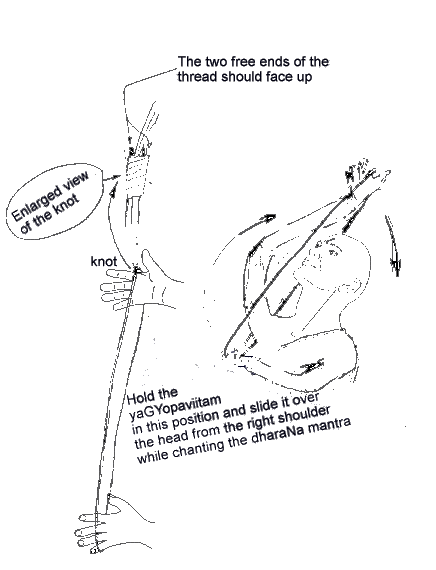
Use of the Thread:
Some persons use the thread to count their gayatri japa when chanting
a large number of times. They use right and left hands to count to one
hundred, and wind the thread around the thumb to record the hundreds. In
chanting gayatri in lesser numbers, this practice is not necessary. Others
hold the knot while chanting because they say it represents the power of
brahman. Though there is no scripture reference to wrapping the thread
around the thumb while performing gayatri japa or while performing acamana
or puja rites, it is a common local custom in Bengal. Thus it may be done,
but is not a necessity. The thread represents upper cloth, and is a symbol
of vaidic initiation, or admittance into the upper three varnas as a twice-
born individual.
Respect for the Upavita:
One should not be without his upavita at any time. One should not touch
the upavita with contaminated hands. One should not break another persons
upavita. It is considered a great offense, for which prayaschitta must
be done. One should keep the thread (it may be in niviti position) over
the right ear (pure at all times) while passing nature, since the thread
remains pure in that position while the rest of the body is impure. After
saucha is completed, the thread may be restored to its normal position.
TANTRIKA SANDHYA
Just as the qualified son is given brahma gayatri at the upanayanam
samskara in accordance with Vedic rites, a qualified man or woman of any
background, may be given pancaratrika gayatri and mantras in accordance
with pancaratrika vidhi. Just as a person must chant his Vedic gayatri
mantra daily at the sandhyas according to certain rules, so one must also
chant ones pancaratrika mantras at the sandhyas according to rules. One
should perform tantrika sandhya after the vaidic sandhya. Procedure for
tantrika sandhya is described in Hari Bhakti Vilasa and is given in the
practical manual. The rules for chanting are similar to the Vedic gayatri.
The pancaratrika mantras should be chanted daily at the sandhyas. One should
concentrate on the mantra and not engage in other activities simultaneously.
One should be properly dressed, with clean cloth, tilaka, and tied sikha.
The place should be clean and quiet. The hands should be covered. The japa
should be manasika. The mantra should be chanted ten times minimum. One
should know the meaning of the mantra being chanted.
Meaning of Kama Bija: Just as oµ is prefixed to all mantras
from the Vedic hymns, various bijas are prefixed to different pancaratrika
mantras. one of these commonly associated with Krsna mantras is the kama
bija. As "om" is endowed with energy, so these bijas are also endowed with
energies to invoke the deity to which is corresponds. Prabhodananda Sarasvati
states that this bija represents Krsna, Radha, and their relationship of
love. By chanting this bija, one can gain access to their service. According
to the scriptures, Srila Prabhodananda Sarasvati has analyzed the meaning
of the kama bija as follows:
K gives rise to water.
L gives rise to earth.
I gives rise to fire.
M (chandrabindu) gives rise to air and ether.
This bija is called "bhutatmaka" or consisting of the elements.
Gautamiya Tantra says that this bija gives rise to the universe: klimkarat
asrjat visvam iti prahuh sruter girah. The sounds also represent various
shaktis of Krsna, and various parts of the body.
K represents the face, head and throat.
L represents the eyes, ears and arms.
M (chandra bindu) represents the chest, back, waist, thighs, knees
and feet.
K represents the nayaka or hero, Krsna.
L represents ananda or prema.
I represents the nayika or heroine, Radha.
M (Chandra bindu) represent kiss and embrace.
Gopala mantra: It is stated in the Brahma Samhita that Lord Brahma was
initiated into the eighteen letter Krsna mantra, which is generally accepted
by all the devotees of Lord Krsna. We follow the same principle because
we belong to the Brahma sampradaya, directly in the disciplic chain from
Brahma to Narada, from Narada to Vyasa, from Vyasa to Madhva Muni, from
Madhva Muni to Madhavendra Puri, from Madhavendra Puri to Isvara Puri,
from Isvara Puri to Lord Caitanya and gradually to His Divine Grace Bhaktisiddhanta
Sarasvati, our divine master. The chanting of this holy mantra is the only
shelter of the desireless pure devotee of the Lord. SB 2.9.6, purport.
The gopala mantra is an example of a diksa mantra which is not in gayatri
rhythm, which both chanted at sandhya time and used during puja. This diksa
mantra was given to Lord Caitanya by his guru Isvara Puri when he was initiated
at Gaya. He had previously undergone upanayanam and received the brahma
gayatri as a child. This krsna mantra is glorified in pancharatra for its
extraordinary powers. It is a direct glorification and meditation on Krsna,
his form, qualities, and pastimes, establishing sambandha (krsna), abhidheya
(govinda) and prayojana (gopijana vallabha).
Kama gayatri: There are many gayatris mentioned in pancaratrika scriptures,
such as visnu gayatri, nrsimha gayatri, krsna gayatri. Kama gayatri indicates
kama deva, but in relation to Krsna, it refers to the the Lord of prema.
As the seed of the brahma gayatri is oµ the seed of the kama gayatri
is the kama bija klim. Whereas the brahma gayatri is a meditation on the
Supreme Lord in his functional aspect as Lord of all energies and as the
creator, maintainer and destroyer of the universes, the kama gayatri is
a meditation on the Supreme Lord in his ultimate aspect as Krsna, with
specific name, form, qualities and pastimes. Whereas the brahma gayatri
purifies a person of the material modes, removing material kama, the kama
gayatri impels one towards the form of Krsna in Goloka with the experience
of madhurya rasa. This is the form Gayatri Devi takes in the rasa lila,
according Srila Bhaktivinode Thakur. As in the gopala mantra, the meditation
takes place in three stages: sambandha, by acknowledgment (vid) of the
transcendental Cupid; abhidheya or worship (dhi) of Krsna, by which one
can develop prema; and prayojana or prema, which impels one (pracodayat)
spontaneously to Krsna. We know Kamadeva, the personality who enjoys pastimes
with steady desire towards the object of his love. Let us meditate upon
Kamadeva, possessed of flower arrows, with which he pierces the hearts
of those who become the object of his desire. May Kamadeva inspire us to
meditation and service. According to Prabhodananda Sarasvati, each syllable
represents one of the moons on the body of Krsna, by which he enacts his
pastimes. Klim represents the Lord. kama are his two cheeks
deva are his mouth and forehead. ya, a half moon, is his tilaka.
vidmahe, puspa are the five moons on the right hand. vanaya dhimahe
are the five moons on the left hand. tan no'nanga are the five moons
of his right foot. pracodayat are the five moons of his left foot.
Thus the kama gayatri is a sound representation of the all- attractive
form of Krsna. By chanting this mantra one should realize Krishna's sublime
beauty.
NAMA JAPA (Chanting Hare Krsna on Beads)
Japa of the Holy Name is considered to be one type of kirtana, for
internal, personal purification and development of attraction to Krsna.
It is the essential item of devotional service as taught by Lord Caitanya,
combining hearing, chanting and remembering the Lord's name.
Necessity of chanting: Then the Bhattacharya asked Caitanya Mahaprabhu:
Which item is most important in the execution of devotional service?
The Lord replied that the most important item was the chanting of the
holy name of the Lord. CC Madhya v.2.p.334 yadyapi anya bhaktih kalau
kartavya, tada kirtanakhya bhakti samyogenaiva. The other eight processes
should be executed, but they must be preceded and followed by kirtana,
the chanting of the holy name. CC Madhya v.6.p.53 from Bhakti Sandarbha,
Jiva Goswami.
Unless one has come to the platform of spontaneous love of God, he must
follow the regulative principles... he first regulative principle is that
one must chant the Hare Krsna mahamantra loudly enough so that he can hear
himself, and one must vow to chant a fixed number of rounds. CC Antya v.4.p.12
Rules for Nama Japa (chanting Hare Krsna on beads):
The rules given in scripture for chanting japa apply to the chanting
of mantras (e.g. Gopala mantra). The holy name is not dependent on such
rules for its effect. However, since many of these rules are for the purpose
of concentration on the mantra, in chanting the Holy Name one may utilize
these rules in order that one fix ones mind on Krsna and to avoid offense
to the Holy Name. The hare krsna mahamantra,
... may be chanted at any place and any time, and this will bring results
very quickly. Yet even while chanting the Hare Krsna mantra one may observe
regulative principles. Thus while sitting and chanting one may keep his
body straight, and this will help one in the chanting process; otherwise
one may feel sleepy. SB 7.15.31.
Counting Japa:
One should count ones japa. To do this one may use fingers or beads:
anguly agresu taj japtam yaj japtam meru langhaneasakhyatan ca yaj japtam
tat sarvam nisphalam bhavet. Japa done on the finger tips, japa which
passes over the head bead, and japa done without counting the number of
times is all useless. Vyasa Smrti, HBV Ch.17, v. 135.
Mala (Japa beads):
According to the Varaha Purana one should use beads to count his japa.
One who does not do so is considered asuric, whereas one who chants his
mantras using mala becomes quickly favored by the Lord. One may have mala
of twenty beads, fifty beads or one hundred and eight beads. The latter
is the best type. Beads may be made of different materials, each with its
own benefits. Thus there are conch, silver, gold, lotus seed, rudraksa,
coral, pearl, and jewel beads. But beads made of tulasi are considered
the best, as they yield all results to all people. tulasi kastha
ghatitair manibhir japamalikasarva karmani sarvesam ipsitartha phala prada
(Gautama) The beads should be washed in pancha gavya before stringing.
The beads should be strung on cotton thread, with knots (preferably brahma
granthi) tied between each bead. There should be an extra bead, called
meru over which one should not cross in ones chanting. After the beads
have been strung mala samskara should be performed.
Holding the beads:
The different fingers have different qualities: The thumb gives moksa.
The forefinger is used for cursing. The middle finger gives perfection
of dharma. The ring finger gives peace. The little finger gives siddhi.
The Gaudiya Vaishnavas should chant on the beads using the thumb and middle
joint of the middle finger. One should not touch the mala with the left
hand of the forefinger. One should keep the beads and the hand covered,
for when one chants with the beads uncovered, the bhutas, raksasas, and
gandharvas steal the effect of ones chanting. The mala should not fall
from the fingers. (this is usually due to inattention or dozing.)
Types of Japa:
There are three types of japa: vacika: pronouncing the mantra
so that it is audible. upamsu: chanting the mantra so that it is
audible only to the chanter. manasika: chanting in the mind.
Diksa mantras should be chanted in the manasika manner, but the Holy Name
may be chanted in any manner.
Cleanliness:
One should have brushed his teeth in the morning, for if one does not
do so one is considered asuci, unclean. Kasi Khanda, HBV ch3, v.211)
One should be bathed. pratah snanam vina pumsam papitvam karmasu
smrtam home jape visesena tasmat snanam samacaret. If
one does not take the early morning bathe (before sun rise) all of ones
activities, especially japa and homa, become impossible to execute purely.
Therefore one should take the early morning bathe. Kurma Purana.
Ones hands should be clean.
Dress:
One should not be naked. (Note: one is considered naked if he wears
only one piece of cloth; if he does not wear his dhoti in trikaccha style,
or alternatively, with kaupina;, oil stained cloth, torn cloth, cloth too
long or too short; if he wears dirty cloth. cotton is considered clean
if washed in water and dried. One should dress in two pieces of clean
cloth as for puja): japa homopavasesu dhauta vastra dharo bhavet (Padma
Purana HBV ch4, v.150) For japa, homa, and fasting one should were
a washed piece of cloth. One should wear vaishnava tilaka. Ones sikha
should be tied. Throat should be uncovered. Head should not be covered,
by cloth, hat or turban. One should not chant with too little or too much
clothing on. One should not wear shoes.
Posture:
One should sit decently, with legs crossed and covered, not spread
out. One should sit on a asana and face east. One should not lie down to
chant japa. One should not shake the head and neck while chanting. One
should not show the teeth.Place: One should not make a habit of chanting
in dark places. One should chant ones japa in a crematorium (an impure
place), on the open road, in a vehicle, on a bed. Time of chanting: One
should not chant ones japa at night, but rather in the early morning. Chanting
japa should be done early in the morning with full concentration preferably
during the brahma muhurta. Concentrate fully on the sound vibration of
the mantra pronouncing each name distinctly and gradually your speed in
chanting will increase naturally. Do not worry so much about chanting fast,
most important is the hearing. letter of Srila Prabhupada, Bombay, Jan.6,
1972 Number of rounds: The sixteen rounds is just a minimum I set
for my disciples so they will chant at least that much. Actually chanting
should always be going on. letter from Srila Prabhupada, Jun.25, 1974
Incomplete rounds:
If one cannot complete the fixed number of rounds he is assigned, he
should be considered to be in a diseased condition of spiritual life. CC
Antya v.4.P.11 Everyone should strictly follow the regulations of
sixteen rounds daily. If one is busy for other Krsna consciousness activities
and cannot fulfill the regular routine of chanting he must compensate it
the next day, curtailing his activities in the matter of sleeping or eating
or any other sense gratificatory process. letter from Srila Prabhupada
Oct.11, 1969
Attention:
One should not chant while carrying on a conversation. One should not
chant while moving here and there, while shaking the body, while lying
down. One should not chant while looking here and there. One should not
chant while giving and receiving gifts. One should not chant with a troubled
mind, being filled with anger or while afflicted with hungry. One should
not chant while possessed of yawning, sneezing or hiccupping. One should
withdraw the mind from objects of the senses, exclusively concentrate on
the sounds of the mantra, meditate on the meaning of the mantra (relationship
to Radha and Krsna), and remain undisturbed by any other thoughts or external
situations. Through devoted concentration on the syllables of the Holy
Name one should step by step realize the form, qualities, and pastimes
of the Lord.
Negligence in chanting:
There are two types of negligence. Negligent utterance for the
sense gratification of materialistic persons is not a vibration of transcendental
sound. Utterance of the holy name while one engages in sense gratification
is an impediment on the path toward achieving ecstatic love for Krsna.
On the other hand, if one who is eager for devotional service utters the
holy name even partially or improperly, the holy name which is identical
with the Supreme Personality of Godhead, exhibits its spiritual potency
because of that person's offenseless utterance. Thus one is relieved from
all unwanted practices, and one gradually awakens his dormant love for
Krsna. "The letters of the holy name have so much spiritual potency that
they act even when uttered improperly." CC Antya V.1.p.236 Meaning
of the Mantra: Hare Krsna Hare Krsna Krsna Krsna Hare Hare Hare Rama Hare
Rama Rama Rama Hare Hare. Meaning (as explained by Gopala Guru Goswami,
disciple of Svarupa Damodara of Puri): The word "Hare": hari harati
papani dusta cittair api smrtahanicchayapi samsprsto dahaty eva hi pavakahvijnapya
bhagavat tattvam cid ghanananda vigrahamharaty avidyam tat karyam ato harir
iti smrtahJust as the fire, on contacting an object, automatically burns
it, so the name of Hari takes away (harati) or burns up all the sins of
the people with materialistic hearts. It removes (harati) all ignorance
and reveals the transcendental, blissful form of the Lord. Gopal Guru Goswami
also says that Hari means that personality who attracts (harati) the minds
of all the people in the universe by when they hear stories of his transcendental
qualities, or he who attracts the minds of people by his beautiful youthful
form. "Hari" in the grammatical form of address, (vocative, calling out
of a person) becomes "hare". The word "hare" has another meaning.
svarupa prema vatsalyair harer harati ya manahhara sa kathyate sadbhih
sri radha vrsabhanuja. Hara is Srimati Radhika, daughter of Vrsabhanu,
who steals (harati) the mind of Hari, Krsna by her unalloyed love. Hara,
in the form of address, also becomes "Hare. "The word "Krsna": krsir bhu
vacakah sabdo nas cananda svarupakahtayor aikyam param brahma krsna ity
abhidhiyate. The word "krsna" is composed of the root "krsi" meaning
"bhu," the shelter of all existence and the word "na" meaning "nivriti"
or the form of supreme bliss. Combined they form the word "krsna" which
signifies the param brahma, the supreme personality of godhead with blissful
form. Krsna in the form of address remains as "krsna". The word "Rama":
ramante yogino'nante nityanande cidatmaniiti rama padenaiva param brahmabhidhiyate.
The param brahma is known as Rama because the yogis take pleasure (ramante)
in meditating on his eternal, blissful form. vaidagdhi sara sarvasva
murti liladhidevatamsri radham ramayan nityam rama ity abhidhiyate.
The Supreme Lord is called Rama because he carries out pastimes of pleasure
with the most beautiful Sri Radha. Hare Krsna Hare Krsna Krsna Krsna
Hare Hare Hare Rama Hare Rama Rama Rama Hare Hare Oh Radha, please
attract my mind, and free me from this material world. Oh Krsna,
please attract my mind. Oh Radha, attract my heart by showing your
sweetness. Oh Krsna, purify my mind by giving knowledge of how to
perform worship of you through your pure devotee. Oh Krsna, give
me steadiness to appreciate your name, qualities and pastimes. Oh
Krsna, may I develop a taste for serving you. Oh Radha, please make me
qualified for your service. Oh Radha, please instruct me one how
I can serve you. Oh Radha, let me hear of your intimate pastimes with your
beloved. Oh Rama (Krsna), let me hear of your intimate pastimes with
your beloved. Oh Radha, reveal to me your pastimes with your beloved.
Oh Rama, reveal to me your pastimes with your beloved. Oh Rama, engage
me in remembering your name, form, qualities and pastimes. Oh Rama
please make me qualified for your service. Oh Radha be pleased with
me. Oh Radha be pleased with me.
Vaidik, Pancaratrika Mantras and Hare Krsna:
According to the pancaratrika philosophy, vaidic initiation with brahma
gayatri (upanayanam) is insufficient by itself to stand as spiritual sadhana
for Kali yuga. In this age, without following the regulations of pancaratrika
diksa (initiation into visnu or krsna mantras), spiritual progress is very
difficult. In this age, the vedic mantras will bear fruit only if chanted
along with the pancaratrika mantras. Therefore in order to worship the
deity one must not only have upanayanam, but pancharatrika or vaisnava
diksa. Additionally, even without undergoing upanayanam, a person who has
pancaratrika diksa is permitted to worship the deity. Lord Caitanya
has however emphasized that sravana and kirtana of the the Hare Krsna mantra
as the principle sadhana, superceding chanting of vedic or pancharatrika
diksa mantras. The Holy Name is independent of diksa. no diksam na
ca sat kripyam na ca purascaryam managa iksate. Chanting the holy
name does not depend on initiation, pious activities or the purascharya
regulative principles generally observed before initiation. The holy name
does not wait for all these activities. It is self-sufficient. CC Madhya
V.6, p.59, verse by Srila Rupa Goswami, PadyavaliIt may be given out to
and chanted by all people without restriction. Thus the Holy Name may be
utilized in public chanting, sankirtana. The Holy Name therefore functions
as a practical preaching instrument in Kali yuga. At the same time Lord
Caitanya has also emphasized, and shown by his personal example, that those
interested in spiritual progress must take Vaisnava (pancharatrika) initiation.
Though the Holy Name itself is independent of diksa vidhi, the majority
of serious aspirants in spiritual life need the pancharatrika process of
initiation to tame the restless mind and assist in the purification process.
Thus both taking up the chanting of the Holy name and receiving pancharatrika
mantras from a bona fide guru have been fundamental to the movement of
Lord Caitanya.
Vaidic initiation (upanayanam samskara) on the other hand has not been
given a crucial role for several reasons. Over the centuries the vaidic
initiation has become a formality performed by a family priest on behalf
of the father, with little spiritual significance and no training under
a guru in the gurukula. As well, it has also been misconceived as a ceremony
based on birth right: if one is born in a brahmana family, one is entitled
to be initiated as brahmana no matter what qualities one may have. As well
the upanayanam rites connote the excessive rules of varnasrama, which impede
bhakti on the level spontaneous love for Krsna. Lord Caitanya however never
rejected the Vedas or the rules of varnasrama. Those who require those
rules for their spiritual development should practice them. Thus, those
on the level of sadhana bhakti should follow those rules of varnasrama
which purify body and mind and thus aid the development of pure bhakti.
Srila Gopal Bhatta Goswami has written Sat Kriya Sara Dipika as a samskara
manual for Vaishnavas, and included in it the upanayanam ceremony, or Vaidic
diksa. Srila Bhaktisiddhanta Sarasvati Thakur implemented this Vaidic diksa
samskara according to the pancharatrika philosophy that the initiated Vaisnava
surpasses the brahmana in qualification. Thus anyone who is qualified for
pancaratrika initiation qualifies also for the Vaidic initiation, regardless
of family or background. When he gave Vaisnava mantra (pancharatrika initiation),
he also gave the vaidic mantra (brahma gayatri, vaidic initiation). He
was of course criticized by the orthodox followers of varnasrama for superceding
the conventional rules of caste by birth, and he was criticized by some
Gaudiya Vaishnavas for emphasizing varnasrama vidhi over raga (spontaneous
love). His act was simply a confirmation of pancaratrika theory of the
superior nature of the Vaisnava, and an attack on the misconceptions of
casteism. The Upanishads and Mahabharata give examples of those who, though
from low family, were initiated as brahmanas. As well he restored the samskara
to its original significance as a spiritual samskara, which may assist
the devotee on the level of sadhana bhakti. Thus the practicing devotee
chants the Hare Krsna mantra, pancaratrika mantra and vaidic mantra.
The purpose of Samashrayanam - Panch samskara diksha
SEEING THE LORD:
Since the first sense impressions of the day leave a lasting impression
on the mind, one is advised to gaze upon auspicious items and avoid looking
upon inauspicious items. The following items are auspicious: a brahmana,
ones chaste wife, a cow, a sacrificial fire, rochana (yellow pigment),
sandalwood paste, mrdanga, mirror, jewels, guru (elders and teachers),
and the sun. The following are inauspicious: any person who is sinful,
blind, disfigured, or naked; crows, rats, cats, and asses. The Lord is
the most auspicious to see. Therefore it is advised that on waking in the
morning, one should chant the Lord's name, meditate on his form, qualities
and pastimes, and visit the temple to see the form of the Lord and His
first worship of the day. This makes ones whole day Krsna conscious. One
is advised to perform the mangala aratrika of the Lord after waking Him
in the morning, but if that is not possible one should at least see the
worship at this time.
strinam pumsam ca sarvesam etat sarvesta purakamsamasta dainya darikdrya
duritady apasantikrt.
By worshipping the Lord at mangala aratrika the desires of all men and
women become fulfilled, and all sorrows, poverty, and sins are destroyed.
Hari Bhakti Vilasa Ch.3, V. 152
aradhanasamarthas ced dadyad arcana sadhanamyo datum naiva saknoti kuryad
arcana darsanam.
One who can perform the worship of the deity personally should give
items for worship. One who cannot give items for worship should see the
worship of the Lord, Hari Bhakti Vilasa Ch.11, V.52 from Agastya Samhita
nirajanantvidam sarvaih kartavyam suci vigrahaihparama sraddhayotthaya
drastavyam ca sada naraih.
One should always perform the early morning aratrika to the deity, and
if one cannot do it personally, then at least one must rise and with devotion
see it being performed. Narada Pancharatra. Whereas one may have
difficulty in meditating on the Lord's form, pastimes and qualities early
in the morning, by attending mangala aratrika one can engage the eyes in
seeing the wonderful forms of Radha and Krsna, one can engage the ears
in hearing their names, one can engage the tongue in chanting the Lord's
name, and one can engage the whole body in dancing for His pleasure. In
this way, by such complete engagement of the senses, one is sure to remember
the Lord early in the morning and make the whole day auspicious (mangala).
Therefore attendance at mangala aratrika is a necessity for the serious
devotee: Please institute these most important points of attending mangala
aratrika and chanting 16 rounds. These are the most important points of
Krsna consciousness process. letter from Srila Prabhupada, Calcutta, Feb.13,
1972. All men who live in the devotee rooms must attend mangala aratrika
or starve. letter from Srila Prabhupada Giriraj, Bombay.
Going to the temple, seeing the deity with great devotion and seeing
the aratrika and worship of the Lord are among the angas of devotional
service (direct means of developing bhakti) mentioned by Srila Rupa Goswami
in Bhakti Rasamrta Sindhu. At the aratrika and after, one should engage
in the the following angas of devotional service: singing songs before
the deity, performing sankirtana before the deity, dancing before the deity,
worshipping the deity, paying obeisances to the deity, circumambulation
of the deity, drinking charanamrta and accepting the prasad flowers of
the Lord on ones head.
NRTYA (dancing):
By dancing for the pleasure of the Lord a person can employ his whole
body in devotional service. The devotee of Vishnu who dances in joy destroys
all inauspiciousness in the earth by his feet, in all directions by his
glance, and in svarga by his hands. Hari Bhakti Sudhodaya. One who
dances joyfully and with great attention and devotion turns hundreds of
sinful births to ash. Dvaraka Mahatmya, Hari Bhakti Vilasa, Ch 8. V.287.
All the sins of those who dance before the deity while playing karatala
fly from their bodies like birds. Vishnu Dharmottara Hari Bhakti Vilasa
Ch.8, V.291.
Rules:
When the devotees are dancing no one should remain sitting and watching
and no one should come between the Lord and the dancers. That person who
remains sitting and watches the devotees dance will be born lame birth
after birth. Hari Bhakti Vilasa Ch.8, v. 252-3. Dancing should be done
enthusiastically by raising hands. All of Lord Caitanya's followers used
to dance with raised hands. If someone dances with ecstasy, that is all
right, but is is better to dance with raised hands. letter from Srila Prabhupada,
Kirtanananda Swami, Nov.10, 1975. While dancing, a person on the level
of sadhana bhakti one should as a rule maintain reverence and avoid deity
offenses, such as pointing feet disrespectfully at the deity, keeping ones
back to the deity, acting or thinking irreverently etc.
GITA (singing songs for the Lord's pleasure):
One should use the voice to sing melodious tunes glorifying the Lord.
The songs may be about the Lord's activities or the activities of the devotees.
One should not sing unauthorized songs. The words or songs of a person
not fixed in vaisnava behavior, not strictly following the rules and regulations
and chanting the Hare Krsna mantra should not be accepted by pure devotees.
SB6.16.33. The devotee should absorb his mind in the Lord and sing for
the Lord's pleasure, but should not sing to earn his living. No one should
come between the the devotee singing and the deity, who is receiving the
song. The songs may be accompanied by instrumental music and dance. The
songs may be according to raga suited for that part of the day and season.
There may be singing at all times for the Lord but especially at the sandhyas
(sunrise, noon and sunset) and on special days such as ekadasi or festivals.
SANKIRTANA:
Loudly proclaiming the lord's names, lilas, and qualities is called
kirtana. Kirtana may also take the form of lectures, reciting scripture
or explanations of Krishna's glories. When this is performed by a group
of devotees it is called sankirtana. Kirtana is the main process of devotional
service. Though one should perform the other eight angas of bhakti in kali
yuga, one should perform them along with kirtana. As it says in Srimad
Bhagavatam, yajnair sankirtanaih prayair yajanti hi sumedhasah (The intelligent
men of kali yuga will worship the Lord by sankirtana). This indicates the
superiority and independent nature of sankirtana. Jiva Goswami, Krama Sandarbha.
Of the types of kirtana, nama kirtana, or chanting.
Hare Krsna is the best:
Then the Bhattacharya asked Caitanya Mahaprabhu: Which item is most
important in the execution of devotional service? The Lord replied that
the most important item was the chanting of the holy name of the Lord.
CC Madhya v.2.p.334
Nama sankirtana is the best process of preaching in Kali yuga.
yagnaih sankirtana prayair yajananti hi su medhasah
In execution of nama kirtana or nama sankirtana one should chant the
authorized names of Krsna: Not liking the chanting of His transcendental
qualities, Sri Caitanya Mahaprabhu chastised them as if He were angry.
"What kind of chanting is this?" He asked. "Are you leaving aside the chanting
of the holy name of the Lord?"
Purport: Thus Sri Caitanya Mahaprabhu chastised all the devotees, telling
them not to show impudence and spoil the entire world by becoming independent.
CC Madhya V.1. vv270-271.
Regarding kirtana during the aratrika, Srila Prabhupada has taught his
disciples to chant:
sri krsna caitanya prabhu nityanandasri advaita gadadharasrivasadi gaura
bhakta vrnda
Hare Krsna Hare Krsna Krsna Krsna Hare Hare Hare Rama Hare Rama Rama
Rama Hare Hare
The Hare Krsna mantra as taught by Lord Caitanya himself, should be
the main element of the kirtana. All the words should be pronounced and
heard distinctly in their proper order. One person should sing the mantra
alone, and then the group of devotees should sing the same mantra together
in response. In addition, at the first aratrika in the early morning
Gurvastakam by Srila Visvanatha Cakravarti should be sung first, in the
standard melody for that time of day. At the evening aratrika the Gaura
Aratrika by Srila Bhaktivinode Thakur should be sung.
Names of the Lord for all occasions:
One should chant the names of the Lord all day while engaging in ones
activities.
The following names have specific potencies.
madhusudana: for purification.
vasudeva: when bathing, doing puja, homa, parikrama,
pranamarama, parasurama, nrsimha visnu, trivikrama: for victory over
enemies.
balabhadra: at the commencement of battle
hrsikesa: for dispelling fear
narayana: when sneezing, falling, in drought and excessive rain, during
eclipses or inauspicious times
nrsimha: for warding off wild animals or bandits
jalasayi, visnu: when there is a fire
sri nrsimha jaya nrsimha jaya, jaya jaya nrsimha: for destroying the
effect of killing a brahmana
rama: for success
pursottama: for success in scholastic pursuits
ajita, dhipa, sarva, sarvesvara: for success in business
halayudha: when starting an agricultural venture
cakri, gadi, sarngi, khadgi: for beginning a journey
pundarikaksa, keshava: for relief to the eyes
acyuta, marta, visnu: for gaining best effect from medicine
garuda dvaja: to stop the effects of poison
visnu: when rising from bed
madhava, padmanabha: when taking rest
govinda, janardana: when eating
prajapati: at a wedding
varaha: when in the water
nrsimha: when in a forest
raghunandana: when on a mountain
madhava, vasudeva: for all activities
PUJA: Guru Puja:
Before beginning the daily worship of the Lord the scriptures prescribe
that one must worship the spiritual master. As one must respect the spiritual
master in the same way that one respects the Lord, the procedure for worship
follows the method of worship of the Lord, that is, by offering asana,
foot water, arghya, achamana, madhuparka, bath, cloth, thread, gandha,
flowers, incense, lamp and mahaprasadam. This is described in the archana
section. If one does not have opportunity to personally perform guru puja
he can at least perform mental worship, and participate in the guru aratrika
at the conclusion of the guru puja.
Deity Puja:
One should perform worship of the deity (archana) according to pancaratrika
vidhi.
Who should perform worship of the deity?
According to scripture, all initiated householders should engage in
deity worship.
It should be performed by means of rightfully obtained wealth and with
a pure heart: ayam svastyayanam pantha dvijater grhamedhinahyacchraddhayapta
vittena suklenejyeta purusah (S B 10.84.37) This is thus a nitya kriya
or daily activity prescribed for the householder to engage his body and
mind in serving the Lord. As the rules for this nitya kriya are extensive,
they are explained in a separate section. If one cannot maintain such worship,
one should give materials for worship to one who is executing such worship,
and he will gain half of the results of that worship. If one cannot give
donations for worship, then one should take darshana of the deity while
aratrika is being performed, and in that way one can accrue the benefits
of deity worship. Thus after the morning worship has been completed by
the assigned pujaris the general devotees should view the srngara aratrika
being offered to the Lord.
PARIKRAMA or PRADAKSINA (circumambulation):
To walk around a person clockwise, showing ones right side to the person
is a mode of showing respect. Here one utilizes the whole body to give
worship to the Lord. One may circumambulate the deity, the temple or the
Lord's ratha. One should not circumambulate someone else in front of the
deity, as a matter of etiquette, for by doing so one will have to show
ones back to the Lord. One should not circumambulate Vishnu only once.
One should circumambulate Vishnu four times. Candi accepts one circumambulation,
surya seven, ganesa three and siva one half (like a crescent moon). Circumambulating
the whole temple only once is allowed. One should perform pradaksina while
performing kirtana. After circumambulating one should pay pranamas.
PRANAMA (paying obeisances):
One should bow down immediately upon seeing the deity. Offering respect
by lowering the body is called pranama. Nrsimha Purana says that prostration
before the Lord is the best of yajnas. As it is a physical expression of
complete surrender to the Lord and indicates offering ones head beneath
the Lords lotus feet.
Occasions:
One should offer pranamas to the Lord out of respect on entering the
Lord's temple, when having darshana of the Lord, before and after worshipping
the deity (it is counted as the sixteenth upachara or item of archana),
or after meditating on the Lord. One should the same form of respect to
the followers (parishad such as Garuda, Hanuman) of the Lord, advanced
Vaishnavas, brahmanas and sannyasis.
Types of Pranama:
Panchanga pranama (using five limbs) consists of touching the ground
with two knees, two arms, head; with mind intent on surrender; and with
tongue offering words of submission.
Astanga pranama (using eight limbs) consists of touching two arms,
two feet, two knees, chest and head to the ground, with eyes half closed,
with mind thinking that ones head is at the lotus feet of the Lord, and
with tongue uttering words of submission. According to some, women should
only perform the five limbed pranama, since there is an injunction that
women's breasts should not touch the earth (due to their sacredness, life
giving potency for feeding generations).
Men may perform either.
Before the puja, after the offering of upacharas and after the japa
one may offer five limbed pranama, but at the conclusion of puja one should
offer eight limbed pranama.
Hands:
According the Kurma Purana, the hands should be crossed, with the thought
that ones right hand is touching the right foot of the Lord and ones left
hand is touching the left foot of the Lord. It is offensive to touch only
one hand on the ground. Words: Words of submission may be "prasida bhagavan"
(Oh Lord, please accept my service, be satisfied with me) or suitable pranama
prayer. Pranama prayers usually have the word "namah" (or its derivatives
"namas" and "namo") or "pranamami"
Head:
Ones head and upper body should not be covered with a cloth. Anyone
who offers respects and obeisances to the deity while wearing garments
on the upper portion of his body is condemned to be a leper for seven births.
CC Antya v.4.p.68
Purity:
One should be in a pure state when offering or accepting pranamas.
Direction:
One should face different directions for offering pranamas to different
personalities. One should approach from the Lord's right side and pay pranama
showing ones left side to the deity. One should show ones right side in
paying pranamas to Siva and Parvati, and one should directly face the spiritual
master when paying pranamas to him.
Number:
One pranama is insufficient. One should offer three times or any greater
uneven number of times. Not only the head, but the whole body should be
lifted after each pranama.
Exception:
In paying respects to many people in a gathering, one should offer
pranamas only once:
sabhayam yajna salayam devatayatanesv apipratyekan tu namaskaro hanti
punyam purakrtam (Brhannaradiya Purana)
One should not pay obeisances to individuals while they are in an assembly,
in a yajna arena or in a temple of the Lord. One should offer ones respects
once only for all of the vaishnavas. If one fails to act in this manner
one will lose all his previous punya.
Place:
Out of respect, one should not pay pranamas directly in front of the
deity, nor behind the deity, nor too close to the deity, nor in the deity
room. The deity of the Lord and the spiritual master should be seen from
a distant place. This is called maryada. Otherwise, as is said, familiarity
breeds contempt. Sometimes coming too near the deity or the spiritual master
degrades the neophyte devotee. Personal servants of the deity and the spiritual
master should therefore always be very careful, for negligence may overcome
them in their duty. CC Madhya v.5.p.105 To maintain the conception
and mood that the Lord is the supreme object of worship and respect according
to the rules of vaidhi bhakti one should not offer respects to others in
the presence of the deity. For this reason worship and pranamas to tulasi
is done with deity curtains closed. According to the rules and regulations,
no one should accept obeisances in the temple of the Lord before the deity.
Nor is it proper for a devotee to offer obeisances and touch the feet of
the spiritual master before the deity. This is considered an offense. The
point is that even though one plays the part of a spiritual master, he
should not accept obeisances or permit a disciple to wash his feet before
the deity. This is a matter of etiquette. CC Madhya v.5.p.60
CHARANAMRTA
Drinking charanamrta and placing on ones head is an anga of bhakti
mentioned by Srila Rupa Goswami. Charanamrta is the water which has been
used to wash the body of the Lord during the daily worship. Sometimes the
offered footwash, achamana, arghya (if it does not contain inedible items),
madhuparka and bath water are combined and offered for drinking. Items
which have not been offered to the deity should not be added to the charanamrta
just to make a palatable drink. As an anga of arcana the pujari should
drink charanamrta at the conclusion of the puja. It is offered to the general
devotees any time after the morning puja is completed. One should accept
charanamrta in ones right hand, drink some and place some on ones head
saying:
akala mrtyu haranam sarva vyadhi vinasanamvisnoh padodakam pitva sirasa
dharayamy aham
I drink and place on my head the foot water of visnu, which cures all
diseases and prevents untimely death.
Charanamrta should not fall on the floor or feet, since it is respected
as the Lord. Thus some people hold a cloth under the right hand when they
receive the charanamrta. If is also offensive to wash out the mouth after
drinking charanamrta.
NIRMALYA DHARANA:
Taking the used garlands, flowers and tulasi leaves (nirmalya) sandalwood
paste from the Lord's body and touching them to the head is called nirmalya
dharana. It is one of the angas of bhakti and also the concluding anga
of arcana, after circumambulation, pranama and drinking charanamrta. This
anga is often performed at the end of the puja when all the items used
by the Lord are collected and distributed, but it may be performed independently
whenever one receives the Lord's remnants. All items related to the deity
are worshippable. Some items (such as clothing and ornaments) are kept
for long periods for the use of the deity while other items such as sandal
wood paste, tulasi leaves, charanamrta, naivedya, are enjoyed by the Lord
and then distributed to the devotees. Nirmalya refers to the flowers and
tulasi which have previously been worn by the deity. The nirmalya, the
old flowers from the previous night, must be removed from the Lord at the
dawn before the sunrises. The longer one delays the more sins and suffering
one incurs. This means that one must wake the Lord and begin caring for
him by removing the old garlands by the first light of dawn. This rule
does not apply to tulasi. Being related to the deity, used flowers and
tulasi, candana, old deity clothing and old deity ornaments are sacred
and must be respected properly. Upon receiving them one should touch them
to ones head and say "Mahaprasadam." By touching them to ones head one
shows ones surrender to the Lord in the same manner as when giving pranamas
(obeisances). That should be ones mentality at the time. One may wear the
garlands or clothing on the upper part of the body, but they should not
touch below the waist. Such flowers, tulasi leaves etc. should never be
stepped upon or touched by ones feet, touched by contaminated items or
thrown in unclean places. They may be discarded in a body of clean water
after use. Lamps and incense offered to the deity should be respected in
the same way. If the lamps are not distributed amongst the crowd of devotes,
when the lamps are waved in the direction of the crowd one should mentally
touch the lamps and then touch ones head. The lights should not be forcibly
extinguished. One may rub the smoke from the incense on the upper part
of ones body.
TULASI SEVA
Serving the tulasi plant is one of the angas of devotional service,
classified as tadiya seva (service to things
dear to the Lord) along with service to scripture, the dhama And vaishnavas.
Tulasi is glorified and worshiped because she is the sakti or energy of
the Lord, like the gopis and Radha, by whose mercy one can gain the favor
of Krsna. One serves tulasi by planting, caring for, watering, worshiping
the plant and plucking leaves. Though all people may not be prepared for
full worship of tulasi they can derive the benefit by observing her worship
or aratrika. Worship: One may offer as many articles as possible using
the system for offering upacaras saying the mantra "om tulasyai namah",
as well as special prayers for some items. The items listed below are those
listed in Hari Bhakti Vilasa, though one may perform worship using sixteen
items. A simple tulasi puja may consist of dhupa, dipa, puspa, water, circumambulation
and pranama. It should be performed while the deity is closed from view,
since it is an offense to worship anyone else in front of the deity.
Puja Mantra:
nirmita tvam pura devaih arcita tvam surasuraihtulasi hara me'vidyam
pujam grhna namo'stu te.
Oh tulasi, formerly you were created by the devas and now both demigods
and demons worship you. Please remove my sins and accept what I offer in
worship. I pay my obeisances unto you. Arghya Mantra: sriyah sriye sriyavase
nityam sridhara sat krtebhaktya dattam maya devi arghyam grhna namo'stu
te. You are the shelter and abode of Laksmi, and Sridhara adores
you eternally. Please accept this arghya which I have given in devotion.
I pay my obeisances to you. idam arghyam om tulasyai namah offer
arghya water.
Bathing Mantra:
om govinda vallabham devim bhakta chaitanya karinimsnapayami jagad
dhatrim krsna bhakti pradayinim
I now bathe tulasi, the dear most of Govinda, the giver of life to the
devotees, the support of the universe, and bestower of Krsna bhakti.
idam snaniyam om tulasyai namah - Sprinkle water on tulasi.
ete gandha puspe om tulasyai namah - gandha and flowers
esa dhupah om tulasyai namah - offer incense.
esa dipah om tulasyai namah - offer lamps.
idam sri krsna charanamrtam om tulasyai namah - offer Krishna's
charanamrta.
idam mahaprasada-nirmalyadikam sarvam om tulasyai namah - offer Krishna's
prasad, garlands, water etc.
idam achamaniyam om tulasyai namah - offer achamana.
Pranama mantras:
mahaprasada janani
sarva saubhagya varddhini
adhi vyadhi hara nityam
tulasi tvam namo'stu te.
I pay my obeisances unto tulasi, the mother of mahaprasada, the increaser
of all auspiciousness and the remover of all illness.
om vrndayai tulasi devyai priyayai keshavasya ca visnu bhakti prade
devi satyavatyai namo namah
I pay my obeisances unto Vrnda, Tulasi Devi, the dear devotee of Keshava,
Satyavati (the most chaste woman), the bestower of devotion to Krsna.
DHAMA SEVA (Service to the Dhama):
One should serve a sacred place like Mathura, Vrindavana, Puri or Dvaraka
(abodes of the Lord), and the bank of the Yamuna or Ganga. These are places
where the Lord resided and performed wonderful pastimes. The Dhama is a
manifestation of the sat potency or the energy manifesting eternal existence,
and provides the support for the Lord's appearance and pastimes. The Dhama
acts as an agent of purification for the fallen souls and is under the
direction of Balarama. Dhama seva and other types of tadiya seva are included
in padasevana, or serving the lotus feet of the Lord, one of the nine processes
of devotion glorified by Prahlada Maharaja. One obtains the perfection
of remembering when one constantly thinks of the lotus feet of the Lord.
Being intensely attached to thinking of the Lord's lotus feet is called
pada sevanam. When one is particularly adherent to the process of pada
sevana, this process gradually includes other processes such as seeing
the form of the Lord, touching the form of the Lord, circumambulating the
form or temple of the Lord, visiting such places as Jagannatha Puri, Dvaraka
and Mathura to see the Lord's forms, and bathing in the Ganges or Yamuna...
Services to Vaishnavas, tulasi, Ganga and Yamuna are included in pada
sevanam. SB7.5.24
Types of Dhama Seva:
Serving the Dhama consists of hearing about, remembering, glorifying,
desiring, observing from afar, going towards, touching, taking as ones
shelter, repairing and cleaning the Dhama. Of these forms of dhama seva,
Rupa Goswami considers taking shelter of the dhama, or residing in Mathura
mandala as one of the five most important angas of bhakti. If one is fortunate
and pure enough to reside permanently in the dhama of the Lord, many aspects
of seva will be daily (nitya kriya), whereas if one does not permanently
reside in the dhama, service in the form of observing from afar, going
towards, taking as ones shelter, repairing and cleaning, will be more irregular.
Hearing about the dhama, glorifying and desiring the dhama, however, may
always be daily, even if one is not living in the dhama.
Rules:
When going to a sacred place the following rules should be observed:
The pilgrims take bath, worship the deity, and give in charity; they are
also recommended to fast one day. They should go to a place of pilgrimage
and stay there at least for three days. The first day is spent fasting,
and at night they can drink a little water because water does not break
the fast. Krsna book I.p.226 Those who have not attained the stage
of spontaneous love for Krsna should not live in Vrindavana very long.
It is better for them to make short visits. One should also avoid climbing
Govardhana Hill to see the Gopala Deity. CC Antya V.4.p.137 One who
intends to visit Vrindavana should follow the ideal footsteps of Akrura
and always think of the pastimes and activities of the Lord. As soon as
one reaches the boundary of Vrindavana, he should immediately smear the
dust of Vrindavana over his body without thinking of his material position
and prestige. Krsna book, I.p.248
Navadvipa pranama mantra:
navina sri bhaktim nava kanaka gaura krti patimnavaranya sreni nava
sura saridvat balitamnavina sriradha hari rasa mayotkirtana vidhimnavadvipam
vande nava karuna madhyan nava rucim.
Vrndavana pranama mantra:
ananda vrnda pari tundila mandirayaananda vrnda pari nandita nandaputramgovinda
sundara vadhu pari nanditam tadvrndavanam madhura murttam aham namami.
Govardhana pranama mantra:
saptaham evacyuta hasta padmake bhrngayamanam phala mula kandaraihsamsekyamanam
harim atma vrndakair govarddhanam tam sirasa namami.
Srila Rupa Goswami has mentioned only the four primary types of tadiya
seva. Everything related to the Lord should be respected as expansions
of the Lord. Thus the Holy Name, wherever it is written, (on paper, cloth
etc), should not be disrespected by touching with the feet or lower body.
Similarly pictures or representations of the Lord's form should not be
defiled. If we throw pictures this way and that way, that is offense. The
name and picture are a good as the person in the spiritual world. In the
material world, either picture or person, everything is illusion, Jadurani,
Sept.4, 1972
SASTRA SEVA (service to scripture):
Service to the scriptures consists of worshipping, studying and hearing
the scriptures.
Definition of Sastra:
rg yajuh samatharvam ca bharatam pancharatrakammula ramayanam caiva
shastram ity abhidhiyateyac canukulam etasya ta ca sastram prakirtitamato'
nya grantha vistaro naiva sastram kuvartma tat.
The four Vedas--rg, yajus, sama and atharva, Mahabharata, the original
Ramayana, and Pancharatra are called sastra or scripture. As well, all
those books which share the same purport (puranas, smrti sastra) are considered
as sastra (that which teaches the law of God).
All other books are not scripture but false doctrines which simply lead
one on the wrong path.
Madhvacharya on the Vedas:
The four Vedas are Rg, Yajur (Krsna and Sukla), Sama, Atharva. Of these
the first three are considered the principal works, the Atharva containing
mainly hymns for protection from disease and calamity. Among the samhita
or mantra portion of the Vedas, the Rg Veda contains verses in praise (rg)
of the Lord, which were intended to be recited aloud at the time of worship
for the pleasure of the Lord. The Yajur veda consists of verses and prose
which were to be uttered softly at the time of sacrifice (yajus). There
are two versions of the text: Taittiriya Samhita or Black Yajur (in which
the hymns and the Brahmana portions for practical use are merged) and Vajasaneyi
Samhita or White Yajur (in which the hymns and brahmana portions are clearly
defined). The Sama Veda consists of metrical verses which are to be sung
at the time of sacrifice using the different notes of the musical scale.
Each of the Vedas has been transmitted in disciplic succession by a number
of different sages. Thus each veda may have a number of different sakhas
or sampradayas who chant the hymns in a particular manner. The term "veda"
often refers not only to the samhita or mantra portions containing the
hymns, but also to the Brahmanas (the works utilized by brahmanas or priests
during the sacrifices) and Aranyakas (composed in the forest) attached
to each Veda. They contain explanations of the meanings of the hymns and
rules for use during sacrifice. The word "Sruti", meaning that which is
heard, in the strictest sense refers to the Mantra and Brahmana portion
of the Vedas, which were simply heard as the word of God, but not composed
by mortal man, and handed down by the rsis.
Upanisads:
Attached to the Aranyakas are the Upanishads (doctrines which lead
one to realization of the Lord), containing the ultimate spiritual import
of the Vedic hymns. There are a hundred and eight principal upanishads.
These are also sometimes accepted as sruti. Sutras: Based upon the Brahmanas
are the Srauta Sutras (derived from sruti), which are concise compilations
(sutras) of rules for performance of sacrifice; and based upon what was
handed down in tradition are the Grha Sutras, and Dharma Sutras, concise
rules for household duties (samksaras, nitya kriyas), and social duties
respectively. Among the Grha Sutras, Asvalayana and Sankyayana grha sutras
belong to the Rg Veda, Manava, Apasthamba, Hiranyakeshi and Vaikhanasa
Grhasutras belong to the Black Yajur Veda, Katyayana Grha sutra belongs
to the white Yajur Veda and Khadira, Gobhila, and Gautama Grha Sutras belong
to the Sama Veda school.
Vedangas:
Closely related to the Vedas are the works meant for preserving the
Vedas, called the vedangas: siksa, for phonetics and pronunciation; chandas,
for knowledge of meters; vyakarana, for knowledge of Vedic grammar; nirukti,
for study of meaning of Vedic words; jyotis, for selection of proper time
for ceremony; and kalpa, for practical use of the mantras in ceremony.
Smrti Sastras:
Dealing with the same subject as the Dharma Sutras (also called Smrti
Sutras) are the Smrti or Dharma Shastras, which deal extensively with conduct
within the varnas and ashramas. These are regarded the a codes of law for
mankind. The word smrti (remembered as tradition by certain sages and recorded
by them) is sometimes used in contrast to sruti (the Vedas, having no human
author, but directly heard by the rsis) works other than the sruti. In
that sense the smrti sometimes means all the sacred works other than the
Vedas. In a more narrow sense smrti refers to the dharma sastra, the laws
of conduct for mankind. A follower of such laws is called a smarta. The
smrti shastras or dharma shastras are eighteen in number written by Manu,
Yajnavalkya, Atri, Vishnu, Harita, Sukra (Usanas), Angiras, Yama, Apastamba,
Samvarta, Katyayana, Brhaspati, Parasara, Vyasa, Sankha, Likhita, Daksa
and Gautama. Some of these works are quoted in Hari Bhakti Vilasa.
Pancharatra:
ratram ca jnana vachanam jnanam pancha vidham smrtamtenedam pancharatram
ca pravadanti manisinah.
Ratra means knowledge. There are five types of knowledge: satisfaction
of the senses, yoga, birth and death, liberation and devotion to Krsna.
Narada Pancharatra
pancharatrasya krtsnasya vakta tu bhagavan svayam. The Supreme
Lord is the speaker of the pancharatra scriptures.
Mahabharata.
The pancharatra scriptures are accepted as authority by Sri Ramanuja,
Madhvacharya and Lord Chaitanya. These scriptures explain the different
expansions of Vishnu, establish the supremacy of Vishnu, explain Vaisnava
diksa, Vaisnava conduct, rules for deity worship, festivals, establishing
deities, and establishing and building temples. Puranas: The Puranas and
the itihasas (historical records) --Mahabharata and Ramayana --are sometimes
called the fifth Veda.
rg yajuh samatharvaakhya vedas chatvara uddrtahitihasa puranam ca pancamo
veda ucyate SB 1.4.20.
This is confirmed by the Chandogya Upanishad and Brhad Aranyaka. Srila
Jiva Goswami states in the Tattva Sandarbha that this means that the puranas
and itihasas share the the same distinguishing characteristics as the other
Vedas. The puranas are named as such because they make the Vedas complete
(purana): "puranat puranam." As it is not possible to make the Vedas complete
by anything which is also not Veda or which does not have the same goal
as the Vedas, the puranas must be accepted as non-different from the Vedas,
the only difference being that the Vedas have svara or intonation.
The puranas, like the Vedas must be considered apauruseya or not written
by mortal man but stated by God himself, like the srutis (Vedas), and cannot
be relegated to a secondary position. Though the puranas appear to have
been composed by Vyasa deva (who is also avatara of the Lord), they are
rather abbreviations and divisions into eighteen parts of eternal knowledge
for the understanding of the common people of Kali yuga. (Matysa Purana)
Srimad Bhagavatam (Twelfth Canto) lists the eighteen chief puranas: brahma,
padma, visnu, siva, linga, garuda, naradiya, bhagavata, agni, skanda, bhavisya,
brahma vaivarta, markandeya, vamana varaha, matsya, kurma and brahmanda.
They are classified as follows, according to the Brahma Vaivarta Purana:
Sattvika: visnu, naradiya, Bhagavata, Garuda, Padma, Varaha.
Rajasika: brahmanda brahma vaivarta, markandeya, bhavisya, vamana,
brahma.
Tamasika: matsya, kurma, linga, siva, skanda, agniIn the sattvika puranas,
Vishnu is the main object of glorification.
In the rajasika puranas, brahma is mainly glorified, and in the tamasika
puranas, siva, durga and agni are mainly glorified. The Sattvika Puranas
are predominant in spiritual knowledge. Of these, The Bhagavata Purana
is recognized as the sum and substance of all the puranas and the explanation
of the Brahma Sutras. This is established by Skanda, Matsya, Padma, and
Garuda Puranas, as well as by the Srimad Bhagavatam itself. Thus Srila
Rupa Goswami has recommended listening the Srimad Bhagavatam as one of
the most important activities of devotional service.
Worship of Scripture:
One may worship Srimad Bhagavatam according to the method outlined
in the puja section, or more simply offer incense, lamp, candana, flowers,
mala and pranama. One should also respect the scriptures at all time, never
stepping on or over them, never placing them in a low or unclean place,
never criticizing or hearing criticism of them. Studying the Scriptures:
After the worship of the Deity in the morning the civilized person should
study from the bona fide scriptures, and if one is qualified one should
teach the scriptures. This is an essential element of sad acara, the activities
of a devotee of Sri Krsna.
sruti srmti ubhe netre vipranam parikirtiteekena vikalah kano dvabhyam
andhah prakirtitah.
The Sruti and Smrti scriptures are the two eyes of the vipra. If one
is lacking in knowledge of one of them he is like a one eyed man; if he
has knowledge of neither he is no better than blind. Hari Bhakti Vilasa,
Ch.9, V.247
na veda patha matrena santusyed esa vai dvijahyathoktacara hinas tu
panke gaur iva sidati.
Everyone should read. I am also reading. Everyone should be engaged
24 hours. That is the sum and substance. How much you should read and how
much you should do other types of service, that has to be decided by each
individual devotee. Eating and sleeping should be minimized--not a single
moment should be misused. letter from Srila Prabhupada to Govardhana, Feb.15,1975.
Your first job should be to make sure that everyone of the devotees in
your zone of management is reading regularly our literature and discussing
the subject matter seriously from different angles of seeing, and that
they are somehow or other absorbing the knowledge of Krsna conscious philosophy.
If they are fully educated in our philosophy and if they can get all of
the knowledge and study it from every viewpoint, then very easily they
will perform tapasya or renunciation and that will be their advancement
in Krsna consciousness. letter from Srila Prabhupada, Satsvarupa, June
16, 1972.
One who studies must ultimately act according to scripture:
yo'dhitya vidhivad vedam vedartham na vicarayetsa candhah shudra kalpas
tu padartham n prapadyate.
One should not be content just to recite the scriptures. If one does
not behave according to the scriptures is in the same disastrous position
as a helpless cow sinking in a muddy hole. One who performs his prescribed
study but does not come to the proper conclusions is equivalent to a shudra
or a blind man. Hari Bhakti Vilasa, Ch.9. V.249-50
Hearing the Scriptures:
Sravana consists of hearing the Lord's glories in the form of song,
mantra, and scripture, but the hearing of Srimad Bhagavatam is most glorified:
Sravana consists of hearing the names, forms, qualities and pastimes of
the Lord and his devotees. Hearing the Lord's name is necessary in order
to purify the heart of the neophyte. When purification is accomplished,
one should hear about the Lord's form. By hearing about the Lord' s form
one attains suitability to realize the Lord's form. When by continued hearing
one realizes the Lords form, by hearing about his qualities one should
realize the Lord' variegated qualities. Finally when the Lord' s name,
form, and qualities have been realized in detail, one realizes the pastimes
of the Lord. Of all things to hear, Srimad Bhagavatam is the best. Krama
Sandarbha, Srila Jiva Goswami
Necessity:
We must always remember that hearing and chanting are the basic principles
of discharging devotional duties, and if they are properly performed there
will follow the reactional ecstasy with signs of tears in the eyes and
standing of the hairs on the body.... If the reaction does not take place,
even after continuous hearing and chanting of the holy name of the Lord,
it may be considered to be due to offenses only. That is the opinion of
the sandarbha. SB2.3.24 The two processes of sravana and kirtana
are of primary importance to progressive spiritual life. Only one who has
properly grasped the transcendental knowledge from the right source by
submissive hearing can properly explain the subject. SB1.1.6
Qualification for Hearing:
Ardent hearing from the bona fide master is the only way to receive
transcendental knowledge, and there is no need for medical performances
or occult mysticism for miraculous effects. The process is simple, but
only the sincere party can achieve the desired result. SB1.12.3 Those
who listen to the Bhagavatam may put questions to the speaker in order
to elicit the clear meaning, but this should not be done in a challenging
spirit. One must submit questions with a great regard for the speaker and
the subject matter. SB 1.1.5
Effects of Hearing:
By regular attendance in classes on the Bhagavatam and by rendering
of service to the pure devotee, all that is troublesome to the heart is
almost completely destroyed, and loving service unto the Personality of
Godhead, who is praised with transcendental songs, is established as an
irrevocable fact. Here is the remedy for eliminating all inauspicious
things within the heart which are considered to be obstacles in the path
of self realization. The remedy is the association of the bhagavatas.
There are two types of Bhagavatas, namely the book bhagavata and the
devotee Bhagavata. Both Bhagavatas are competent remedies, and both of
them or either of them can be good enough to eliminate the obstacles. A
devotee Bhagavatam is as good as the book Bhagavata because the devotee
Bhagavata leads his life in terms of the book Bhagavata.... bhagavata book
and person are identical. SB1.2.18... transcendental topics of the
Lord act like injections when received by the sincere devotee from a person
who is perfectly uncontaminated by material tinges. ...When a hungry man
is given food to eat, he feels satiation of hunger and the pleasure of......
.simultaneously. Thus he does not have to ask whether he has actually been
fed or not. The crucial test of hearing Srimad Bhagavatam is that one should
get positive enlightenment by such an act. SB2.4.6 Therefore hearing
Srimad Bhagavatam every day is the recommended program for spiritual advancement.
VAISNAVA SEVA (serving the Vaishnavas):
Of all types of people to whom respect, reception, service and worship
should be offered, the true Vaishnava, regardless of his varna or ashrama,
his age or position in society, is the most deserving, for his the most
advanced in spiritual knowledge. Serving vaishnavas is an important anga
of devotional service is the active element of sadhu sanga or association
with devotees. Service to vaishnavas (vaisnava seva) consists of such things
as giving a seat to a Vaisnava (reception), washing his feet (respect),
hearing from him and assisting him in any way. Practically speaking, that
vaisnava will be ones spiritual master, or any similarly spiritually advanced
vaisnava.
1. The Vaisnava:
One should respect all Vaishnavas, and should associate with all true
Vaishnavas, but one should perform seva or service, as mentioned above,
to the advanced Vaisnava. Thus, in relating with other devotees, one must
learn how to recognize devotee from non devotee, how to recognize the different
standards of devotees and how to behave with the different types of devotees.
In that way no offense will be committed, one will gather the fruits of
true association or sadhu sanga, one of the most important factors for
ones progress in devotional service. General Character of the Vaisnava:
Sri Krsna dasa Kaviraja, the author of Chaitanya charitamrta, says that
all good qualities become manifest in the body of a Vaishnava and that
only by the presence of these good qualities can one distinguish a Vaishnava
from a non-Vaishnava:
sarva mahaguna gana vaisnava sarirekrsna bhakte krsnera guna sakali
sancare
A Vaishnava is one who has developed all good transcendental qualities.
All the good qualities of Krsna gradually develop in Krishna's devotees.
Cc Madhya V.8, p.369
yasyasti bhaktir bhagavaty akincanasarvais gunais tatra samasate surahharav
abhaktasya kuto mahad gunamano rathenasati dhavato bahih
In one who has unflinching devotional faith in Krsna, all the good qualities
of Krsna and the demigods are consistently manifest. However, he who has
no devotion to the Supreme Personality of Godhead has no good qualifications
because he is engaged by mental concoction in material existence, which
is the external feature of the Lord. SB 5.18.12
titiksavah karunikahsuhrdah sarva dehinamajata satravah santahsadhavah
sadhu bhusanah.
Devotees are always tolerant, forbearing and very merciful. They are
the well wishers of every living entity. They follow the scriptural injunctions,
and because they have no enemies, they are very peaceful. These are
the decorations of devotees. SB 3.25.21
krpalu akrta droha satyasara, samanirdosa vadanya mrdu suci akincanasarvopakaraka
KRSNAIKA SARANA
akama niriha sthira vijita sad gunamitabhuk apramatta manada amanigambhira
karuna maitra, kavi, daksa mauni.
He is very kind to everyone. He does not make anyone his enemy.
He is truthful. He is equal to everyone. No one can find any fault
in him. He is magnanimous. He is mild. He is always clean. He is without
possessions. He works for everyone's benefit. He is very peaceful. He is
always surrendered to Krsna. He has no material desires. He is very meek.
He is steady. He controls his senses. He does not eat more than required.
He is not influenced by the Lord's illusory energy. He offers respect to
everyone. He does not desire any respect for himself. He is very grave.
He is merciful. He is friendly. He is poetic. He is expert. He is silent.
CC Madhya V.8 P371 Of these characteristics, the principal characteristics
(svarupa): surrendered to krsna, and the concomitant characteristics (tatastha)
are all the others.
mahat seva dvaram ahur vimuktestamosvaram yositam sangi sangammahantas
te samacittah prasantavimanyavah suhrdah sadhavo yeye va mayise krta sauhrdarthajanesu
dehantara vartikesugrhesu jayatmaja rati matsuna priti yukta yavad arthas
ca loke
Service to the great souls is the door to liberation from the material
world, and association with women is the door to hell. Those who regard
all as their friends, who are satisfied in worshipping the Lord, who are
devoid of anger, who recognize devotion to me as the goal of life, who
have no taste for the talks of those who are attached to eating and drinking,
who have not affection for house, family, wealth and sons, who have no
desire for accumulating more than to support their bodies are termed mahat.
SB 5.2.2.-32. Three grades of Vaishnavas: One can recognize a Vaishnava
from a non vaishnava by the presence or absence of the above general characteristics.
However, devotees of varying degrees of advancement will manifest these
qualities in different degrees. The first class devotee will manifest all
of the characteristics. The symptoms for discerning the level of advancement
of the devotees are given below.
Broadly speaking there are two categories of Vaishnavas:
ordinary and real (transcendental). There is a third category, the
person who appears to be a Vaisnava but is not.
Ordinary:
The ordinary Vaishnavas are of three classes: those who believe in
the philosophy but do not practice strictly; those who accept the markings
of a vaisnava and respect the vaishnavas but do not practice strictly;
and those who are from Vaisnava acharya families and wear the marks of
a Vaisnava but do not practice strictly.
Real: One is a real vaisnava to the extent that ones devotion
is pure and genuine, and can be distributed in the same manner to others.
One attains the status of a real Vaisnava when pure Krsna bhakti appears
in the heart even to a very small degree.
False Vaishnava:
At the same time one should not give the respect due to a Vaishnava
to a person who is not a Vaishnava of the two categories mentioned above.
Such people, called fraudulent Vaishnavas, are those who wear the marks
of a vaishnava for deception, such as those who disguise themselves as
vaishnavas to introduce impersonalism and those who act as Vaishnavas for
material enjoyment, money or position. These people should always be avoided.
They are no different than materialists. They may be treated with the respect
that one should offer to all men. Sri Caitanya Siksamrta Tritiya Vrsti,
Dvitiya Dhara, Srila Bhaktivinode Thakur
Real Vaisnavas:
The real Vaishnavas may be subdivided according to chanting of the
Holy Name, according to faith and according to realization of Krsna. In
relation to the chanting of the Holy Name, Sri Caitanya has described three
types of Vaisnavas:
a. prabhu kahe yanra mukhe suni ekabarakrsna nama pujya sei srestha
savakara.
Sri Chaitanya Mahaprabhu replied, "whoever chants the holy name of Krsna
just once is worshippable and is the topmost human being." ...Simply by
chanting the holy name of Krsna once, a person becomes perfect. Such a
person is understood to be a Vaishnava. With such faith and belief, one
may begin a life of Krsna consciousness, but an ordinary person cannot
chant the holy name of Krsna with such faith. .... One should understand
that the name Krsna and Krsna are identical. Having such faith, one must
continue to chant the holy name.
b. krsna nama nirantara yanhara vadanese vaisnava srestha bhaja tanhara
carane.
A person who is always chanting the holy name of the Lord is to be considered
a first class Vaishnava, and your duty is to serve his lotus feet. Srila
Bhaktisiddhanta Sarasvati Thakur says that a vaishnava who is constantly
chanting the holy name of the Lord should be considered to have attained
the second platform of Vaisnavism.
Such a devotee is superior to a neophyte vaishnava who has just learned
to chant the holy name of the Lord. A neophyte devotee simply tries to
chant the holy name whereas the advanced devotee is accustomed to chanting
and takes pleasure in it... Generally a devotee in the intermediate stage
becomes a preacher. A neophyte devotee or an ordinary person should worship
the madhyama bhagavata who is a via medium...The madhyama adhikari devotees
should exchange obeisances between themselves. CC Madhya v.6.p.195
c. yanhara darsane mukhe aise krsna namatanhare janiha tumi vaisnava
pradhana
Sri Caitanya Mahaprabhu said, "A first class vaisnava is he whose very
presence makes others chant the holy name of Krsna."If an observer immediately
remembers the holy name of Krsna upon seeing a vaishnava that vaishnava
should be considered a maha bhagavata a first class devotee. Such a vaishnava
is always aware of his krsna conscious duty, and he is enlightened in self
realization. He is always in love with the Supreme Personality of Godhead,
Krsna and this love is without adulteration. Because of this love he is
always awake to transcendental realization.
A neophyte and intermediate devotee should always be anxious to hear
the mahabhagavata and serve him in every respect. CC Madhya v.6.p.197.
Comparing the depth of faith of the devotees practicing sadhana bhakti,
Bhakti Rasamrta Sindhu has given the following classification of devotees:
a. yo bhavet kamala sraddhahsa kanistho nigadyate
One whose faith is soft and pliable is called a neophyte, but by gradually
following the process, he will rise to the platform of a first class devotee.
Bhakti Rasamrta Sindhu 1.2.19
b. yah sastradisv anipunahsraddhavan sa tu madhyamah
One who has attained the intermediate stage is not very advanced in
sastric knowledge, but he has firm faith in the Lord. Such a person is
very fortunate to be situated on the intermediate platform. Bhakti Rasamrta
Sindhu 1.2.18
c. sastre yuktau ca nipunahsarvatha drdha niscayahpraudhu sraddho' dhikari
yahsa bhaktav uttamo matah
One who is expert in logic and understanding of revealed scriptures,
and who always has firm conviction and deep faith that is not blind, is
to be considered a topmost devotee in devotional service. Bhakti Rasamrta
Sindhu 1.2.17
According to their realization of the Krsna, Srimad Bhagavatam has listed
the following types of devotees:
a. arcayam eva haraye yah pujam sraddhayehatena tad bhaktesu canyesu
sa bhaktah prakrtah smrtah
A prakrta or materialistic devotee does not purposefully study the sastra
and try to understand the actual standard of pure devotional service. Consequently
he does not show proper respect to advanced devotees. He may, however,
follow the regulative principles learned from his spiritual master or from
his family who worships the Deity. He is to be considered on the material
platform, although he is trying to advance in devotional service. Such
a person is a bhakta praya or bhaktabhasa, for he is a little enlightened
by Vaisnava philosophy. but does not show proper respect to the devotee
and to others is known as a materialistic devotee. SB11.2.47.
This type of Vaishnava may be classed as an ordinary Vaishnava rather
than a real Vaishnava, but is qualified by some faith in the Lord.
b. isvare tad adhinesu balisesu dvisatsu caprema maitri krpopeksa yah
karoti sa madhyamah
An intermediate, second class devotee shows love for the Supreme Personality
of Godhead, is friendly to all devotees and is very merciful to neophytes
and ignorant people. The intermediate devotee neglects those who are envious
of devotional service. SB11.2.46.
The second class devotee, even though he cannot support his position
with sastric reference, can gradually become a first class devotee by studying
the shastras and associating with a first class devotee. However, if the
second class devotee does not advance himself by associating with a first
class devotee, he makes no progress. CC Madhya V.8p.366
c. sarva bhutesu yah pasyed bhagavad bhavam atmanahbhutani bhagavaty
atmany esa bhagavatottamah
A person advanced in devotional service sees within everything the soul
of souls, the Supreme Personality of Godhead, Sri Krsna. Consequently he
always sees the form of the Supreme Personality of Godhead as the cause
of all causes and understands that all things are situated in Him. SB11.2.45
With great love and affection, the mahabhagavata observes the Supreme
Personality of Godhead, devotional service and the devotee. He observes
nothing beyond Krsna, Krsna consciousness and Krishna's devotees. The maha
bhagavata knows that everyone is engaged in the Lord's service in different
ways. He therefore descends to the middle platform to elevate everyone
to the Krsna conscious position. CC Madhya V6, p.1983.
Association:
Necessity: One should associate with real Vaisnavas.
krsna bhakti janma mula haya sadhu sangakrsna prema janme tenho punah
mukhya anga
The root cause of devotional service to Lord Krsna is association with
advanced devotees. Even when one's dormant love for Krsna awakens, association
with devotees is still most essential. CC Madhya V8, p373
The value of a moment's association with the devotee of the Lord cannot
even be compared to the attainment of heavenly planets or liberation from
matter, and what to speak of worldly benedictions in the form of material
prosperity, which are for those who are meant for death. SB1.18.13
Srila Jiva Goswami in his thesis Bhakti Sandarbha (202) has stated that
uncontaminated devotional service is the objective of pure Vaishnavas and
that one has to execute such service in the association of other devotees.
By associating with devotes of Lord Krsna one develops a sense of Krsna
consciousness and thus becomes inclined toward the loving service of the
Lord. This is the process of approaching the Supreme Lord by gradual appreciation
in devotional service. If one desires unalloyed devotional service, one
must associate with devotees of Sri Krsna, for by such association only
can a conditioned soul achieve a taste for transcendental love and thus
revive his eternal relation with Godhead in a specific manifestation .....
Consequence of avoiding association with devotees:
The living entity is a social animal, and if one gives up the society
of pure devotees, he must associate with nondevotees (asat sanga). By contacting
nondevotees and engaging in nondevotional activities a so-called mature
devotee will fall victim to the mad elephant offense. Whatever growth has
taken place is quickly uprooted by such an offense. One should therefore
be very careful to defend the creeper by fencing it in; that is, by following
the regulative principles and associating with pure devotees. CC Madhya
v.7.p.340
Types of Association:
According to ones own level of advancement one will behave in a particular
way, and according to the level of advancement of the other devotee one
will behave in a particular way.The inexperienced devotee, not being able
to differentiate the types of devotees, must simply take shelter of the
spiritual master with faith and follow the rules and regulations to the
best of his ability. He should be trained to respect all Vaishnavas, but
should remain under the shelter of the spiritual master or one appointed
by him . By the mercy of the spiritual master he can advance to the intermediate
stage.The devotee in the highest category, as he is beyond the level of
sadhana bhakti, does not depend upon following rules of respect for his
advancement. However by nature he sees everyone equally as devotees of
the Lord, and internally will give all respects to all. He may make distinctions
only for practical purposes. The devotee on the intermediate level (madhyama
adhikari) is qualified to differentiate types of devotees and as stated
in the verse above from Srimad Bhagavatam, he treats them in the proper
way so that he may advance in sadhana bhakti. To the less advanced devotees
he should show compassion; to equals he should show friendship; and to
superior devotees he should offer all respects and services, and hear his
instructions with great submission. The non devotees he avoids. The pure
devotee should execute devotional service by giving the greatest respect
to the spiritual master and the acharyas. He should be compassionate to
the poor and make friendship with persons who are his equals, but all his
activities should be executed under regulation and with control of the
senses. 3.29.17
It is advised that an advanced devotee should be tolerant. He should
show compassion to persons who are ignorant or innocent. A preacher devotee
is meant to show mercy to innocent persons who can be elevated to devotional
service. Everyone by constitutional position, is an eternal servant of
God. As for a devotee's treatment of other devotee who are his equals,
he should maintain friendship with them. His general view should be to
see every living entity as part of the Supreme Lord. It is said, therefore,
that a saintly person is always tolerant and merciful, he is a friend to
everyone, never an enemy to anyone, and he is peaceful. SB4.11.13
Thus with sincere but less advanced devotees the madhyama adhikari should
give respectful treatment and give good instructions for advancement in
devotional service. With equals he should be straightforward, respectful
and friendly. He should live together with them, take prasadam together
and sing the name of the Lord together and share realization of Krsna together.
To the advanced category of Vaisnava he should offer all types of respect
and worship with great devotion, and should offer him worship and service
to the best of his ability (vaishnava seva). And most important, in the
association of the advanced devotee he should practice the devotional anga
of sravana, hearing from him Srimad Bhagavatam with great attention.
krsnet yasya giri tem manasadriyetadisasti cet pranatibhis ca bhajantam
isamsusrusaya bhajanan vijnam ananyam anyanindadi sunya hrdam ipsita sanga
labdhya
One should mentally honor the devotee who chants the holy name of Lord
Krsna (kanistha adhikari); one should offer humble obeisances to the devotee
who has undergone spiritual initiation and is engaged in worshiping the
deity (madhyama adhikari); and one should associate with and faithfully
serve that pure devotee who is advanced in undeviated devotional service
and whose heart is completely devoid of the propensity to criticize others
(uttama adhikari). Srila Rupa Goswami Nectar of Instruction
Treatment of Vaishnavas--Respect:
All vaishnavas may be shown respect. Srila Bhaktivinode says that one
should give outward respect to the ordinary Vaishnava (listed above. According
to the level of the devotee being received, the respect may be more elaborate.
This will be according to the procedures outlined for respect and reception
of guests. Thus to the lowest class of Vaishnava and to the ordinary Vaishnava
one should offer at least polite words, and give outward respect, but one
may avoid their association. Even if one is a vaisnava, if he is not of
good character his company should be avoided, although he may be offered
the respect of a Vaishnava. Anyone who accepts Vishnu as the Supreme Personality
of Godhead, is accepted as a Vaisnava but a Vaisnava is expected to develop
all the good qualities of the demigods. SB3.29.16
Necessity of Showing Respect:
To other types of Vaishnavas, at least one must offer sincere respect
in the proper way and friendship.
vaisnavo vaisnavam drstva dandavat pranamed bhuviubhayor antara visnuh
sankha chakra gadadharah
Vaisnavas, on seeing one another, should pay their obeisances to each
other without reservations, for both should be conscious that Vishnu is
residing within both of them.
Tejodravina Pancaratradrsta bhagavatam daivat sammukhe yo na yati hina
grhnati haris tasya pujam dvadasa varsikim
If one sees a devotee of the Lord but does not approach and respect
him properly the Lord will not accept ones puja for twelve years. Skanda
Purana
A devotee of the Lord does not demand respect from anyone, but wherever
he goes he is honored by everyone throughout the whole world with all respect.
SB4.9.47
tatas ca vaisnavah praptah santarpya vacanamrtaihsad bandhur iva sammanyo'nyatha
dosa mahan srmtah
When a vaisnava comes one should treat him as a friend and say kind
words. To do otherwise is a great fault.
vaisnavam cagatam viksyabhigamyalingya vaisnavamvaidesikam prinayeyur
darsayantah sva vaisnavan
When one sees a devotee coming from another locality one should go to
him, embrace him, introduce him to ones fellow vaishnavas and make him
feel comfortable. Brhad Naradiya Puranavipram bhagavatam drstva dinam aturam
anasamna karoti paritranam kesavo na prasidati
One who sees a devotee of the Lord in great trouble and anxiety but
does not relieve him of his troubles reaps the displeasure of the Lord.
Hari Bhakti Vilasa
The householder should sincerely welcome the vaisnava to his house according
to the rules of reception.
yo na grhnati bhupala vaisnavam grham agatamtad grham pitrbhis tyaktam
smasanam iva bhisanamathavabhyagatam durat yo narcayati vaisnavamsvasaktya
nrpa sardula nanyah papa ratas tatah
Skanda Purana
If one does not receive a vaisnava who has come to ones house, that
house becomes like a crematorium, which the forefathers will avoid. There
is no greater sinner than one who does not receive according to his means
a vaisnava who has come from a distant place.
OFFERING RESPECT
Respect must be shown to all living entities by just treatment:
That the Lord is represented in everyone's heart is a fact, and therefore
the highly advanced devotee offers his respects to every living entity,
considering that the body is the temple of the Lord. Krsna Book, II.P.175
In regards to human beings, one should offer respect according to the person's
position. One should show respect to a person superior by wealth, relationship
(father mother, uncle etc) by age, by varna (brahmana, kshatriya etc.),
and by knowledge (teacher, guru).
It is a vedic custom that the junior members of the family should offer
respects to the elderly persons every morning. The children or the disciples
especially should offer their respects to the parents or spiritual master
in the morning. Krsna book. II .p.217
As father and mother, they should be offered proper respect according
to social custom, but you cannot accept their non-godly instructions. Best
thing to avoid misunderstanding, is to remain silent without any affirmation
or negation of their instructions. letter from Srila Prabhupada, San Fransisco,
Mar.29, 1968
You must treat your father as respectfully as myself. Even if you re
sometimes ill-treated, you should tolerate. That should be your policy;
also that you will never agree to your father's demoniac principles, but
still you will try to serve him as faithfully as a nice obedient son. letter
from Srila Prabhupada, Los Angeles, Nov.22, 1968
People in general must always respectfully honor saintly persons. It
is ordered that as soon as one sees a vaishnava, or even a sannyasi, one
should immediately offer respects to such a holy man. If one forgets to
show respect in this way, one must observe a fast for that day. This is
a vedic injunction. One must be extremely careful to refrain from committing
offenses at the lotus feet of a devotee or saintly person. SB9.9.6.
It is enjoined therefore, that a householder who does not bow down before
a saint at once must undergo fasting for the day in order to neutralize
the great offense. SB1.19.33
Most important for the Vaishnava is that he show respect to other Vaishnavas:
Sri Caitanya Mahaprabhu then finally advised, "One who is chanting
the Hare Krsna mantra is understood to be a Vaishnava; therefore you should
offer all respects to him." An advanced devotee should respect a
person who has been initiated by a bona fide spiritual master and who is
situated on the transcendental platform of chanting the holy name with
faith, and obeisances, and following the instructions of the spiritual
master. ...One may be initiated and yet contaminated by the Mayavadi philosophy,
but a person who chants the holy name of the Lord offenselessly will not
be so contaminated. A properly initiated Vaishnava may be imperfect, but
one who chants the holy name of the Lord offenselessly is all-perfect...It
is the duty of the householder to offer respects to such an unalloyed Vaishnava.
CC Madhya v.6.p.60, verse and purport
When a learned person stands up or offers obeisances in welcome, he
offers respect to the supersoul, who is sitting within everyone's heart.
It is seen, therefore, among Vaishnavas, that even when a disciple offers
obeisances to his spiritual master, the spiritual master immediately returns
the obeisances because they are mutually offered not to the body but to
the Supersoul. SB 4.3.22
Example:
As soon as He saw Narada enter the palace, Krsna got down immediately
from Rukmini's bedstead and stood up to honor him. Lord Krsna is the teacher
of the whole world and in order to instruct everyone how to respect a saintly
person like Narada Muni, Krsna bowed down, touching his helmet to the ground.
Not only did Krsna bow down, but he also touched the feet of Narada and
with folded hands requested him to sit on his chair....When therefore he
washed the feet of the sage Narada and took the water on his head, Narada
did not object, knowing well that the Lord did so to teach everyone how
to respect saintly persons. Krsna Book II.p.101
As soon as the sages and ascetics arrived all the kings...immediately
got up from their seats and offered their respects by bowing down to the
universally respected sages. After this, the sages were properly welcomed
by being offered seats and water for washing their feet. Palatable fruits,
garlands of flowers, incense, and sandalwood pulp were presented and all
the kings led by Krsna and Balarama worshiped the sages according to the
Vedic rules and regulations. Krsna Book IIp.207
Procedure:
One should clean the reception area and decorate with auspicious items
such as mango leaves, banana trunks, mangala ghatas (water pots), lamps,
ranguli (floor designs made with powder or rice flour paste).As the king
entered the gate of the city, all the citizens received him with many auspicious
articles like lamps, flowers and yogurt. The king was also received by
many beautiful unmarried girls whose bodies were bedecked with various
ornaments, especially with earrings which collided with one another. SB4.21.3
One should go out to meet the exalted vaisnava.One should respect the
mahabhagavata as follows:
1. pratyutthana:
rising from a sitting position when the superior approaches.
2. abhivadana: identifying oneself by name and offering greetings .aham
bho ..........(his name) abhivadaye (My name is........) The superior must
reply by giving blessings:ayusman bhava saumya (May you live long, Sir.)
3. pranama (namaskara): prostration on the ground, with five or eight
limbs, touching the superior's feet with crossed hands.
4. puja: worship may be simple or complex in form. One should offer
sandalwood and flowers or garlands. One should offer a seat to the vaishnava.
One should wash his feet with cool water, and place that water on ones
own head and on the heads of others present. One should offer food and
water. If food is unavailable, then simply water may be offered. One should
offer kind words. One should perform any other services for his comfort
such as chamara and fan. One may offer worship according to the rules of
archana:
Pancha Upachara:
Perform all purificatory rites (purvanga karma, such as bhuta suddhi)
according to puja manual)
Acarya Dhyana Manasa Puja Mantra:
One may use guru mula mantra (for ones own guru), om parama gurave
namah (for the guru of ones guru), om paratpara gurave namah (for the guru
of the guru of ones guru, grand guru),om maha gurave namah (great grand
guru), om paramesthi gurave namah (for the great great grand guru) if the
mantras apply. Or use the name in the dative case with namah (or svaha)
for other personalities.
esa gandhah + mantra
idam sa gandha puspam + mula mantra
esa dhupah + mula mantra
esa dipah + mula mantra
idam naivedyam + mantra
esa puspanjali + mantra (all assembled devotees may offer flowers and
pranamas three times)
One should offer pranama using prayer of acarya:eg.
namo om visnu padaya krsna presthaya bhutalesrimate bhaktivedanta swamin
iti namine
namaste sarasvati devam gaura vani pracarinenirvisesa sunyavadi pascatya
desa tarine
om ajnana timirandhasya jnananjana salakayacaksur unmilitam yena tasmai
sri gurave namah
One may also perform aratrika with nama kirtana:
sri krsna caitanya prabhu nityanandasri advaita gadadhara sri vasadi
gaura bhakta vrnda
hare krsna hare krsna krsna krsna hare harehare rama hare rama rama
rama hare hare
or Dasa Upacara (offering ten items):
Dhyana Manasa Puja
etat padyam + mantra
idam arghyam+ mantra
idam achamaniyam + mantra
esa madhuparkah + mantra
idam achamaniyam + mantra
esa gandhah + mantra
idam sa gandha puspam + mantra
esa dhupah + mantraesa dipah + mantra
idam naivedyam + mantra
esa puspanjali + mantra (all assembvled devotes may all offer flowers
and pranamas three times)
pranama:
nama om visnu padaya etc.
om ajnana timirandhasya jnananjana salakayacaksur unmilitam yena tasmai
sri gurave namah
Aratrika and kirtana:
sri krsna caitanya prabhu nityanandasri advaita gadadhara sri vasadi
gaura bhakta vrnda
hare krsna hare krsna krsna krsna hare harehare rama hare rama rama
rama hare hare
or Sodasa Upacara Puja (offering sixteen items):
(items in parentheses are additional)
Dhyanam Manasa Puja
idam asanam + mantra
svagatam su svagatam + mantra
etat padyam + mantra
idam arghyam + mantra
idam achamaniyam + mantra
esa madhuparka + mantra
idam achamaniyam + mantra
idam snaniyam + mantra
idam vastram + mantra
(idam tilakam) + mantra
idam abharanam + mantra
esa gandha + mantra
idam sagandha puspam + mantra
esa dhupah + mantra
esa dipah + mantra
idam naivedyam + mantra
(idam paniyam) + mantra
(idam achamaniyam) + mantra
(idam tambulam) + mantra
esa puspanjali + mantra (all assembled Vaishnavas may participate ate
this time by offering flowers and pranamas three times)
pranama:
nama om visnu padaya etc.
om ajnana timirandhasya jnananjana salakayacaksur unmilitam yena tasmai
sri gurave namah
Aratrika and Kirtana:
sri krsna caitanya prabhu nityanandasri advaita gadadhara sri vasadi
gaura bhakta vrnda
hare krsna hare krsna krsna krsna hare harehare rama hare rama rama
rama hare hare
One should distribute sumptuous prasadam to all present. If the worship
described above is not possible then one should offer aratrika with kirtana
and distribute prasadam.
5. dana: giving gifts, such as cloth, gold, money, grains. One
should then offer the guest a private place to rest. One should accompany
the guest when he leaves, at least out the premises or yard.
Pratyutthana, abhivadana, and pranama are commonly performed before
elders, parents and teachers, while puja and dana are reserved for special
occasions (eg. weddings, sacrifices) and for guru.
Exceptions:
If one is in an impure state, such as eating, bathing,, or with shoes
one or head covered, one should not offer or receive respects. If
a superior is in an impure state or situation where he cannot respond properly,
one should delay in offering respects to him, until he can respond properly.
Reception of a Sannyasi:
If the guest is a sannyasi one may add the following elements to the
welcome procedure:
One should establish a mangala ghata (see samskara manual) with water,
leaves and coconut, and worship the Lord in the pot with as many articles
as possible. The mangala ghata should be presented to the sannyasi,
who should touch it.
One should recite the sannyasa sukta:
na karmana na prajaya dhanenatyagenaike amrtatvam anasuh
parena nakam nihitam guhayam
vibhrajate yad yatayo visanti vedanta vijnanasuniscatarthah
sannyasa yogad yatayah suddha sattvahte
brahma loke tu paranta kaleparamrtat parimucyanti
sarvedahram vipapamam paravesma
bhutamyat pundarikam pura madhya samsthamtatrapi dahram
gaganam visokastasmin yad antas tad upasitavyamyad
vedadau svarah proktovedante ca pratisthatahtasya prakrti linasyayah
parah sa mahesvarah
One can attain eternal life in association with the Lord, not by ones
own pious activities (as recommended in the karma khanda section of the
vedas), nor by the pious activities of ones sons, nor by accumulation of
any type of wealth, but only by renunciation of all enjoyment for oneself
and offering everything to the Supreme Lord. That state of perfection,
which is attained by the real sannyasis, is situated far beyond this world,
and is difficult to reach for the ordinary man. The sannyasis, having realized
the actual conclusion of the Vedic statements, having giving up personal
sense enjoyment for engagement in the Lord's service, and being completely
cleansed of the material modes, at the end of their lives become freed
from the material world and enter that Vaikuntha realm. There is
a lotus situated within the body, in the middle of the heart, a place free
from all suffering. It is the spiritual sky, free from all material contamination
and lamentation. There resides the object of our worship. Who is proclaimed
at the beginning of the Vedas, and is firmly established at the end of
the Vedas, who stands beyond the material world, who is second to none,
He is the Vishnu, the Supreme Lord.
RECEPTION OF GUESTS
Reception of guests, usually at noon or evening, is the special duty
of the grihastha. If the grihastha does not receive the unexpected guest
warmly, no matter who he be, he is considered to have committed a great
sin. Homes from which guests (uninvited) go away without having been received
even with an offering of a little water are like those holes in the field
which are the homes of jackals. SB8.16.7 The law of reception in
the codes of the Vedic principles state that even if an enemy is received
at home, he must be received with all respects. He should not be given
a chance to understand that he has come into the house of an enemy. SB1.18.27
Not only the grihastha, however, but everyone in any ashrama or varna,
should be in able to give the proper reception when required. Lord Caitanya
himself set the example.After everyone had finished his lunch and washed
his mouth and hands, Sri Caitanya Mahaprabhu (as a sannyasi) personally
decorated everyone with flower garlands and sandalwood pulp. CC Madhya
v.4.p.319 According to ones ability his means of reception may differ:
Every householder, regardless of his position or economic condition, can
at least receive saintly guests with great devotion and offer them drinking
water, for drinking water is available always. In India the custom is that
even an ordinary person is offered a glass of water if he suddenly visits
and one cannot offer him foodstuff. If there is no water, then one can
offer a sitting place, even if it is on straw mats. And if one has no straw
mat, he can immediately cleanse the ground and ask the guest to sit there.
Supposing that a householder cannot even do that, then with folded hands
he can simply receive the guest, saying welcome. And if he cannot do that,
then he should feel very sorry for his poor condition and shed tears and
simply offer obeisances with his whole family, wife and children. SB 4.22.10
Example:
Srutadeva, being not at all rich offered only mattresses, wooden planks,
straw carpets, etc to his distinguished guests, Lord Krsna and the sages,
but he welcomed them to his best capacity. He began to speak very highly
of the Lord and the sages and he and his wife washed the feet of each one
of them. After this he took the water and sprinkled it over all the members
of his family, and although it appeared that the brahmana was very poor,
he was at that time most fortunate. According to his capacity he bought
fruits, incense, scented water, scented clay, tulasi leaves, kusa straw
and lotus flowers. They were not very costly items and could be secured
very easily, but because they were offered with devotional love, Lord Krsna
and his associates accepted them very gladly. The brahmana's wife cooks
very simple foods like rice and dahl, and Lord Krsna and his followers
were very pleased to accept then because they were offered in devotional
love. Krsna Book II.p.232
Procedure:
One should consider reception as an extension of offering respects,
and therefore the elements mentioned in the procedure for offering respect
are also incorporated.One should clean the place and decorate with auspicious
items such as mango leaves, banana trunks, mangala ghatas (water pots),
lamps, ranguli (floor designs made with powder or rice flour paste).
As the king entered the gate of the city, all the citizens received him
with many auspicious articles like lamps, flowers and yogurt. The king
was also received by many beautiful unmarried girls whose bodies were bedecked
with various ornaments, especially with earrings which collided with one
another. SB4.21.3
One should go out to meet the guest.One should offer a seat to the guest.
One should wash the feet of the guest with cool water, and place that water
on ones own head and on the heads of the other members of the household.
When a saintly person comes to one's home, it is the vedic custom first
to wash his feet with water and then sprinkle this water over the head
of oneself and one's family. SB4.22.5
One should offer lamp to the guest. One should offer food and
water to the guest. If food is unavailable, then simply water may be offered.One
should offer kind words to the guest. One should perform any other
services for the comfort of the guest, such as camara and fan. One
should offer the guest a place to rest. One should accompany the
guest when he leaves, at least out the premises or yard. If everything
is lacking, at least one should offer kind words. To welcome a person
one should perform as many of the following as possible. The more elevated
the guest the more particular one should be to include the more elaborate
elements.
CHOICE OF FOOD
According to the Chandogya Upanishad, when there is purity of food,
the mind becomes pure; when the mind becomes pure, it remembers the Lord
and by remembrance of the Lord, liberation is attained:
ahara suddhau sattva suddhihsattva suddhau dhruva smrtihsmrti lambhe
sarva granthinam vipra moksah (quoted in BG Ch3. V.11 purport)
This verse mentioned "ahara suddhi" or purification of food as a crucial
element in spiritual progress. For this reason also the smrti shastras
proclaim that greatest of purifiers is pure food. The scriptures have therefore
carefully delineated proper and improper food for the person who desires
perfection in life.
Foods chosen by quality:
Different foods, due to their composition, affect the body in different
ways when they are eaten by the human being. Foods may create sattvic,
rajasic or tamasic influences of the body and mind. Since the quality of
sattika opens the door for spiritual realization, sattvika foods are recommended
for one pursuing spiritual realization.
Forbidden Food:
Since meat, wine, onions and garlic are by their inherent nature in
the modes of raja and tama guna, the Vaishnava is forbidden to eat them,
or even touch them.
Other untouchable items are as follows:
intoxicants, milk mixed with salt, milk from animals other than the
cow, milk from a cow without calf, milk from a cow during the ten day period
after bearing a calf (cholestrum), milk from a cow that has been mated,
milk mixed with buttermilk, milk in a copper vessel, red spinach - kalambi
sak, burned rice, white egg plant, radish, coconut water in a bell metal
vessel, honey and yoghurt in a copper vessel, ucchista (someone's remnants)
mixed with ghee, sesame, cornmeal, and yoghurt at night, barley during
the day, burned preparations, ones own half-eaten fruit or sweets (saved
and to be eaten later).
A food product, even though it is in the mode of goodness, may, due
to the influence of time and weather, become stale or rotten. Such food
is transformed to the mode of ignorance and is unhealthy for the body.
Thus these transformed foods are also forbidden for offering to the Lord
and for consumption. A food product, though in the mode of goodness and
yet fresh, may, due to constant with some impure object, become contaminated.
In that state the food cannot be offered or eaten.
For some types of contamination there are remedial measures of purification.
After the food is purified again, it may be offered and eaten. Some types
of contamination have no remedial purification method and must therefore
be totally rejected.
For instance, if a dog or rat eats part of a fruit, that is not fit
for human consumption.
A food product, though classed in the mode of goodness, fresh, and
uncontaminated, may be of inferior quality, having bad taste, texture or
color.
The same food product of superior taste and quality is preferable is
possible.
A food product may be in the mode of goodness, may be fresh, uncontaminated
and of superior quality, but if it is prepared by a person who is impure
and sinful, that food should not be taken.
Prepared or cooked foods, particularly grains, take on the qualities
of the person who has prepared them. If one eats such foods one will take
on those sinful qualities as well.
Furthermore, a food product though in the mode of goodness, fresh, uncontaminated,
of superior quality, and prepared by a sinless person, is filled with sin
if it is not first offered to the Lord.
yajna sistasinah santomucyante sarva kilbisaihbhunjate te tv agham papaye
pacanty atma karanat
The devotees of the Lord are released from all kinds of sins because
they eat food which is offered first for sacrifice. Others, who prepare
food for personal sense enjoyment, verily eat only sin. BG Ch.3, V.13
When suitable foods are offered to the Lord they surpass sattva guna
and become transcendental to material nature. Such food is called prasadam,
the mercy of the Lord. Therefore the Vaishnava takes only those cooked
foods which are prepared by another Vaishnava, who has thorough knowledge
of what is acceptable for offering and consumption and what is not, who
is sinless in conduct, and who offers everything to the Lord before serving
it. The considerations of quality, impurity etc do not apply however to
food which has been offered by bona fide devotees to the Lord without offense
(who offer it to the Lord considering the proper standards mentioned above).
That food or bhoga is called mahaprasadam and is absolute like the Lord:
One should eat the mahaprasada of the Lord immediately upon receiving
it, even though it is dried up, stale or brought from a distant country.
One should consider neither time nor place. CC Madhya v.2.p.324
In the Brhad Vishnu Purana it is stated that one who considers mahaprasada
to be equal to ordinary rice and dahl certainly commits a great offense.
Ordinary edibles are touchable and untouchable, but there are no such dualistic
considerations where prasada is concerned. Prasada is transcendental and
there are no transformations or contamination's, just as there are no contamination's
or transformations in the body of Lord Vishnu Himself. CC Madhya V.1, p.293
Source of Food:
The brahmana is forbidden to take food from a shudra, since the shudra
by his inherent character is a person addicted to sinful activity. Since
all of a man's sins reside in his cooked grains, if one eats the grains
cooked by a shudra, one must suffer for all his sins. Therefore to avoid
undue difficulties, this food is avoided.
Exceptions are made however.
One can take food from shudra after giving suitable payment. After
paying one can take rice cooked in sugar and milk, items cooked in ghee
or oil (not boiled items); cow milk, sweet cakes and oil cakes. One can
take honey, water, fruits, and roots from a shudra if they are offered
without ones asking. One can accept food from a shudra who works someone
else's land and takes half the crop. One may take food from a shudra if
one is well acquainted with the his family and habits. One can also accept
food from a shudra who tends cows or is the family barber.
The word "shudra" must refer to a person of shudra quality, rather than
of shudra ancestry, for one must always take food grains cooked by a Vaishnava,
who offers the grains to the Lord, regardless of his caste.
The Skanda Purana says that there are four pure things:
ekadasi vrata, the heart of a devotee, Ganga water, and the grains
cooked by Vaishnava.
As you will pay for the dinner, for the foods, you can offer them to
Krsna within your mind, then eat them as Krsna prasadam. Any foods stuff
when it is paid for it becomes purified... The source of receipt
of the things may be not very good, but if one pays for it, it becomes
purified. So vegetable diet, when it is paid for, you can offer it in your
mind to Krsna and take it. Meat is not considered an eatable... It is not
to be done ordinarily--We should prepare our own foodstuff and offer--
as much as possible of course. letter from Srila Prabhupada Brahmananda,
Oct. 6, 1968
COOKING
Cooking should be understood to be a devotional activity, for the product
must be offered to the Supreme Lord with devotion. The rules which apply
to deity worship, cleanliness and devotion, also apply to cooking.
Cleanliness:
Ones body should be clean. One who cooks must have performed his morning
nitya kriyas of saucha, brushing teeth, bathing, dressing properly and
applying tilaka. The hands should be always clean, never touching impure
objects or the holes of the body.Utensils and ingredients must be clean.
Just articles for deity worship must be cleaned before performing deity
worship, before cooking one must be sure that his utensils and kitchen
are pure. One must know what is considered pure and impure, and how contamination
spreads. One must also know how to rectify impurity if that is possible
i.e. the proper method of purifying different articles. The ingredients
are for offering to the Lord, and therefore one should not enjoy them first,
by smelling or tasting or looking upon with lust. As well non devotees
or those not familiar with the rules of cleanliness and worship, should
not be allowed to cook, nor should any animals be allowed entrance in the
kitchen. Nor can the unoffered preparations and ingredients be mixed with,
touched to or placed in proximity to items already offered.
The place should be clean. The kitchen should be thoroughly washed before
starting and garbage should not be allowed to accumulate in the kitchen.
Shoes should not be worn into the kitchen. The mind should be purified
by strict sadhana and constant chanting of the Holy Name. While engaged
in cooking one should not discuss mundane matters, but as in deity worship
maintain silence on these matters. Instead one should meditate on pleasing
the Supreme Lord by ones activity, and constantly chant the Holy Name.
As far as possible non-initiated devotees may not enter the kitchen or
deity area. They can help from outside. letter from Srila Prabhupada April
4, 1971
Unless one is initiated he cannot cook. One must be regular disciple
then he can do deity worship. There is no question of the outsiders cooking
in the New Delhi temple. letter from Srila Prabhupada Gopal Krsna das,
July 11, 1976
In the kitchen you should always see that nothing is wasted. letter
from Srila Prabhupada Upendra das, Nov.10, 1975
Food which has been offered should never be put back into the refrigerator
or kitchen. Refrigerator should always be very clean and pure. If there
is any food extra, that should be kept separately, not within the kitchen.
No one should wear shoes within the kitchen. Smelling and tasting of foods
being prepared for the Lord should never be done. Talking within the kitchen
should be only what is necessary for preparing the prasadam or about the
Lord. Dirty dishes should not be brought back into the kitchen. Hands should
always be washed when preparing prasadam. Nothing should be eaten before
offering to the Lord. letter from Srila Prabhupada June 6, 1968, Montreal
BHOJANA (taking meals):
Dress:
One should take his meals in a clean state, with peaceful mind.
One may wear prasada garlands of the Lord and sandalwood paste.
The grihastha may wear rings on his fingers.
One should wear two pieces of cloth.
Ones cloth should not be damp.
One should not have ones head covered.
One should not be wearing shoes.
Sikha should be tied.
Five parts of the body should be damp (washed with water): two hands,
two feet, and the mouth.
Place:
One should eat in a place which is clean and spacious.one should not
eat in a vehicle.
One should sit on an asana, but the asana should not be broken.
One should sit with legs crossed, not spread out.
One should not receive foods directly in the hands and place it in
the mouth, nor place food directly on the floor, but should take his meal
from a plate.
One should not eat off a broken plate.
One should not keep the plate on the lap.
Direction:
One should sit facing east, or north, according to the Vishnu Purana.
E - By eating facing east, ones duration of life increases;
S - by eating while facing south one gains fame;
W - by eating facing west one gains wealth;
N - and by facing north all of ones desires are fulfilled (Kurma Purana).
Or one may face in the direction of the sun.
One should not face northeast, northwest, southeast or southwest.
Time:
One should not eat at the sandhyas: sunrise, noon and sunset.
One should not eat until food form the previous meal has digested.
One should not eat before having performed sandhya vandana (chanting
gayatri at the sandhya) or daily morning puja.
One should not eat for four praharas before an eclipse of the sun or
three praharas before an eclipse of the moon.
Sitting Arrangement;
Those of similar rank should sit in the same row.
According to the rules, the moment one person in a row finishes his
meal and rises to go, the meal has ended, and the rest of the people in
the row are forbidden to continue eating. All of the remaining food is
considered ucchista (leftovers) and untouchable. Therefore, out of respect,
all persons in the row should wait for the senior ranking person in the
row to finish before rising to go. When the senior person rises, then all
others in the same row should also rise and leave.
The senior person may sit separately, so that he is not affected by
anyone else rising and leaving.
Respects:
Mahaprasad is nondifferent from Krsna. Therefore instead of eating
mahaprasada one should honor it. It is said here, karila vandana ...he
offered prayers. When taking mahaprasada one should not consider the food
ordinary preparations. One should consider mahaprasad a favor of Krsna.
CC Antya v.4. p.10 Before beginning the meal, one should glance over
the prasadam and pay ones respects to it remembering that it is he mercy
of the Lord. One should always seek the permission of the Lord to
act or eat or speak and by the blessing of the Lord everything done by
devotee is beyond the principle of the four defects typical of the conditioned
soul. SB2.4.11
One should recite;
sarira avidya jal jodendriya tahe kaljihve phele visaya sagaretar madhya
jihva ati lobha maya sudurmatitake jete kathina samsarekrsna boro doya
moya koribare jihva jayasva prasadanna dilo bhaisei annamrta pao radha
krsna guna gaoprema dako sri caitanya nitai
One may also recite jayadhvani prayers.
According to Hari Bhakti Vilasa one should chant the gayatri mantra,
then chant ones mula mantra seven times over the prasadam.
Prana Ahutis:
According to the Vedic tradition, there is a prescribed way to begin
the meal, which is taught to all twice born persons when they accept the
sacred thread in the upanayanam ceremony. At that time the brahmachari
vows to chant the gayatri mantra at the sandhyas daily for the rest of
his life and offer his food to the pranas or life airs before beginning
his meal. this system is still followed by brahmanas in many parts of India.
1) Wash your feet and palms and perform aachamanam.
2) After the rice and ghee are served, sprinkle little water on the
food while chanting the following mantra, inorder to do nivedhanam to
Bhagawan who resides in you as an antharyAmi (paramatma - supersoul).
Om antharyAmiNE nama:
3) In your right palm, have some water, and put it around your leaf(or
plate) in clockwise direction and chant the following mantra.
Om bhurbhuvassuva:
4) Do the following nyasam.
prANAgnihotramanthrasya bhrahmA rushi: (touch top of the
head)
anushtup cchandha: (touch the tip of the nose)
vaishvAnarAgnirdevathA (touch the heart)
prANAgnihotrE viniyOgha: (both the palms together do the semicircular
motion starting from outside towards you)
5) In your right palm, have some water, and put it around your leaf(or
plate) in clockwise direction and chant the following mantra.
sathyam thvarthEna parishinchAmi (during the day)
rutham thvA sathyEna parishinchAmi (during the night)
6) Then partially lift the top left corner of the leaf or you could
touch the
plate. Use only the thumb, index finger and middle finger of the left
hand. You can skip this step if perumAL theertham is self-served.
7) Request for the perumAL theertham to be served. First, sprinkle
the theertham onto the food. Second, hold the perumal theertham(pAdhyam).
Don't have yet, wait until the theertham is served for all.
8) Chant the following manthra and then have the theertham without noise.
amruthOpastharaNamasi
9) Then perform the following prANAhoothi. Use only the thumb,
index finger and middle finger of the right hand and take a very little
amount of the rice and ghee mixed and swallow it without touching the teeth.
Om prANAya svAhA (east)
Om apAnAya svAhA (south)
Om vyAnAya svAhA (west)
Om udhAnAya svAhA (north)
Om samAnAya svAhA (center)
Om bhrahmaNE svAhA (center)
Om bhrahmaNi mama AthmamruthathvAya (center)
SriGovindhAya nama:
10) Now, switch the one you are holding with left hand to right hand.
Request to serve water to purify your left hand at that corner.
11) Until you come to this point don't have anything other than what
you had during parisEshanam.
12) Have thrupthi bhOjanam.
13) Have what you need to (food, fruits, water etc) before the utthara
bhojanam.
14) utthara bhojanam. Request for the perumAL theertham to be
served. Hold the perumal theertham(pAdhyam). Don't have yet,
wait until the theertham is served for all. Chant the following manthra
and then have half what was served.
amruthApidhAnamasi
15) And pour the rest around the leaf while chanting the following.
rauravE apuNyanilayE padmarbudha nivAsinAm |
arththinAmudhakam dhaththam akshayyamupathishtathu ||
16) Then, gargle 16 times, wash your feet and perform the Achmanam twice.
Version 2:
First you address the food "AsmAkam nityam astu Etat"
1. Om Bhurbhuvasuvaha: Sarva sAdhArana Prokshana Mantram for purifying
the food
2. Satyam tvA ruthEna ParishinchAmi: Here the food is addressed
as satyam. I encircle you with 'rutham'. These two words are often
used in vEdAs. For
e.g. Brhma Yagnyam etc., In the evening the address
is reversed. The meaning of rutham as righteousness.
3. amruta upastaranam asi; Be a 'lining' to the amrutam (i.e.
the food)
4. amruta abhidAnam asi: Be a 'lid or cover' to the amrutam.
I am sure learned members will be able to add more on what adiyEn has
been able to provide and I will look forward to more info on this subject.
There is actually philosophical significance to the parisecana and prANAhuti
mantras.
1) Parisecana
After we sit down for our meal, we say the mantra:
satyam tvartena parishincAmi
(O Food! You are True. I encircle you with divine righteousness.)
and we circumambulate our food with a sprinkling of water. This sprinkling
of water is known as "parisecana".
At night, this mantra is 'Rtam tvA satyena parishincAmi', transposing
the 'Rtam' and 'satyam'.
I am not sure of the exact philosophical details as to why Vaidikas
do this particular part, but I can surmise one meaning from the mantra.
"Satya" means that which is real or true. "Rta" is a notion of the
Divine Law or moral principle. The term "Rta" is often found in the Rg
Veda, and it is from this that the idea of "dharma" later evolved.
From this we can gather that the parisecana mantra is sort of a formulaic
"protection" for the food we are about to eat. Practically, it does
also serve to ward off insects, etc., and perhaps this is another reason
why the ritual developed in this particular form.
2) prANAhuti -- the offering to the vital breaths
The next step is the part of greater philosophical significance. Recall
that in the Vedic tradition, every act eventually becomes an act of worship,
an act of recognition of the pervasiveness of the Supreme Brahman and Its/His
power.
When we eat, we nourish our bodies. Food is therefore essential
for bodily sustenance. Within our body is the "ana" or vital breath.
The "ana" has five activities or "prANa-s". The five prANa-s represent
the various bodily functions that are critical for survival.
They are considered a manifestation of the power of the Supreme in the
bodily plane.
[ It is almost a universal cultural idiom to recognize breath
as the vital force behind life. In English, when someone dies they
are said to have "breathed their last". In Tamil, the word "ushir"
or "uyir" can mean both breath or life. ]
The idea is that by first making an offering to the prANa-s, we pay
homage to their life-giving power by virtue of their performing the bodily
activities that are crucial to our survival. In this way, this ritual
recognizes that not only is food important to survival, but the very bodily
functions that we take for granted are essential, and we owe all of this
to the Supreme, who sits as the superintending power behind all bodily
activity, no matter how mundane.
The vital breaths or "prANa-s" are five in number. The latter four are
derived from the first. They are:
prANa -- the principal breath
apAna -- responsible for excretory activity
samAna -- responsible for digestive activity
vyAna -- responsible for circulatory activity
udAna -- respiratory activity
This act of thanksgiving to God who through these bodily functions sustains
life is done by saying the following mantras, and eating a little bit of
rice and ney (ghee) without chewing it (because, after all, the food is
an offering, not meant for personal consumption):
om prANAya svAhA
om apAnAya svAhA
om vyAnAya svAhA
om udAnAya svAhA
om samAnAya svAhA
om brahmaNi ma AtmA-amRtatvAya
The last line means, "May my self be united in Brahman (the Supreme),
so that I may attain immortality."
Eating, then, is a profound act of worship which sustains the body so
that we may further worship Brahman. There is also an implication that
the swallowing of tasty food symbolizes the oblation of the individual
self to God, so that God may, in a sense "eat" and "enjoy" us.
Before and after eating the meal, water is sipped, once again with a
mantra. The rishis of yore found this aspect of the ritual so important
that they mention it in both of the largest Upanishads, the Brhadaranyaka
and the Chhandogya, in virtually identical terms:
Realized people, while eating, do as follows: before and after
their meal, they "dress up" the prANa with water. The prANa receives
clothing in this manner, and is does not remain naked.
-- Chhandogya 5.2.2 & Brhadaranyaka
6.1.15
I am not quite sure why "clothing the prANa" with water is so important,
but both Sankaracharya and Ramanujacharya write that meditation on prANa
having water as its garments is very important.
It does make some sense, however, from other angles. Water is a purifier,
and drinking water before and after (Acamanam) is a purifier and sustainer
of the body. Furthermore, the yoga shastras recommend that we eat
food to fill only half our stomach; one half of the rest, i.e., one quarter
of the stomach we should fill by drinking water. The rest should
be air. This is supposed to be the ideal proportions for spiritual
and bodily health.
The mantras recited when sipping water before and after imply this as
well:
amRtopastaraNam asi -- Oh water! You are the seat of immortality.
Since water is drunk before and after the food, perhaps this is a suggestion
that to approachimmortality, one should drink water to fill thestomach
1/4 way. But this is just a guess.
Rules for Eating:
People seated should not touch each other while eating.
One should eat in silence, not discussing material affairs.
One should use the five fingers of the right hand only to touch and
place food in the mouth.one should not make noises while eating or drinking
foods or liquids.
One should tear large items with the fingers of the right hand and
then place the small pieces in the mouth.
One should not tear a large item by taking it in the mouth and tearing
it with the teeth.
After finishing the meal, one should take the plate (if disposable)
in the right hand and discard it.
Rules for Drinking water:
One should avoid drinking water out of ones hands.
One should not sip water directly from a water source.
If one has a clean right hand (before a meal) the right hand should
be used to hold the cup.
One should pour the water into the mouth so that the cup does not touch
the lips.
During a meal the right hand touches the mouth.
Therefore at that time one should take the cup in the left hand and
pour water into the mouth without touching the lips.
If the cup cannot pour properly, then one should use the right hand
and drink using the lips.
While drinking water during a meal, no water should fall upon the food,
otherwise the food becomes ucchista (leftovers).
The water cup should be kept to the right hand side of ones plate,
otherwise ones food and water both becomes impure.
Amount of Food:
One should not overeat, because that is the cause of sickness, and
decrease in lifespan. It stops ones spiritual advancement, generates sin,
and becomes the subject of criticism for all people. In Kali yuga the duration
of life is shortened not so much because of insufficient food but because
of irregular habits. By keeping regular habits and eating simple food,
any man can maintain his health. Overeating, too much sense gratification,
over dependence on another's mercy, and artificial standards of living
sap the very vitality of human energy. Therefore the duration of life is
shortened. SB1.1.10
Sometimes it is found that an initiated person, in the name of prasada,
eats very luxurious foodstuffs. Due to his past sinful life he becomes
attracted by Cupid and eats food voraciously. It is clearly visible that
when a neophyte in Krsna consciousness eats too much he falls down. SB4.26.13
One should fill half the stomach with food one quarter with water and
one quarter with air.
Order of Foods:
Hari Bhakti Vilasa mentions that one should start by eating a little
sweet food, then take salty and sour items, and then pungent and bitter
items. Liquid foods should be taken at the beginning and end of the meal
and solid foods should be taken in the middle. This system is still followed
in South India. In Bengal the custom is to take bitter foods first
and end with sweet. Different styles of cooking require that the foods
be eaten in different order.
Serving the Meal:
The grihastha should serve in the following order:
Guests, especially spiritually qualified persons such as sannyasis,
should be treated as like the Lord himself, and should be offered the finest
food first. One should then feed married daughters, pregnant women, elders,
children and sick persons. One should also feed tied up cows and
horses before taking ones meal. The householder and his wife should eat
last. An initiated Vaishnava should serve and initiated Vaishnava. The
server should pure in mind, body, habits and dress, who can perform his
duties quickly, quietly, and efficiently. Loud noises and talking should
be avoided. Neither the server nor the serving utensils should ever touch
the plates or hands of the people who are eating, for this will contaminate
the server and the serving utensil. If this happens, the server should
wash his hands and the utensil before serving further. The prasadam should
be dropped on the plate in a free area (not on the salt etc.) Except
for sweets or water, or dry items, spoons should be used to serve food.
The server should us only his right hand to offer prasadam. The serving
vessels should not touch the feet. The server should not touch anything
impure (his mouth, feet, hair, lower body) nor should he yawn, sneeze or
spit. Servings may be small, and when the guest finishes an item,
the server should be alert to offer more of it. The server should br generous
in giving the guest as much of an item as the guest desires. The guest
should never be left with an empty plate except at the end of the meal.
The server or host may describe the wonderful qualities of an item as he
offers it, to encourage the guest to eat more. All persons in a group
should be offered the same items. The food should be hot if possible.
Washing:
By eating one become contaminated. That is by putting the fingers into
the mouth one becomes contaminated. Small amount of maha-prasadam may be
popped in to the mouth and one may remain pure, but then after mouth will
need washing.
Before performing any activity one must purify himself. After rising
from ones meal, one should wash ones hands without delay. One should then
wash mouth at least three times.
After the meal:
One should not take rest immediately after a meal. One should not perform
strenuous labour directly after a meal. One should maintain a tranquil
mind, as during the meal, by remembering the Lord, chanting his name and
discussing the Lord's pastimes with ones associates.
Digestion Mantras:
One should rub the belly and chant the following verses, remembering
the Supreme Lord who digests ones food so that the body becomes nourished
and so that one can perform devotional service.
agastir agnir vadavanalas cabhuktam mayannam jarayan tv asesamsukha
ca me tat parinama sambhavamyac chantvarogam mama castu dehevisnuh samastendriya
deha dehipradhana bhuto bhagavan yathaikhahsatyena tenannam asesam etadarogya
dam me parinamam etu
May Agasti the fire of digestion and the digestive salts digest the
food I have eaten. May digestion, happiness and healthy body be mine. Since
Vishnu presides over all the senses, the body and the soul, may he assist
me so that my food will digest and so that I will remain without any sickness.
Regarding Leftovers (uncontaminated - remnants):
Regarding prasadam, leftovers should always be taken if they have not
spoiled or if they have not been touched by diseased persons. We should
never waste Krsna prasadam. Best thing is to cook only what is required
and then give each person only what he wants. In this way nothing is wasted
and everyone is satisfied. letter from Srila Prabhupada Kirtiraj Nov.27,
1971
Leftovers (contaminated):
You may not be so advanced that you will take the karmi remnants as
prasad. The karmis should not be given so much that there is waste. letter
from Srila Prabhupada Vedavyasa Aug.4, 1975
Cleaning the Eating Area:
Directly after the meal, the eating area must be thoroughly cleansed
with water, since the area has become impure by the act of eating. One
thing is that you should keep everything very clean. That is the first
business. Every room should be as clean as a mirror. The prasadam room
should be immediately cleaned after taking prasadam, otherwise you are
inviting rats. letter from Srila Prabhupada Mukunda, Oct.20, 1973
SLEEP:
In the evening, after finishing ones duties of worship, kirtana and
study of scripture, receiving and feeding guests, and taking ones meal,
one should take rest at a reasonable hour.
Rules for sleeping:
One should not sleep too much or too little. One should avoid sleeping
during the daytime as much as possible. One should not sleep during the
sandhyas. One should not sleep in a house by oneself. One should not sleep
naked, or with oil on the head. One should not sleep under a pippal tree
during the day or in a cowshed at night. The householder may sleep on a
bed, while others should not. The bed should not be too high or too soft.
The bed should be clean.
Procedure:
One should first relieve oneself of nature and clean oneself. One should
then wash hands, feet and mouth with cool water, and dry the hands and
feet, for one should never sleep with wet feet or hands. One should offer
the results of the days activities to the Lord:
kayena vaca manasendriyair vabuddhyatmana vanusrta svabhavatkaromi yad
yat sakalam parasmainarayanayeti samarpayami
Whatever I have executed with body, said by words, though by the mind,
contacted with the senses or comprehended with the intelligence, I offer
unto the supreme Narayana.One should resolve to correct all of ones mistakes.
One should meditate on the form of the Lord.
One should chant the names of the Lord, particularly madhava and Padmanabha.
Ones head should point east or south, for the east brings knowledge;
south brings long life and strength; whereas west brings worries; and north
brings death.
One should sleep on the back for long life, or the left side for good
digestion, but never on the stomach.
In case of bad dreams one should chant the names of Govinda, Narayana,
Sridhara, Purusottama, Vamana, Sarngadhar, and Khadgadhari

MANTRAS FOR EVERYDAY ACTIVITIES
MANTRAS ON AWAKENING
1) guru pranams
2) pratah prabodhito vishnu
hrsikeshena yat tvayaa
yad yat karayashisana
tat karomi tavajnaya
"O Visnu, O Hrsikesa, now You have awakened me and I am ready to act
according to Your will today."
3) samudra vasane devi
parvata sthana mandite
visnu-patni namas tubhyam
pada-sparshang kshamasva me
"O Mother Earth, you are the resort of the oceans and you are decorated
by mountains. O wife of Lord Vishnu, I offer you my obeisances. Please
forgive me for stepping on you."
BATHING
1) sam no devira bhistasya apo bhavantu pitaye /
sam yor abhisravantu nah
"Gracious be divine waters for our protection, be they for our drink
and stream on us bliss and happiness."
2) apo hi stha mayobhuvasta na urje dadhatana /
mahe ranaya caksase
"Waters! You who are health-giving, give us energy so that we may look
on great delight."
3) idam aapah pra vahata / yat kim ca duritam mayi
yad vahamabhi durdroha / yad va sepa utanrtam
"Wash away, waters, whatever sin is in me, what wrong I have done, what
imprecation I have uttered, and what untruth I have spoken."
4) Purusha shuktam while offering water
VISNU SMARANAM (Cleansing the mind)
Brahma-samhita, Visnu sahasra nama, Narayana upanisad etc, Hare Krsna
BREAKING A FAST
bhunkshyeham pundareekaaksha
sharanang me bhavaacyuta
"O Pundarikaksa, I am going to break my fast. O Bhagavan, let you be
my heaven.
SEEING THE SUN
om dhyeyah sada savitr mandala madhya varti
narayanah sarasijasana sannivistah
keyuravan kanaka kundalavan kiriti
harir hiranmaya vapur dhrta sankha cakrah
Lord Narayana is seated on a lotus flower asana within the sun globe.
He wears a crown, golden earrings and arm bands of silver on His golden
body, and in His hands He holds a white conchshell and a Sudarsana disc
weapon. Because of all this He is ever enchanting and captivating to the
mind. One should always medititate on the supremely effulgent Lord within
the sun globe in this way.
SEEING THE MOON
candrama manaso jatah
caksoh suryo ajayata
mukhad Indras cagnis ca
pranad vayur ajayata
"The moon was gendered from His mind, from His eye the sun had birth;
Indra and Agni from His mouth were born and Vayu from his breath."
TAKING PRASADAM
om pranaya svaha (prana mudra)
om apanaya svaha (apana mudra)
om samanaya svaha (samana mudra)
om udanaya svaha (udana mudra)
om vyanaya svaha (vyana mudra)
DRINKING WATER
Using ankusha mudra, invoke the following mantra into water three times
before drinking it.
aham vaisvanaro bhutva
praninam deham asritah
pranapana-samayuktah
pacamy annam catur-vidham
"I am the fire of digestion in the bodies of all living entities, and
I join with the air of life, outgoing and incoming, to digest the four
kinds of foodstuffs."
PASSING SEMEN DURING SLEEP / SLEEPING DURING DAY
om punah urja nivartasva
punah vishno isha ayusha
punah nah pahi amhasah
Strength, come forth, Vishnu come forth with food and long life. Protect
us from sin.
TAKING REST AT NIGHT
kayena vaca manansendriyair va
buddhyatmana vanusrta svabhavat
karomi yad yat sakalam parasmai
narayanayeti samarpayami
Whatever I have done, said, thought or percieved, I offer unto the Supreme
Personality of Godhead, Narayana.