last updated 21st July 2013
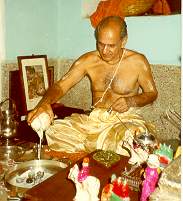
The late Vishvambar Gosai of Radha Raman temple in Vrindavan
The late Vishvambar Gosai of Radha Raman temple in Vrindavan
 Pre-requisit
to beginning the puja
Different
kinds of Vaishnava(s)
Pre-requisit
to beginning the puja
Different
kinds of Vaishnava(s)
A
Saga in Stone - by Sadagopan Swami of the Sri Sampradaya
Nitya
Kriya - the daily activities of the Vaishnava
Temple
Goer's Guide
Initiation
- Panch samskaras - samashrayanam
striyo va yadi va sudra brahmanah ksatriyadayah
pujayitva sila cakra labhante sasvatam padam
Worship of Salagram Sila can be done by women, shudras (untrained - low caste), brahmanas (twice born), ksatriyas (administrators), etc. and they can all achieve the eternal abode of Lord Krsna perfectly. (Hari Bhakti Vilasa 5.452, from Skanda Purana, conversation between Lord Brahma and Narada Muni)
grhita visnu diksako visnu pujaparo narah
vaisnavo'bhihito'bhijnair itaro'smad avaisnavahch
A person who is initiated in Visnu mantras, and who is expert in worshiping Lord Visnu, such a person is known as a Vaisnava. Besides this, everyone else is an avaisnava. (Hari Bhakti Vilasa 1.55, from Padma Purana)
yatha kancanatam yati kasyam rasa-vidhanatah
tatha diksa vidhanena dvijatvam jayate nrnam
As bell metal is turned into gold when mixed with mercury in an alchemical process, so in that very way, by the process of proper initiation by a bona fide spiritual master, a person becomes a brahmana. (Hari Bhakti Vilasa 2.12, from Tattvasagara)
bhaktir asta-vidha hy esa
yasmin mlecche'pi vartate
sa viprendro muni-sresthah
sa jnani sa ca panditah
tasmai deyam tato grah ya-
msa ca pujyo yatha harih
"There are many different kinds of devotees, but even a Vaisnava coming from a family of mlecchas or yavanas is understood to be a learned scholar, complete in knowledge, if he knows the Vaisnava philosophy. He should therefore be given charity, for such a Vaisnava is as worshipable as the Supreme Personality of Godhead."
Though women and sudras are forbidden to worship Salagramas, this injunction does not apply to initiated devotees of the Lord.
striyo va yadi va sudra brahmanah ksatriyadayah
pujayitva silacakram labhante sasvatam padam
" If one is initiated as a vaisnava then
whether one is brahmana ksatriya, vaisya, sudra or a woman,
one can worship Salagrama and attain the Lord's abode."
(Skanda purana )
STRIYO VA YADI VA SUDRA BRAHMANAH KSATRIYADAYAH
PUJAYITVA SILA CAKRA LABHANTE SASVATAM PADAM
(HARI BHAKTI VILASA 5/452 from SKANDA PURANA conversation between Lord Brahma and Narada Muni)
"Worship of Salagram Sila can be done by women, sudras (low caste), brahmanas (twice born), ksatriyas (administrators), etc. and they can all achieve the eternal abode of Lord Krsna perfectly."
KAMAIH KRODHAIH PRALOBHAIS CA VYAPTO YO'TRA NARADHAMAH
SO'PI YATI HARER LOKAM SALAGRAMA SILARCANAT
(HARI BHAKTI VILASA 5/370 from PADMA PURANA)
"Those people who are the lowest of mankind and who are controlled by lust, anger and greed can be elevated to the abode of Lord Hari by worshiping Salagram Sila."
DIKSA VIDHANA MANTRAJNAS CAKRE YO BALIM AHARET
SA YATI VAISNAVAM DHAMAM SATYAM SATYAM MAYO DITAM
(HARI BHAKTI VILASA 5/374 from PADMA PURANA)
"Anyone who has attained mantra diksa initiation properly and
is worshiping Salagram Sila, whatever he offers to Salagram Sila, he achieves
the abode of Lord Visnu. Of this, there is no doubt. I personally say this."
arcye visnau sila-dhir gurusu nara-matir
vaisnave jati-buddhir visnor va vaisnavanam
kali-mala-mathane pada-tirthe 'mbu-buddhih
sri-visnor namni mantre sakala-kalusa-he
sabda-samanya-buddhir visnau sarvesvarese
tad-itara-sama-dhir yasya va naraki sah
"One who thinks the Deity in the temple to be made of wood or stone, who thinks of the spiritual master in the disciplic succession as an ordinary man, who thinks the Vaisnava in the Acyuta-gotra to belong to a certain caste or creed or who thinks of caranamrta or Ganges water as ordinary water is taken to be a resident of hell." (Padma Purana)
candalo 'pi dvija-srestho
hari-bhakti-parayanah
hari-bhakti-vihinas ca
dvijo 'pi svapacadhamah
"Even if one is born in the family of a candala, if one engages in the devotional service of the Lord, he becomes the best of brahmanas. But even a brahmana who is devoid of devotional service is on the level of the lowest dog-eater." (Srimad Bhagavatam 4.31.10, purport, source unspecified)
rg-vedo 'tha yajur-vedah sma-vedo 'py atharvanah
adhitas tena yenoktam harir ity aksara-dvayam
"A person who chants the two syllables Ha-ri has already studied the
four Vedas--Sama, Rk, Yajuh and Atharva." (CC Adi-lila 7.72, purport, source
unspecified)
Prabhupäda: First thing is that when you take shälagräma-sevä,
wherever you stay, this worship must go on daily.
Pradyumna: Yes, nitya-püjä, nitya-sevä.
Prabhupäda: Yes. That you cannot... One day, if you are sick,
your wife will do that. But that half an hour püjä must continue.
That you must decide.
Pradyumna: Yes. Yes. I saw those brähmanas in Udupi, they will
never fail to do it under any condition. They have little box with shälagräma,
little shankha, little thing, little Tulasi leaf they get. They will do
that every day daily. They cannot...
Prabhupäda: So both of you are initiated. In case you are little
sick, your wife will do. In that platform you have to do it. Sevä
shall not be stopped. Gradually as your son grows, he will also do it.
So you can purchase one little simhäsana. That is available in any
utensil shop. All right.
Pradyumna: Jaya Shrila Prabhupäda. (end)
(ACBSP. August 21st 1976. Room Conversation. Hyderabad, India.)
eta bali’ duìhe rahe harashita hanä
shälagräma sevä kare vishesha kariyä
TRANSLATION
After this conversation, both husband and wife were very jubilant,
and together they rendered service to the household shälagräma-shilä.
PURPORT
Especially in every brähmana’s house there must be a shälagräma-shilä
to be worshiped by the brähmana family. This system is still current.
People who are brähmanas by caste, who are born in a brähmana
family, must worship the shälagräma-shilä. Unfortunately,
with the progress of Kali-yuga, the so-called brähmanas, although
very proud of taking birth in brähmana families, no longer worship
the shälagräma-shilä. But actually it has been a custom
since time immemorial that a person born in a brähmana family must
worship the shälagräma-shilä in all circumstances. In our
Krishna consciousness society, some of the members are very anxious to
introduce worship of the shälagräma-shilä, but we have purposely
refrained from introducing it because most of the members of the Krishna
consciousness movement do not originally come from families of the brähmana
caste. After some time, when we find that they are actually situated strictly
in the line of brahminical behavior, shälagräma-shilä worship
will be introduced.
In this age, the worship of the shälagräma-shilä is not
as important as the chanting of the holy name of the Lord. That is the
injunction of the shästra: harer näma harer näma harer nämaiva
kevalam/ kalau nästy eva nästy eva nästy eva gatir anyathä
[Cc. Ädi 17.21]. Shrila Jéva Gosvämi’s opinion is that
by chanting the holy name offenselessly one becomes completely perfect.
Nevertheless, just to purify the situation of the mind, worship of the
Deity in the temple is also necessary. Therefore when one is advanced in
spiritual consciousness or is perfectly situated on a spiritual platform,
he may take to the worship of the shälagräma-shilä." (ACBSP.
purport extract Sri Chaitanya Charitamrita Adi lila 13:86.)
The spell of the salagram shila spread with the patronage of various Vaishnavite sects. In course of time, however, its worship no longer remained the prerogative of the Brahmin class of men. According to H.H. Wilson, it was Rai Das, a chamar and disciple of Ramanand (a break off of the followers of Ramanujacharya), who revolutionised the worship of salagrams. A dream inspired Rai Das to build a temple dedicated to the salagram shila and proclaim himself its high priest. As his fame grew, the infuriated Brahmins complained to the king: 'A chamar. Oh king, ministers to the salagram and poisons the town with his prasad; men and women everyone will become an outcast; banish him to preserve the honour of your people.'
The king sent for Rai Das and asked him to abandon the seva to the sacred stone. Rai Das agreed but requested that he would do so in the royal presence, since, he said, “lf after being given to them (Brahmins) it should return to him, they would accuse him of stealing it.”
The king consented. The salagram was brought to the palace and placed on a cushion before the king. The Brahmins attempted to remove it but in vain. They sang hymns and chanted, read passages from the Vedas, but the stone refused to allow anyone to budge it.
Rai Das addressed the sacred Salagram stone with this particular pada or verse: 'Lord of Lords, thou art my refuge, the root of Supreme happiness art thou, to whom there is no equal; behold me at thy feet; in various wombs have I abided, and from the fear of death have I not been delivered. I have been plunged in the deceits of sense gratification, of passion and illusion, but teach me to place no reliance on what the world deems virtue. Accept Oh God, the humble devotions of thy slave Rai Das, and be thou glorified as the Purifier of the sinful.'
As this chanting came to an end, the salagram, along with the cushion, flew into his arms. The king, reassured by his holiness, commanded the Brahmins to cease their opposition. This is perhaps the first time that non-Brahmins were allowed to perform the worship of the salagram without fear or opposition from the higher castes.
With the worship of salagram shilas as its focal point Vaishnavism prospered and thrived. The holy stone is not merely a spiritual symbol: it manifests mystical and magnetic powers, containing, as it does, a people's faith.
Now we look to understand what is a Vaishnava, and how simply by becoming a sincere devotee of the Lord one can rise above bodily designations of caste and creed.
dhyayami devam lakshmisam shankha-chakra-gadhadharam
peethambara paridhanam padhma sannibha lochanam
manda smitha mukham bhojam madhanayutha sundaram
maaya nirmitha loka-ougam mega syamala vigraham
sri lakshmi naarayanam dhyayami
namo namasthe karunalaya
namo namasthe kamala dhavaya
namo namasthe jagatham cha srashtre
namo namasthe nath soka harthre
thrahi maam karuna sindho ! paahi maam kamala pathe !
thvayi bhakthi: sadhaivasthu mama sarvar tadhayini
(om) namo naarayana ….subham asthu.
There are number of ways to perform AarAdhanam forSaaLagrAmams at one's home:
1) Taantric way with ShOdasOpachArams (16 upacharas).
2) Standard Bhagavath AarAdhanam followed by VaishNava Dinacharya established by AchArya RaamAnujA (please refer to AchArya RaamAnujA interactive multimedia CD ROM for details or ask for help from the family elders or AchAryAs).
3) Chathurvimsathi Murthi sthOthra KaTana PoojA This is simpler and any one can do it by reciting this sthOthram in front of SaaLagrAmam(s) and offer Pushpam, Milk and NaivEdhyam. Thirumanjanam can be done with few spoons of milk as well.
4) Those who are in a hurry can take few minutes to recite the two dhyAna slokams, perform japam of AshtAksharam, offer milk, Taambhulam, Karpoora haratthi. The SaaLagrama Moorthys at home should not be neglected and starved since inauspiciousness will result otherwise to the home.
(If I may add a small story, a smartha friend told me of how in his
family there have been generations of pujaris worshipping their family
Shaligrams, but his grandmother told him as a small boy of a situation
that had occurred in their family. You see her son, my friend's father
had no inclination toward seva puja, so my friend's grandmother continued
the pujas using the system herein, waiting and praying for someone to appear
in their family to again continue the seva pujas. By the grace of the Lord,
her prayers were answered in the form of my friend taking his birth in
that family and with the encouragement of his grandmother developed a taste
for serving the Lord in the Shaligram form unlike his father who was more
interested in business and "providing for his family". At the appropriate
time my friend was given upanayanam and shown how to worship Sri Shaligram,
and continues to do so throughout his life.
So, I'm mentioning this, so that families may not
act hastily if it appears there is no one presently to serve Them. Keep
the faith, pray to the Lord that He may rectify things, and then those
faithful sumangalis and brahmin ladies of the house simply feed the Shaligram
offering with love and devotions purified food items, and in due course
of time the Lord will make all necessary arrangements:)
The two dhyAna slOkams are:
dhyAyAmi Devam Lakshmisam Shankha-chakra-gadhAdharam
PeethAmBara paridhAnam Padhmasannibha lochanam
Mandasmitha mukhAmbhojam madhanAyutha Sundaram
MaayAnirmitha lokaougam megasyAmala vigraham
Sri LakshmI NaarAyaNam dhyAyAmi
NamO NamasthE KaruNAlaya NamO NamasthE KamalAdhavAya
NamO NamasthE JagathAm cha srashtrE namO namasthE nathsOka harthrE
ThrAhi maam KaruNAsindhO ! Paahi maam KamalApathE!
Thvayi bhakthi: sadhaivAsthu mama sarvArTadhAyini
(Om) NamO NaarAyaNa ….Subhamasthu.
Even on days in which one is unable to perform AarAdhanam for SaaLagrAma Moorthys, The ladies of the house or children can recite the above slOkAs in front of the Moorthys, offer the food cooked for the day as naivEdhyam and complete the aarAdhanam (puja) this way.
SaaLagrAma dhyAnam (meditation) is one of the most auspicious dhAnam.
Mula mantras and method of pujan:
In the worship of the salagrama-sila, you should follow the same basic procedure as that for worshiping the Deity form of the Lord. However, you may expand many of the basic sixteen upacaras to include additional upacaras. These optional procedures allow for more elaborate worship according to the list of sixty-four upacaras. The temple salagrama-sila can thus receive full worship on behalf of the main Deities in the temple. Generally one offers the optional upacaras by substitution, either with flower petals or with visesa-arghya water.
When offering each of the main sixteen upacaras to salagrama-sila, you may chant a verse from the Purusa-sukta. The Purusa-sukta is a Vedic hymn which is chanted when worshiping Lord Visnu, in which the Lord is described as the personification of the process of sacrifice. Ideally, the Purusa-sukta is chanted with svara and sama, or proper pitch and rhythm. This must be learned from an expert. In simplified salagrama-sila puja, simply chant the first verse of Purusa-sukta.
In worshiping a temple salagrama-sila, you may use either the mula-mantra
used for the main Deity, or the gopala-mantra (the sixth of the seven guru-given
mantras), or the mula-mantra for Vasudeva (om namo bhagavate vasudevaya
or om namo narayanaya).
Our friends in the Brahmin community
Different kinds of Vaishnavas
Many more Articles of puja, brahminical
qualities, sadhana, sadachar, nitya kriya etc etc.